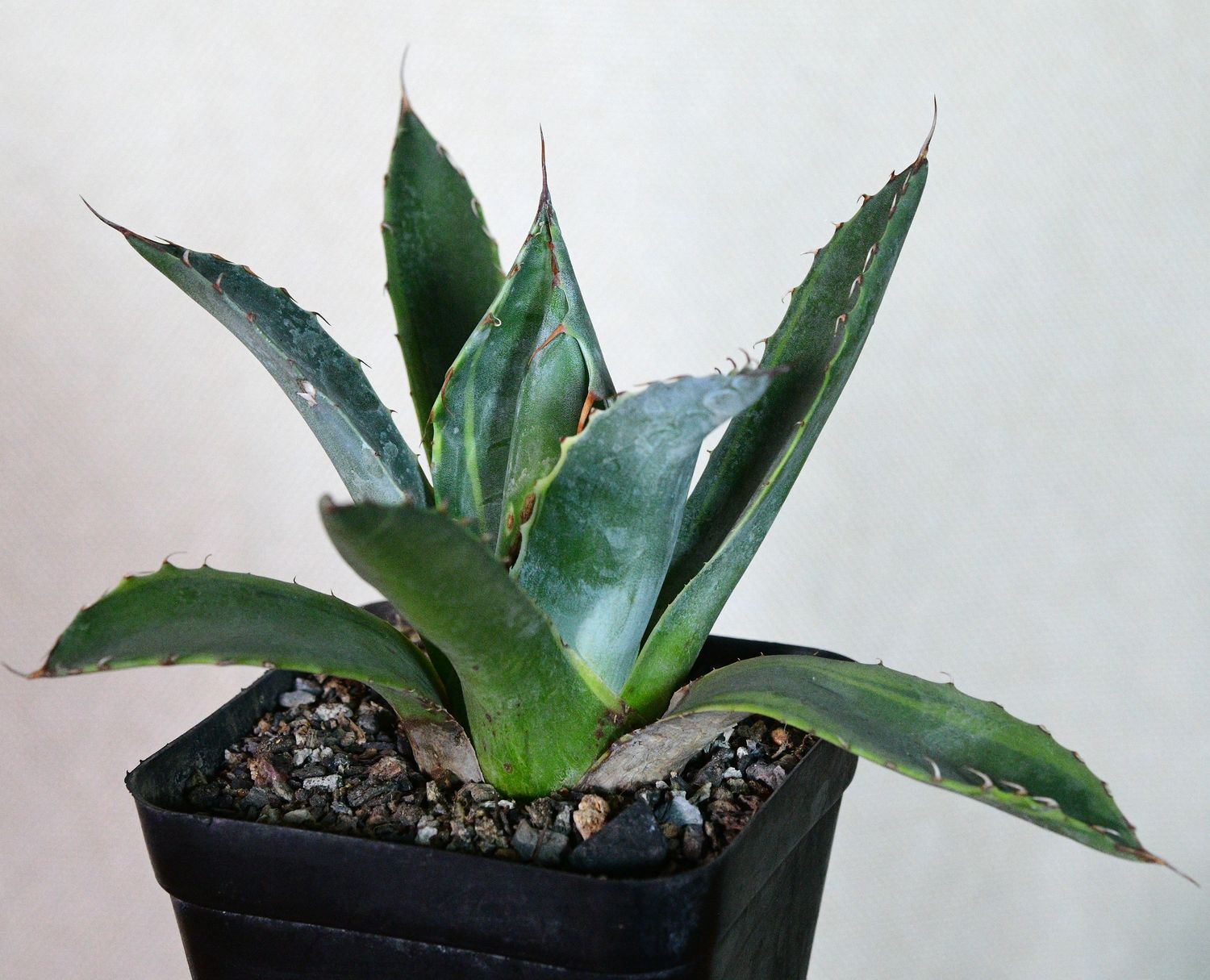
Agave parrasana 'FireBall' (Variegated Cabbage Head Agave)
Product Details
Luminous Geometry: Agave parrasana 'Fireball'
A rare, architectural masterpiece featuring striking cream-to-gold variegation on a perfectly globose form.
- Origin & History of Name: The genus name Agave comes from the Greek agauos, meaning "noble" or "illustrious."
The specific epithet parrasana refers to the Sierra de Parras in Coahuila, Mexico, where the species was first identified. The cultivar name 'Fireball' (sometimes associated with 'Fireball' or 'Variegata') highlights the plant's spherical shape and the vibrant, flame-like contrast of its variegated margins. - Morphology: This succulent is characterized by a dense, "cabbage head" rosette of thick, blue-grey leaves.
Its primary distinction is the marginal variegation, where the leaf edges display stable creamy-yellow bands. The epidermis is waxy and glaucous, featuring prominent, reddish-brown teeth (marginal spines) and a sharp terminal spine. The leaf imprints—marks left by the pressure of adjacent leaves before they unfurl—create a distinct geometric pattern on the leaf surface. - Habitat & Origin: While the base species is wild-sourced from high altitudes (up to 2,400 meters) in Northern Mexico, 'Fireball' is a highly prized cultivar selected for its genetic mutation. It is produced through controlled tissue culture or offsets to preserve the variegation. Our stock is nursery-propagated, ensuring the protection of wild Mexican populations.
- Cultivation Profile:
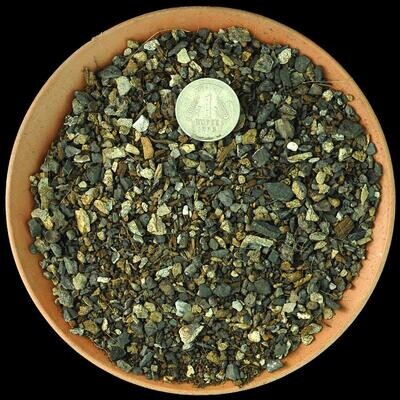
- Substrate: Requires a coarse, mineral-based mix (60% gravel/pumice/leca and 40% sandy loam). In the Indian subcontinent, excellent drainage is vital to survive heavy rainfall.
- Light: Thrives in full sun to partial shade.
In hotter regions like Rajasthan or Central India, afternoon shade is recommended to prevent the variegated edges from burning. - Water/Dormancy: Highly drought-tolerant.
Water thoroughly when the medium is dry, but ensure the crown remains dry during the Monsoon to prevent fungal rot. In winter, reduce watering significantly as the plant enters a semi-dormant state.
- Scientific/Historical Anecdote: Agave parrasana is known for being one of the most cold-hardy agaves, capable of surviving temperatures well below freezing in its native habitat.
Interestingly, while most agaves are "monocarpic" (dying after a single spectacular bloom), this species is famous for its massive, club-like flower spikes that can reach 3–4 meters in height, producing waxy flowers that transition from red buds to bright yellow blooms.
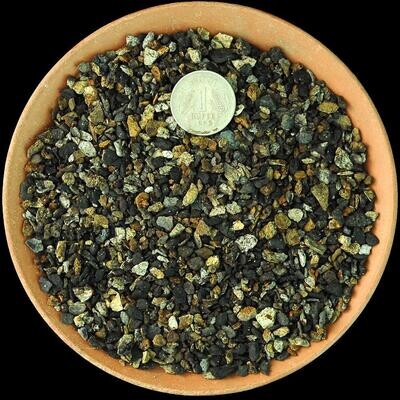
Cactus & Succulent Planting Mix COARSE (aka Cactus Soil Mix or Succulent Soil Mix)
Cactus & Succulent Planting Mix COARSE (aka Cactus Soil Mix or Succulent Soil Mix)
Washed, Free-Draining Mineral Mix for Cactus & Succulents
SKU MNS003
₹44.85
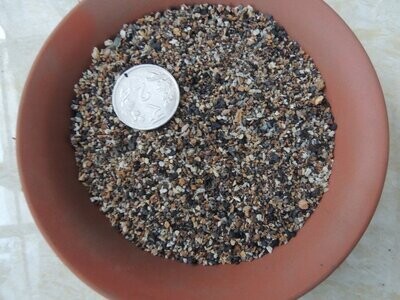
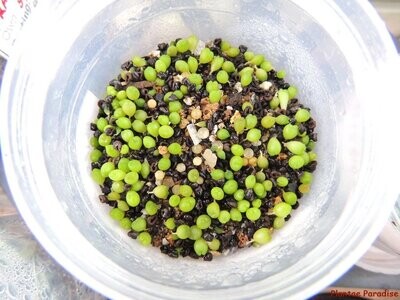
Cactus Seed Planting Mix
Cactus Seed Planting Mix
Sterile, Fine-Grain Media for Cactus & Succulent Seeds
SKU MNS005
₹74.85


Cactus & Succulent Planting Mix FINE (aka Cactus Soil Mix or Succulent Soil Mix)
Cactus & Succulent Planting Mix FINE (aka Cactus Soil Mix or Succulent Soil Mix)
Fine-Grain Potting Mix for Cactus & Succulent Roots
SKU MNS001
₹39.85