

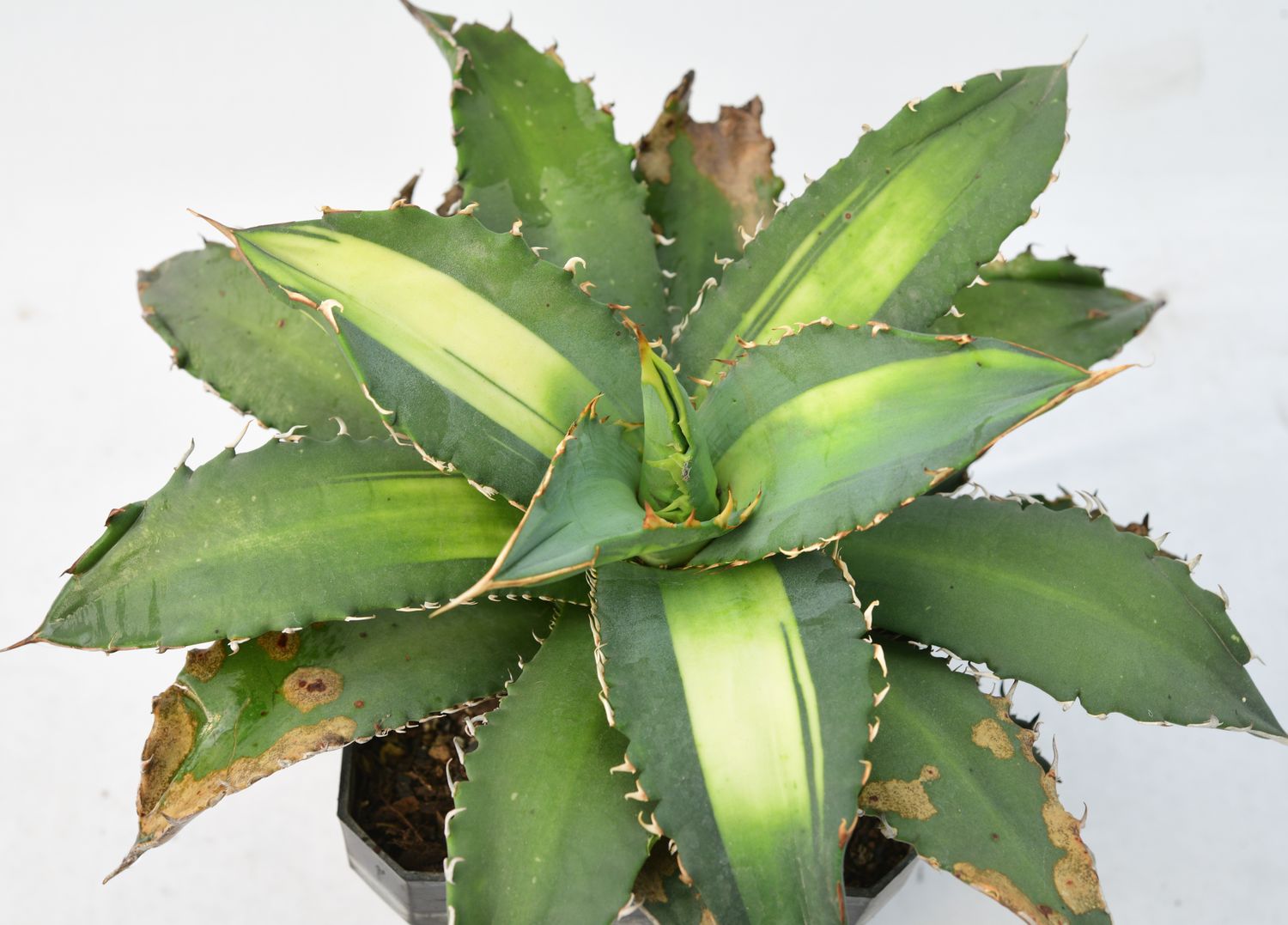
Agave titonata cv 'Solar Eclipse'
Product Details
Radiant Variegation: Agave titanota cv. 'Solar Eclipse'
A high-contrast masterpiece for the serious collector, featuring the dramatic interplay of golden margins and fierce obsidian spines.
- Origin & History of Name: The species name titanota is derived from the Greek titanos, meaning "white earth" or "chalk," referring to the limestone cliffs of its native habitat.
The cultivar name 'Solar Eclipse' is a descriptive "selling name" for the mediopicta or marginata variegation styles, where the dark green center is eclipsed by bright yellow edges, mimicking the corona of the sun during an eclipse. - Morphology: This succulent is characterized by its compact, globose rosette. Its thick, succulent epidermis is a deep glaucous green, framed by broad variegation of creamy yellow. The leaf margins are armed with prominent, papery teeth (marginal spines) that emerge a dark mahogany and fade to a silvery-grey, providing a sharp textural contrast to the smooth leaf surface.
- Habitat & Origin: This is a cultivated selection (cultivar) of the Agave titanota complex.
While the base species is endemic to the limestone canyons of Oaxaca, Mexico, 'Solar Eclipse' was developed through selective breeding in nurseries to stabilize its chimeric variegation. Cultured primarily through tissue culture or offsets, it is a sustainable choice that prevents the poaching of wild specimens. - Cultivation Profile:
- Substrate: Use a strictly mineral-based mix (70% inorganic). Combine crushed brick, pumice, or perlite with a small amount of coco-peat to ensure rapid drainage.
- Light: Requires bright, filtered sunlight. In the Indian subcontinent, provide 50% shade cloth protection during peak summer (April–June) to prevent the variegated yellow margins from scorching.
- Water/Dormancy: Follow a "soak and dry" method. Water deeply when the substrate is completely bone-dry. During the monsoon, protect from constant rain to avoid core rot. It enters a semi-dormant state during the peak of the Indian winter; reduce watering significantly during December and January.
- Scientific/Historical Anecdote: For decades, Agave titanota was shrouded in botanical confusion. It was often confused with Agave kerchovei until it was formally described by botanist Howard Scott Gentry in 1982. Gentry discovered the species at "Rancho Tambor" in Mexico, noting that its distinctively wide, chalky-white marginal teeth made it one of the most "formidably armed" small agaves in the world.
New

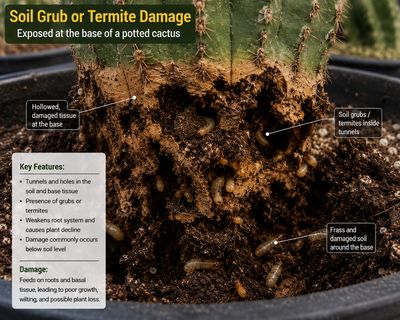
Monsoon Guardian Kit (5 in 1)
Monsoon Guardian Kit (5 in 1)
Complete 5-in-1 biological protection kit for cacti & succulents
SKU MNS024
₹850.00


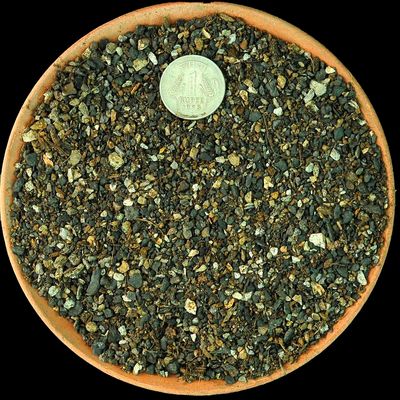
Cactus & Succulent Planting Mix FINE (aka Cactus Soil Mix or Succulent Soil Mix)
Cactus & Succulent Planting Mix FINE (aka Cactus Soil Mix or Succulent Soil Mix)
Fine-Grain Potting Mix for Cactus & Succulent Roots
SKU MNS001
₹39.85
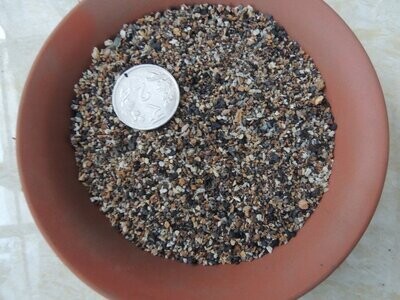
Cactus Seed Planting Mix
Cactus Seed Planting Mix
Sterile, Fine-Grain Media for Cactus & Succulent Seeds
SKU MNS005
₹74.85