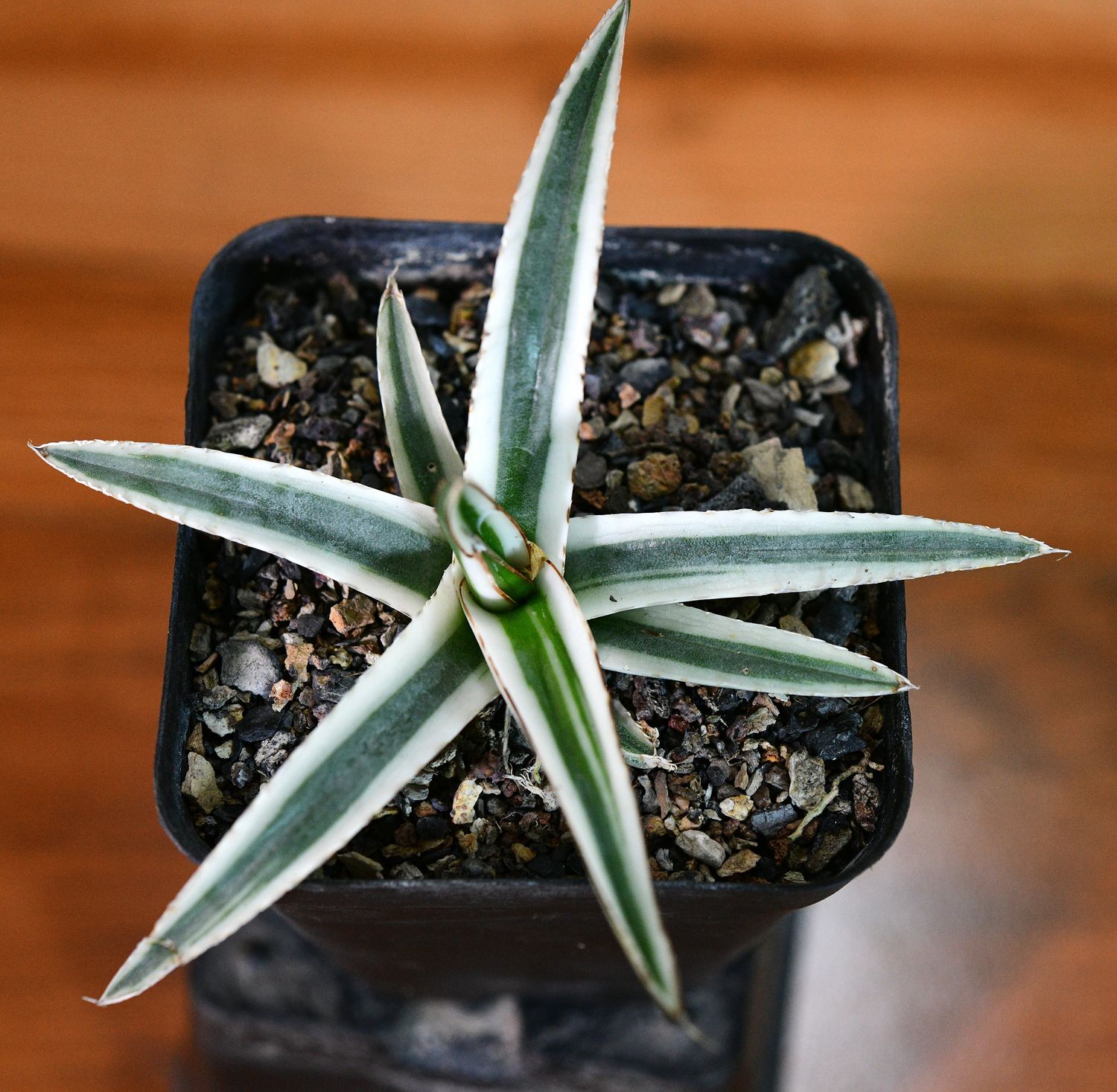
A geometric jewel of the agave world — a rosette of thick, dark green blades so heavily inlaid with broad white bands that the plant seems carved rather than grown, each leaf tipped with a single dark spine like a signature stroke. Slow, sculptural, and unmistakably regal, 'White Rhino' is one of the most coveted forms of an already legendary species.
Origin of Name
The genus name Agave comes from the Greek agauos, meaning "noble" or "admirable" — bestowed by Linnaeus in 1753 on a group of plants whose stately, symmetrical forms had already captured European imaginations. The species epithet, victoriae-reginae, is Latin for "of Queen Victoria," honouring the British monarch (1819–1901) who reigned through most of the 19th century. The name was proposed by the English botanist and horticulturist Thomas Moore, reportedly at the suggestion of the plant collector J. T. Peacock of Sudbury House, Hammersmith, and formally published in the Gardeners' Chronicle on 16 October 1875 — a fittingly regal name for a plant whose precise, jewel-like geometry seemed to demand one.
The species arrived in Europe a few years before it had a name. In 1872, the French collector Victor Considerant brought specimens from Mexico to a Paris flower show, where their striking white-patterned buds won a silver medal. More plants followed in 1874, some distributed to nurseries in Ghent by the Belgian grower Louis Desmet, and it was from these cultivated specimens that Moore drew his formal description the following year. The species has picked up a scattering of synonyms since — Agave consideranti, honouring Considerant himself, and Agave ferdinandi-regis ("of King Ferdinand"), a name later attached to a more open, black-edged form sometimes sold as "King Ferdinand's Agave."
'White Rhino' — also traded as 'Albomarginata' or "Baker's White Queen Agave" — is a cultivar name rather than a wild designation, and a fairly recent one. It describes the broad, brilliant white margins that dominate the leaf, evoking the pale bulk of a rhinoceros horn. By most accounts, it originated as a spontaneous variegated mutation discovered in a California nursery collection in the 1980s. Because such heavy variegation is a genetic mutation, plants grown from its seed rarely breed true, and attempts to multiply it through tissue culture largely failed — growers eventually found that splitting or quartering a mature specimen was the most reliable way to produce new plants, which is part of why well-grown examples remain genuinely scarce in collections.
Origin of Plant
Agave victoriae-reginae is native to the semi-arid highlands of northeastern Mexico, principally the states of Coahuila and Nuevo León, with populations also recorded in Durango — around canyons and cliffs near Saltillo and Monterrey, including the well-known La Huasteca canyon. It grows in calcareous, rocky soils on steep slopes and near-vertical canyon walls, often forming dense colonies and frequently sharing habitat with Hechtia, a spiny terrestrial bromeliad also suited to sheer, sun-blasted limestone.
'White Rhino' itself is a garden and nursery phenomenon rather than a wild population — it does not occur in habitat. Every plant in cultivation traces back to that original variegated mutation and its subsequent divisions, making it, in effect, a modern horticultural invention layered onto a 19th-century botanical discovery.
Description
'White Rhino' forms a tight, symmetrical rosette of thick, rigid, triangular leaves, each one deep green down the centre and bordered with broad, creamy-white margins that can spread irregularly toward the leaf's midline. Fainter white striping often threads through the green as well, and the pattern grows more pronounced — including on the undersides of the leaves — as the plant matures. Leaf margins are smooth and toothless in the manner typical of the species, with each leaf finished in a short, dark, rigid terminal spine.
Mature rosettes are compact, typically reaching around a foot in height and one to two feet across, making this a plant that reads as monumental despite its modest footprint — ideal as a specimen piece in a container or rockery. Growth is famously slow, often taking many years to fill out. Like all agaves, it is monocarpic: after a long maturation — commonly cited at twenty to thirty years or more — a well-grown plant may send up a tall flowering spike bearing creamy white to pale yellow blooms, after which the mother rosette dies. Fortunately, offsets ("pups") are often produced around the base beforehand, ensuring the plant's continuation.
Conservation Status
The species Agave victoriae-reginae is listed under CITES Appendix II, reflecting international concern over unsustainable collection of wild plants for the horticultural trade. In its native Mexican range, published Red List assessment work has categorised it as Critically Endangered, and it is separately listed as endangered under Mexico's own NOM-059-SEMARNAT-2010 federal protection schedule — the pressure coming largely from illegal wild collection rather than habitat loss outright, since the species remains, by contrast, extremely common and secure in cultivation worldwide.
'White Rhino' compounds this distinction further: as a cultivar that exists only through deliberate propagation and division, it has no wild population to speak of. Every specimen sold, including this one, is artificially propagated nursery stock, entirely separate from wild-collection concerns.
Care
- Light: Full sun to bright, lightly filtered light brings out the tightest rosette form and the sharpest white-on-green contrast; too much shade encourages a looser, less compact habit.
- Watering: Drought-tolerant once established. Water deeply, then allow the soil to dry out completely before watering again. Keep noticeably drier through winter dormancy.
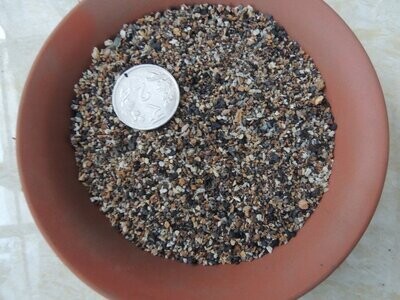
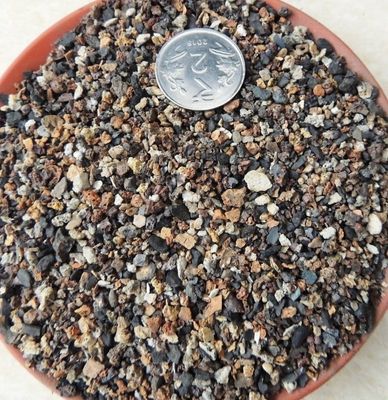
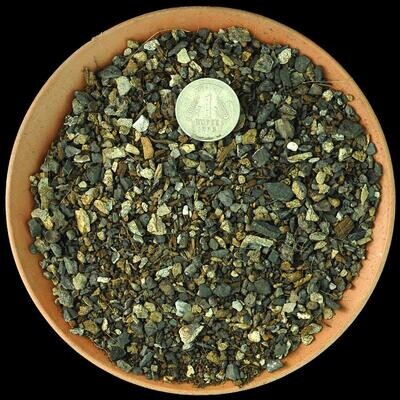
- Soil: A gritty, fast-draining cactus or succulent mix is essential — standard potting soil cut generously with pumice, perlite, or coarse sand.
- Pot: Terracotta or another unglazed, breathable material is preferable to plastic, helping excess moisture escape and reducing the risk of rot around the root crown.
- Temperature: Tolerates brief light frost once established, but is best kept dry and protected from prolonged freezing.
- Feeding: Light feeding with a low-nitrogen, cactus-formulated fertiliser during the active growing season is sufficient; this is a slow grower by nature and does not want to be pushed.
- Handling: The terminal leaf spines are sharp and rigid — site away from foot traffic and handle with care during repotting.
A Story Worth Telling
There's a pleasing symmetry in how this plant has been named twice over, a century and a half apart, by two very different kinds of admiration. The species itself arrived in Europe as a diplomatic gesture of sorts — Victorian-era botanists routinely named their finest discoveries after monarchs, and few plants seemed to deserve the honour more than this one, whose leaves looked as though they'd been inlaid by a master craftsman rather than grown. Thomas Moore's 1875 description, drawn from plants that had already toured a Paris flower show and picked up a silver medal along the way, cemented a name built entirely on royal prestige.
'White Rhino,' by contrast, is a thoroughly unglamorous origin story with an equally striking result: not an expedition or a royal dedication, but a single unpredictable mutation that appeared in a California nursery bench sometime in the 1980s — the botanical equivalent of a lightning strike. That it couldn't be reliably reproduced by seed or tissue culture, and had to be painstakingly propagated by literally splitting mature plants apart, only adds to its cachet among collectors today. Between them, the species and the cultivar tell two very different stories about how a plant earns a name — one through empire and exhibition, the other through sheer horticultural luck.