

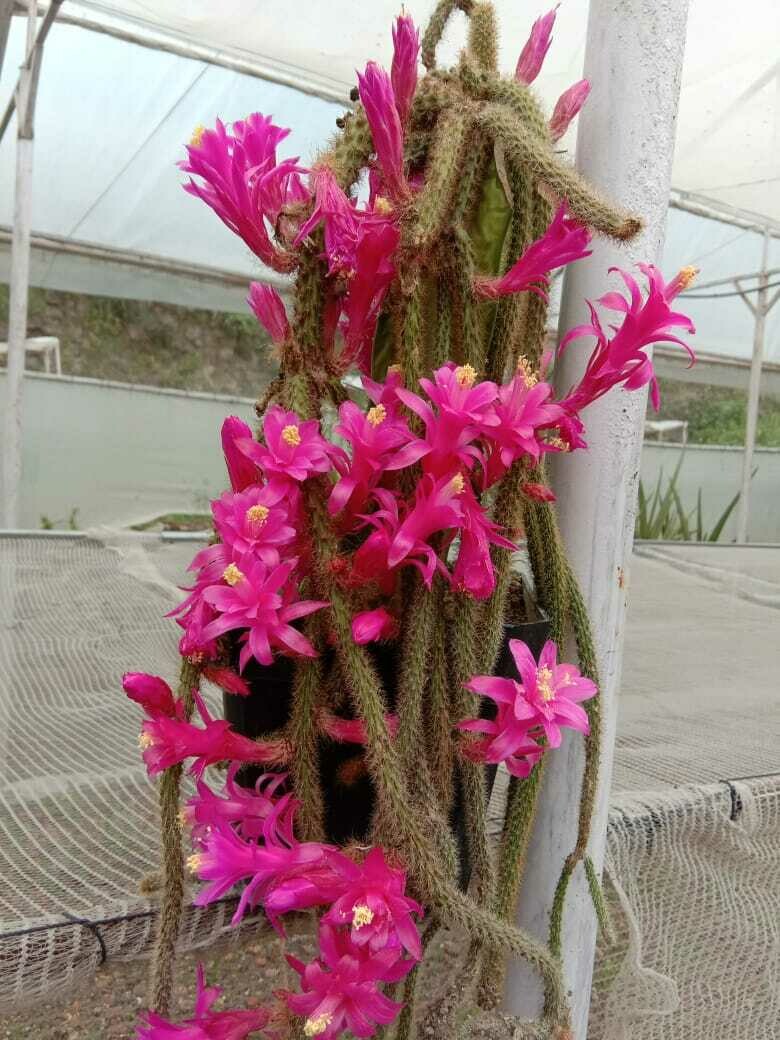
Aporocactus mallisoni
Product Details
Radiant Heritage: Aporocactus mallisoni
A legendary Victorian-era hybrid, celebrated for its dramatic cascading stems and vibrant, architectural blooms.
- Origin & History of Name: The name Aporocactus is derived from the Greek aporos, meaning "impenetrable," likely referring to the dense, spiny nature of the stems.
- Morphology: This lithophytic cactus features elongated, cylindrical stems with a distinct epidermis that transitions from bright green to a greyish hue as it matures. The stems possess 6–8 low costae (ribs) lined with dense, reddish-brown radial spines. Its most striking feature is the zygomorphic flower—large, funnel-shaped blooms in brilliant shades of crimson and scarlet that appear along the length of the trailing stems during spring.
- Habitat & Origin: Aporocactus mallisoni is a cultivar of garden origin, not found in the wild. Its parentage traces back to the cloud forests of Mexico, where its ancestors grew as epiphytes. As a heritage hybrid, it is sustainably propagated via stem cuttings, ensuring no impact on wild succulent populations while preserving historical genetic lineages.
- Cultivation Profile:
- Substrate: Use a highly porous, mineral-based mix (30% organic matter, 70% inorganic like pumice, perlite, or crushed brick). In the Indian climate, ensure the pot allows for rapid drainage to prevent root rot during monsoon.
- Light: Requires bright indirect light or morning sun.
- Water/Dormancy: Water thoroughly when the top two inches of substrate are dry. During the Indian winter (Nov–Feb), reduce watering significantly to induce a cool dormancy, which is essential for stimulating the following season's floral buds.
- Scientific/Historical Anecdote: When it was first introduced in the 19th century, Aporocactus mallisoni was considered a horticultural triumph. It was so highly prized that it was featured in the prestigious Curtis’s Botanical Magazine in 1839. It remains a "bridge" plant in botanical history, proving early on that disparate genera of cacti could be hybridized to create more robust, floriferous specimens for indoor collection.
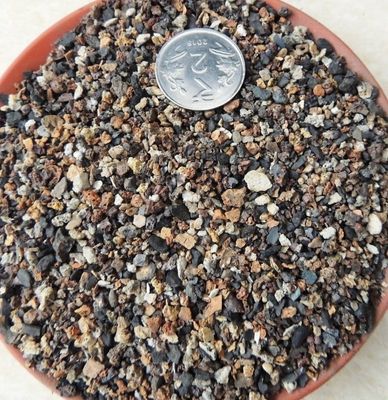
Cactus & Succulent Planting Mix FINE (aka Cactus Soil Mix or Succulent Soil Mix)
Cactus & Succulent Planting Mix FINE (aka Cactus Soil Mix or Succulent Soil Mix)
Fine-Grain Potting Mix for Cactus & Succulent Roots
SKU MNS001
₹35.51

Cactus & Succulent Planting Mix COARSE (aka Cactus Soil Mix or Succulent Soil Mix)
Cactus & Succulent Planting Mix COARSE (aka Cactus Soil Mix or Succulent Soil Mix)
Washed, Free-Draining Mineral Mix for Cactus & Succulents
SKU MNS003
₹40.51
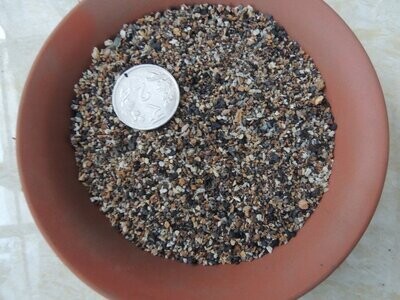
Cactus Seed Planting Mix
Cactus Seed Planting Mix
Sterile, Fine-Grain Media for Cactus & Succulent Seeds
SKU MNS005
₹70.51
