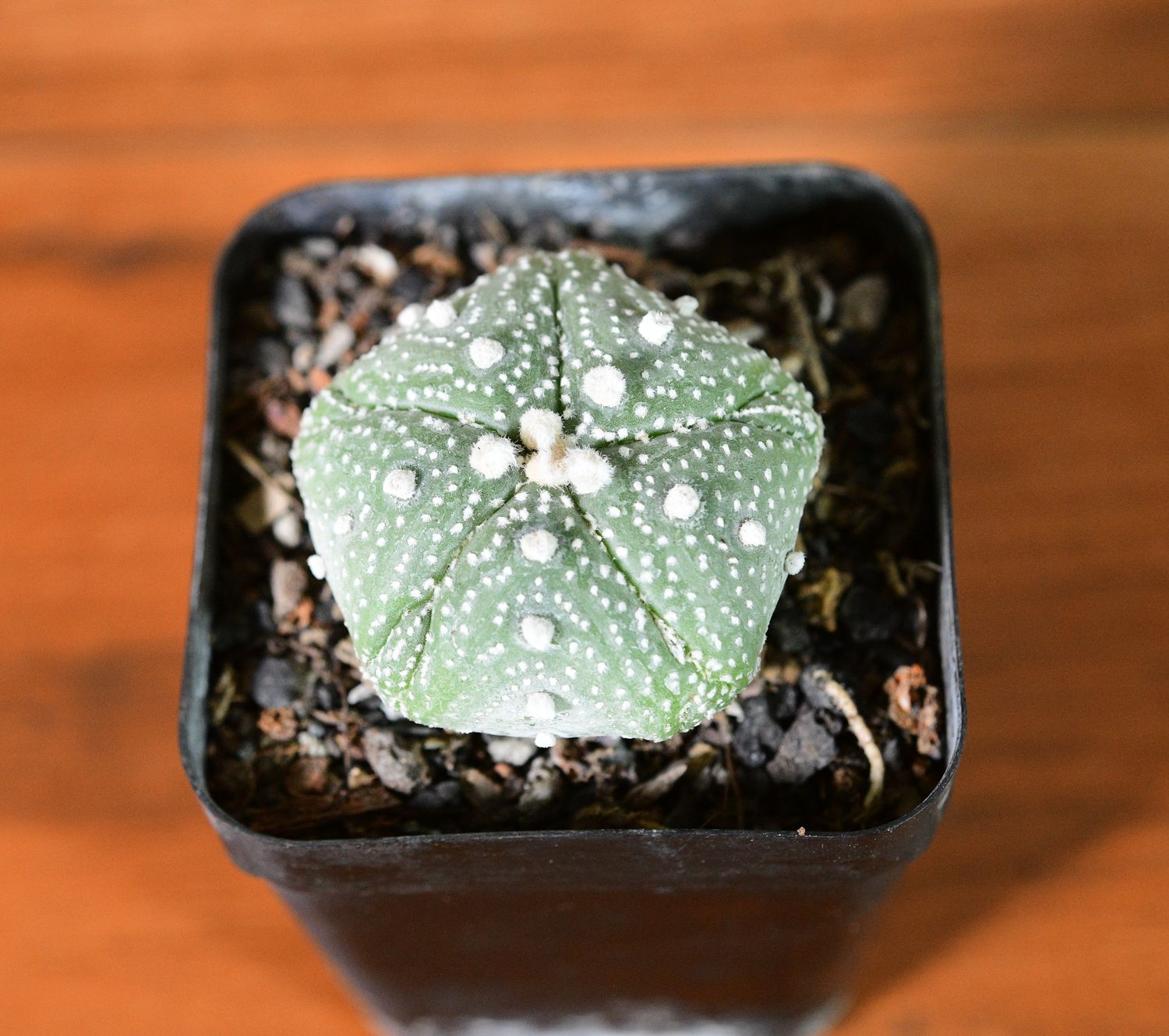
This is 'Miracle' Kabuto, one of the most coveted lineages to emerge from Japan's decades-long obsession with breeding the humble sand dollar cactus into something closer to jewellery.
Origin of Name
The genus name Astrophytum comes from the Greek astron (star) and phyton (plant), a nod to the star-shaped outline shared by most species in the genus. This particular species was first collected in the 1820s–40s by the German naturalist Wilhelm Friedrich Karwinsky von Karwin during his extensive botanical expeditions through Mexico, and material he sent back to Munich was formally described in 1845 by the botanist Joseph Gerhard Zuccarini as Echinocactus asterias — the species epithet asterias, Greek and Latin for "star-like" or "starfish-like," echoing the genus name and describing its flattened, radiating form. Charles Lemaire later moved it into the newly established genus Astrophytum in 1868.
The plant's Japanese common name, "Kabuto," translates to "samurai helmet," a reference to the domed, ribbed silhouette that has long reminded Japanese growers of traditional armor. The specific "Miracle" line traces back to around 1980–81, when the Japanese collector Masaomi Takeo came across an unusual, heavily white-spotted Astrophytum asterias in an American garden centre — a single mutant plant later sold in Japan and propagated into what became known as "Super Kabuto." Takeo continued working with descendants of that original find, and eventually selected out a further variant with distinctively flat, paper-like white markings rather than the raised dots of standard Super Kabuto — a form he himself named "Mirakuru," the Japanese rendering of "Miracle." Decades of careful selection later, a large-areole 'Miracle Kabuto' remains one of the most sought-after prizes in the astrophytum world.
Origin of Plant
The parent species, Astrophytum asterias, is native to a very narrow stretch of the Rio Grande Valley in southern Texas and adjoining parts of Tamaulipas and Nuevo León in Mexico, where it grows low to the ground amid thorn scrub and rocky, semi-arid flatland. The 'Miracle Kabuto' cultivar itself, however, exists nowhere in the wild — it is entirely a product of decades of selective breeding within Japanese and, later, international cultivation, developed and stabilised generation after generation from that single original mutation.
Description
This is a spineless, disc-shaped cactus, flattened and squat, with a body typically divided into eight (occasionally seven) prominent ribs that meet at a woolly central crown. What sets the 'Miracle' line apart from ordinary asterias is its dramatically enlarged, flat, felted white areoles, arranged in radiating rows down each rib and standing out sharply against the dark green skin beneath — a far bolder, more sculptural version of the fine speckling seen on wild-type plants. When mature and given the right seasonal cues, it can produce funnel-shaped yellow flowers with a reddish throat, emerging from the woolly crown.
Conservation Status
Astrophytum asterias is among the most endangered cacti in the wild, listed on CITES Appendix I — the strictest tier of international protection — and also protected under the US Endangered Species Act. Wild populations are now reduced to a small number of sites in southern Texas and neighbouring Tamaulipas, with the total wild population estimated in the low thousands. Under CITES rules, artificially propagated specimens of Appendix I plants are treated as Appendix II for trade purposes, meaning cultivated plants such as this one can be legally grown, sold, and collected without any impact on these fragile wild populations. The 'Miracle Kabuto' cultivar itself, having been developed entirely in cultivation, draws on no wild material at all.
Care
- Light: Bright light is essential for compact growth and strong areole development; in intense climates, filtered or morning sun with some midday shade helps prevent scorching on the more delicate, heavily-flocked skin.
- Watering: Water thoroughly only once the substrate has dried out completely; this species is notably prone to rot if kept too moist, so err on the side of underwatering.
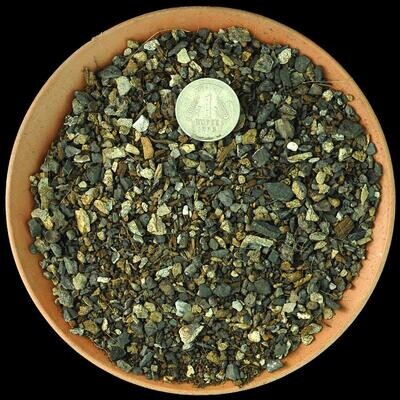
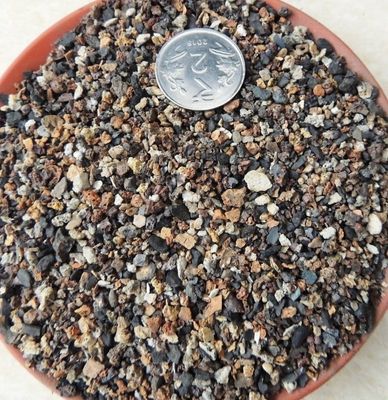
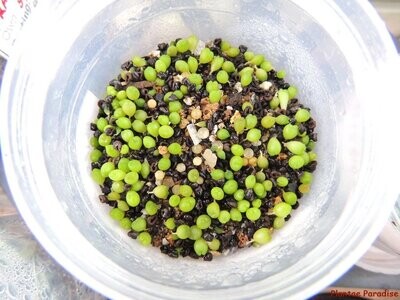
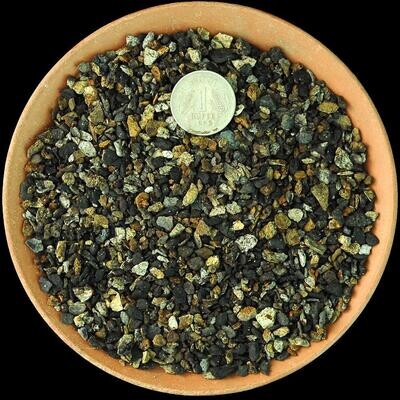
- Soil: A strictly mineral-based mix — heavy on grit, pumice, or perlite with only a small proportion of organic matter — is essential for long-term health.
- Pot: Terracotta is preferred over plastic, helping the fast-draining mix dry out evenly between waterings.
- Temperature: Enjoys warmth during the growing season but should be kept dry and cool over winter, entering a clear dormant rest with minimal to no water.
- Feeding: Feed sparingly with a low-nitrogen, potassium-rich cactus fertiliser during active growth; avoid feeding during dormancy.
A Story Worth Telling
The entire Super Kabuto and Miracle lineage traces back to a moment of pure chance — a single oddly-spotted seedling, sitting unnoticed among thousands of ordinary plants in an American garden centre, caught the eye of one Japanese collector in 1980 or 1981. That one plant, carried carefully back to Japan and painstakingly propagated and refined over decades, gave rise to an entire branch of the cactus hobby now chased by collectors worldwide — a reminder that some of horticulture's most spectacular cultivars begin not in a laboratory, but with someone simply looking closely enough at an ordinary shelf of seedlings to notice the one that wasn't.