

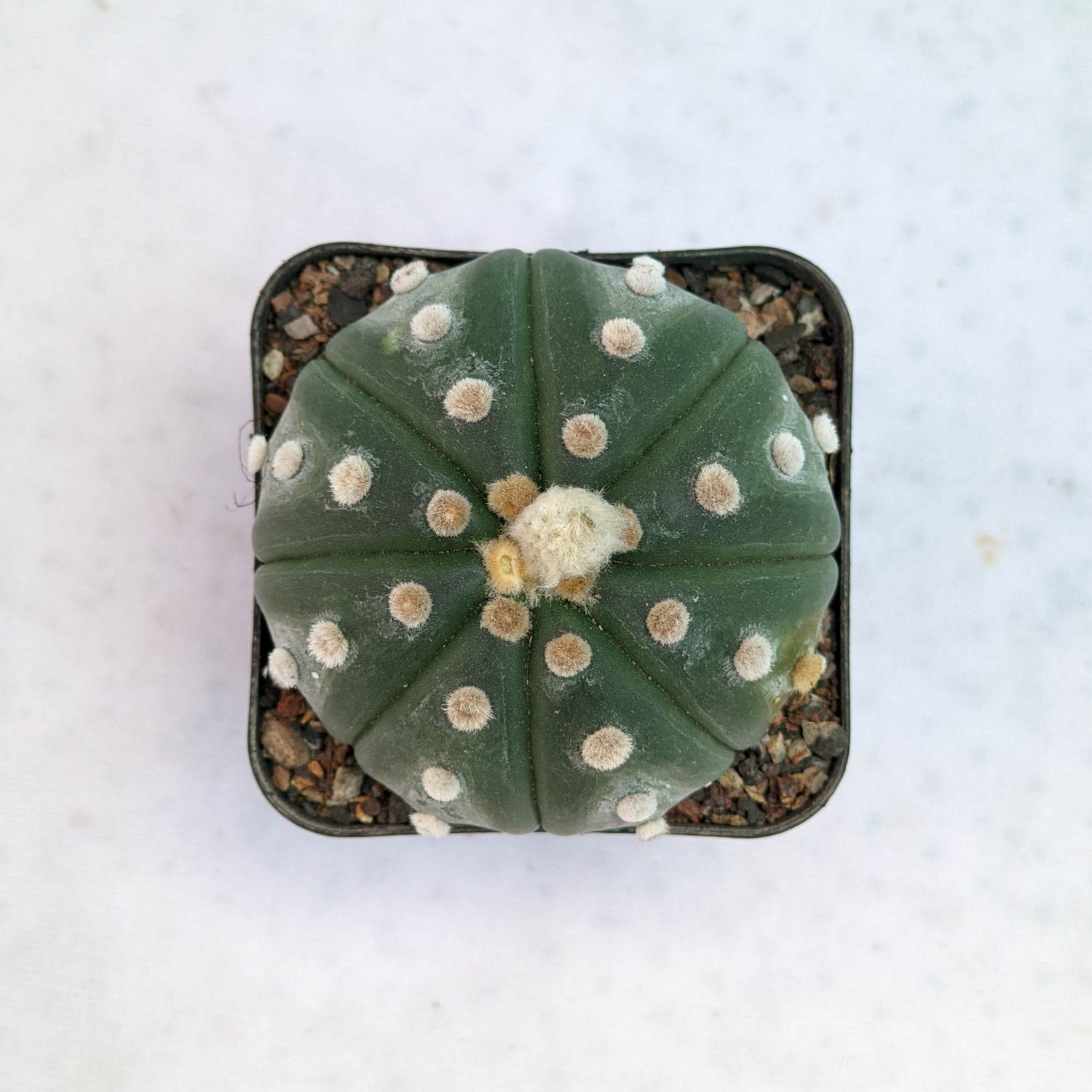
Astrophytum asterias Ooibo Nudum
Product Details
The Zen Minimalist: Astrophytum asterias 'Ooibo Nudum'
A coveted masterpiece of Japanese selection, this spineless marvel offers a seamless, geometric elegance rarely found in nature.
- Origin & History of NameThe genus name Astrophytum is derived from the Greek astron (star) and phyton (plant), referencing its celestial shape.
The cultivar name 'Ooibo' is Japanese for "large warts" or "large areoles," highlighting the prominent woolly tufts. 'Nudum' is Latin for "naked," denoting the absence of the white flecking (trichomes) typically found on the standard species, resulting in a smooth, deep green finish. - MorphologyThis cultivar is characterized by a globose, depressed stem divided into 8 flat costae (ribs). Unlike the type species, its epidermis is entirely glabrous (smooth) and dark green. The most striking feature is the exaggerated size of the areoles—the felt-like circular structures—which form a bold, symmetrical line down the center of each rib, contrasting sharply with the naked skin.
- Habitat & OriginWhile Astrophytum asterias is native to the Rio Grande Valley of Texas and Mexico, 'Ooibo Nudum' is a man-made cultivar perfected by Japanese breeders.
It does not exist in the wild. Our specimens are ethically nursery-propagated, ensuring the preservation of endangered wild populations while providing collectors with high-quality, stable genetics. - Cultivation Profile
- Substrate: Use a strictly mineral-based mix (70% grit such as pumice, perlite, or crushed brick with 30% organic matter). Avoid standard potting soil which retains too much moisture for the Indian monsoon.
- Light: Provide bright, filtered sunlight. In the Indian subcontinent, 30–50% green shade netting is ideal to prevent scorching during peak summer (March–June).
- Water/Dormancy: Water deeply only when the substrate is bone-dry during the growing season. Observe strict winter dormancy (November–February) by withholding water entirely to prevent root rot in humid or cool conditions.
5. Scientific/Historical AnecdoteThe parent species, Astrophytum asterias, was first described by Baron Wilhelm Friedrich von Karwinsky in 1845, but it was lost to science for nearly 80 years. It was "rediscovered" in the 1920s, sparking a global obsession that eventually led Japanese horticulturalists to spend decades selectively breeding for the "naked" and "large areole" traits seen in this plant today.
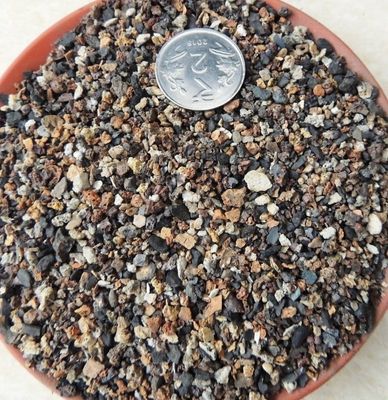
Cactus & Succulent Planting Mix FINE (aka Cactus Soil Mix or Succulent Soil Mix)
Cactus & Succulent Planting Mix FINE (aka Cactus Soil Mix or Succulent Soil Mix)
Fine-Grain Potting Mix for Cactus & Succulent Roots
SKU MNS001
₹39.85

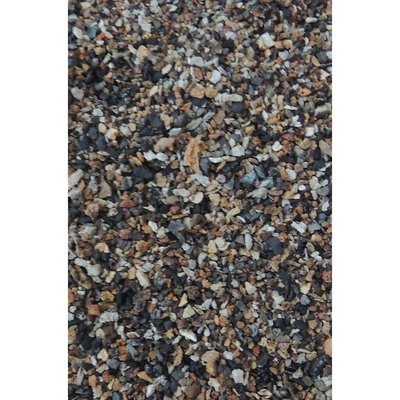
Cactus & Succulent Planting Mix COARSE (aka Cactus Soil Mix or Succulent Soil Mix)
Cactus & Succulent Planting Mix COARSE (aka Cactus Soil Mix or Succulent Soil Mix)
Washed, Free-Draining Mineral Mix for Cactus & Succulents
SKU MNS003
₹44.85
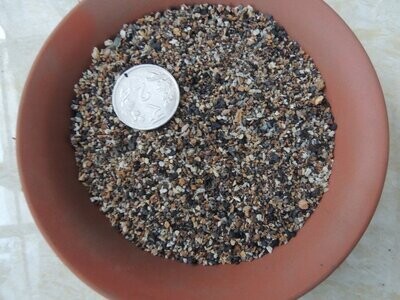
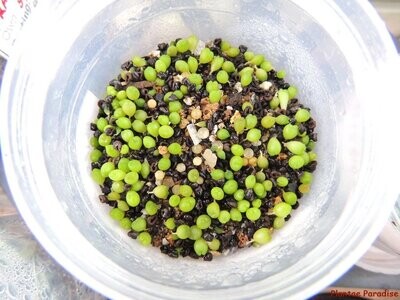
Cactus Seed Planting Mix
Cactus Seed Planting Mix
Sterile, Fine-Grain Media for Cactus & Succulent Seeds
SKU MNS005
₹74.85
