

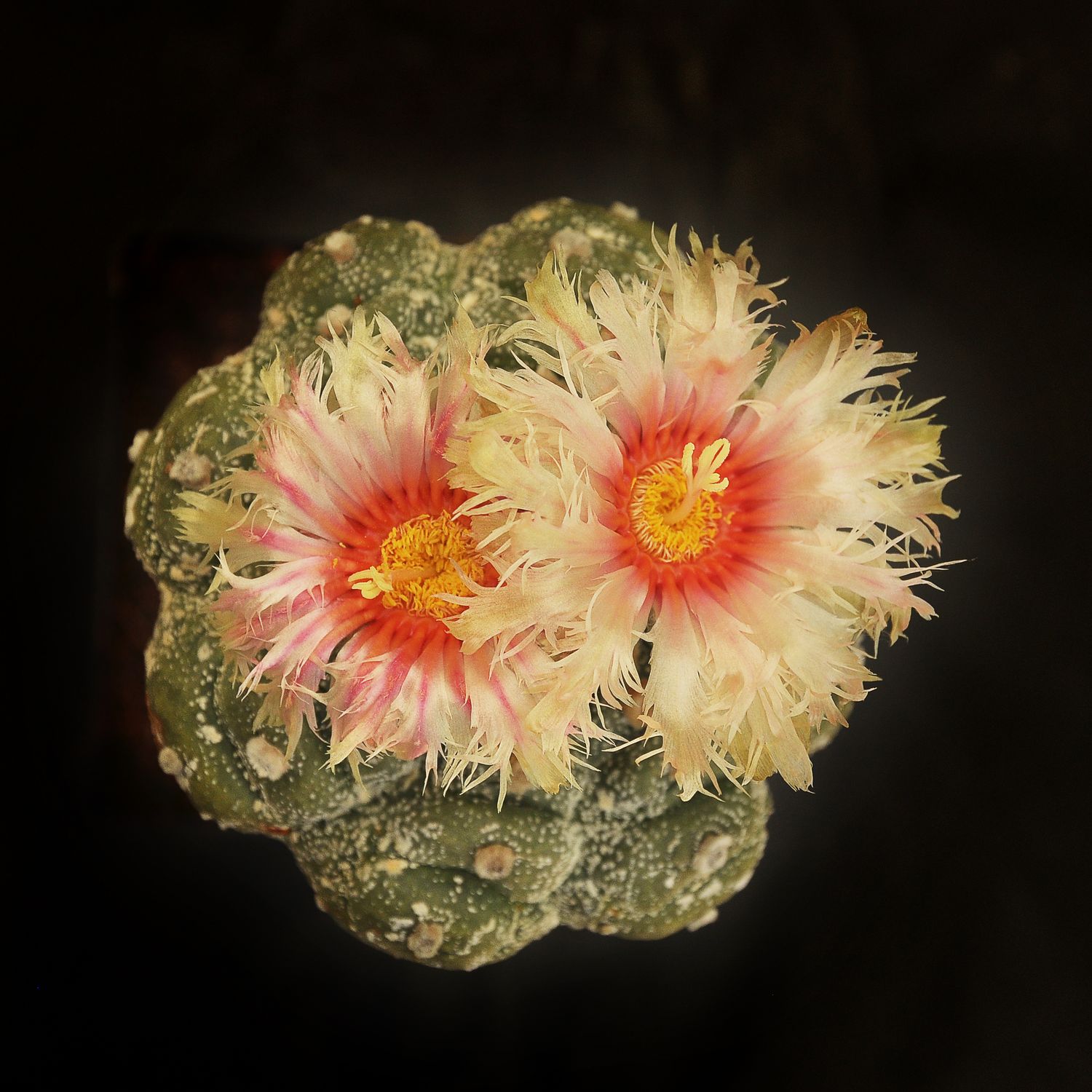
Astrophytum Asterias "Turtle Skin and Feather Petal Yellow"
Product Details
Collector's Gem: Astrophytum Asterias "Turtle Skin and Feather Petal Yellow"
An exquisite living sculpture, this rare Japanese-bred hybrid features a distinct textured epidermis and luminous yellow blooms sought by master succulent collectors.
- Origin & History of Name: The genus name Astrophytum is derived from the Greek words astron (star) and phyton (plant), referring to the star-like shape when viewed from above.
The species name asterias translates to "starry" or "aster-like." The cultivar name "Turtle Skin" describes the unique, rugose texture of the ribs, while "Feather Petal Yellow" refers to the delicate, serrated edges of its yellow flowers, a trait specifically stabilized by succulent breeders. - Morphology: This globose, spineless cactus is distinguished by a highly textured epidermis that mimics the plates of a tortoise shell. It features 8 flat costae (ribs) divided by shallow furrows. Instead of spines, it bears woolly areoles along the center of each rib. The "Feather Petal" variation is unique for its corolla (petals), which exhibit a laciniate or fringed appearance rather than a smooth edge.
- Habitat & Origin: This is a highly refined cultivar, originating from specialized breeding programs in Japan (often referred to as "Super Kabuto" lineage). While the base species is native to the Rio Grande Valley in Texas and parts of Mexico, the "Turtle Skin" form does not exist in the wild. Our specimens are ethically greenhouse-propagated to ensure the conservation of wild populations.
- Cultivation Profile:
- Substrate: A strictly mineral-based mix is essential. Use a ratio of 70% inorganic material (pumice, perlite, or crushed brick) and 30% organic matter to prevent root rot.
- Light: Requires bright, indirect sunlight. In the harsh Indian summer, use 50% shade netting to prevent "sunscorch" on the epidermis, which can cause permanent scarring.
- Water & Dormancy: Water thoroughly only when the substrate is bone-dry. During the monsoon and winter dormancy (November–February), withhold water almost entirely to mimic its natural dry period and prevent fungal issues.
- Scientific/Historical Anecdote: The base species, Astrophytum asterias, was first discovered for Western science by the German physician and botanist Baron Wilhelm Friedrich von Karwinsky in 1843. It was lost to the botanical world for nearly 80 years before being "rediscovered" in the 1920s. Today, it is one of the most protected cacti in the world due to its popularity in the illegal plant trade, making lab-grown cultivars like this one the only sustainable way to own the species.
New


Monsoon Guardian Kit (5 in 1)
Monsoon Guardian Kit (5 in 1)
Complete 5-in-1 biological protection kit for cacti & succulents
SKU MNS024
₹850.00

Cactus Seed Planting Mix
Cactus Seed Planting Mix
Sterile, Fine-Grain Media for Cactus & Succulent Seeds
SKU MNS005
₹74.85

