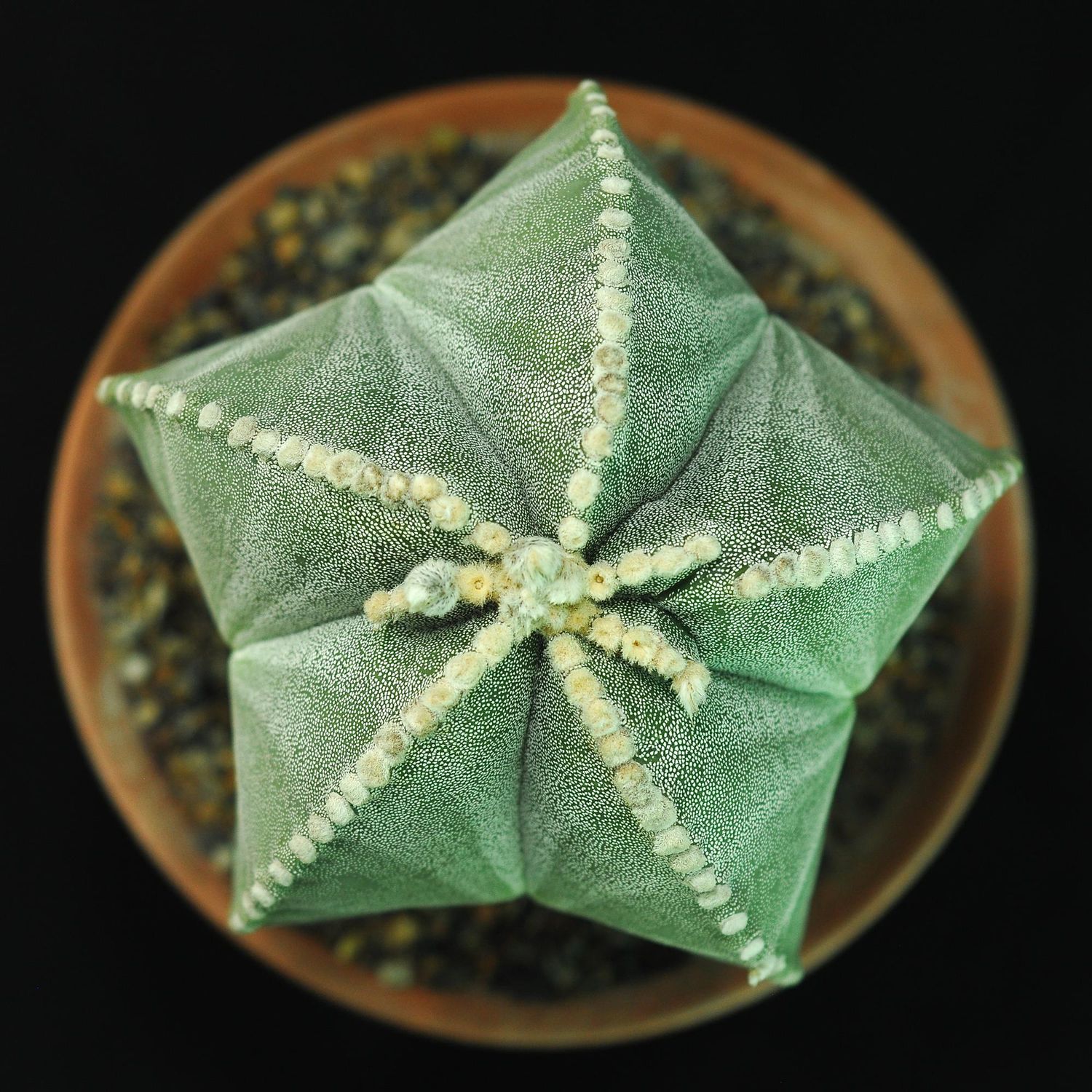
A cactus that looks permanently dusted with frost — five knife-edge ribs rising into a perfect star, the whole body wrapped in a coat of tiny white flecks so dense it reads as silver rather than green. This is Bishop's Cap at its most striking: a specimen selected for exceptionally heavy, close-set flocking that gives it an almost powdered, snow-on-stone appearance year-round.
Origin of Name
The genus name Astrophytum combines the Greek astron ("star") and phyton ("plant"), a direct nod to the sharp, star-shaped outline the ribbed body traces when viewed from above. The species epithet myriostigma pairs Greek myrios ("countless" or "ten thousand") with stigma ("mark" or "spot"), describing the multitude of tiny woolly flecks scattered across the skin — precisely the trait this specimen carries in unusually heavy concentration. French botanist Charles Antoine Lemaire formally published Astrophytum myriostigma in February 1839, establishing both the species and the genus in the same stroke. A few years later, in 1844–45, German botanist Joseph zu Salm-Dyck recombined it as Echinocactus myriostigma, a name still occasionally seen in older literature and collections, though Astrophytum myriostigma remains the accepted name today. Its common names — Bishop's Cap, Bishop's Hat, Bishop's Mitre — come from the resemblance of the ribbed, pointed young plant to the ceremonial peaked hat worn by bishops in the Christian church, a comparison European growers made almost as soon as the plant reached cultivation.
Origin of Plant
Native to the highland deserts of northeastern and central Mexico, spanning the states of Nuevo León, San Luis Potosí, and Tamaulipas, at elevations of roughly 750–1,500 metres. It grows on stony, calcareous, lime-rich soils on scrubby alluvial plains and steep east-, west-, and southwest-facing slopes, typically at low density rather than in dense colonies. In habitat it's frequently found growing beneath Agave lecheguilla, which acts as a natural nurse plant, shading young specimens from the harshest sun. Despite localized pressure from illegal collection and habitat disturbance, the species remains widespread and abundant across its native range.
Description
A spineless, geometrically precise cactus that begins life as a compact, star-shaped globe with typically five (occasionally three to seven) sharply defined vertical ribs, slowly elongating into a columnar form up to a metre tall with age. The entire epidermis is covered in small, woolly white trichome flecks — a trait that varies considerably between individual plants, from light dusting to near-total coverage. The specimen offered here sits firmly at the dense end of that range: closely packed, silvery-white flecking across every rib, giving the whole body a frosted, almost powdered appearance rather than the more typical green-and-white mottling. Mature plants produce fragrant, glossy, funnel-shaped yellow flowers, 4–7 cm across, opening in succession from the crown from spring through autumn; each individual bloom lasts around two days, though a well-grown plant can flower repeatedly through the season, so the number open at any one time is not a fixed trait of the plant.
Conservation Status
Assessed as Least Concern on the IUCN Red List, owing to its wide distribution and generally abundant populations, though some local subpopulations face pressure from overgrazing, mining activity, road building, and illegal collection for the succulent trade. It is listed under CITES Appendix II, which regulates international trade to guard against wild depletion — this specimen is nursery-propagated, not wild-collected, making it a responsible way to own the species regardless of its overall wild status.
Care
- Light: Bright, direct sun for most of the day. Strong light keeps growth compact, ribs crisp, and — for a densely flocked plant like this one — keeps the white coating looking its brightest.
- Watering: Soak thoroughly, then allow the soil to dry out completely before watering again. Reduce sharply in winter, watering only enough to prevent shrivelling; overwatering is the most common cause of loss in this genus.
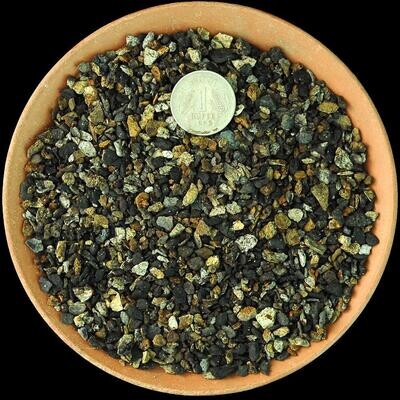
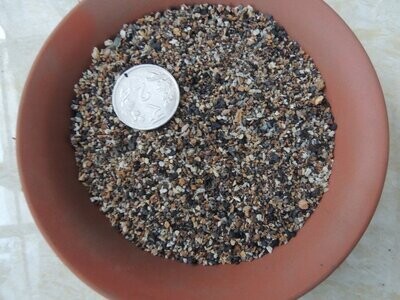
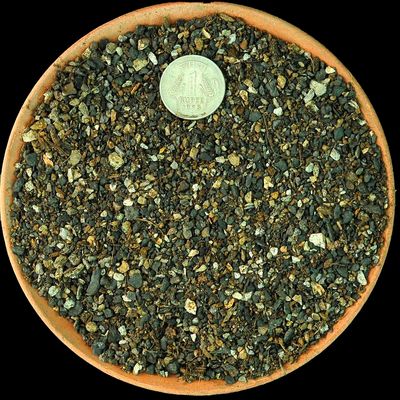
- Soil: A gritty, fast-draining, mineral cactus mix cut with extra pumice, perlite, or coarse sand. As a limestone-country native, it appreciates a slightly alkaline mix.
- Pot: Terracotta is a better match than plastic — its faster moisture evaporation suits a cactus that resents sitting damp, whereas plastic retains water longer and raises rot risk.
- Temperature: Warm and bright through the growing season, with a cool, dry winter rest (down to around 5–10°C) that helps set up strong spring flowering.
- Handling: Spineless and pleasant to handle compared to most cacti, but the dense flocking is delicate surface tissue — lift by the pot rather than gripping the body, to avoid marking the white coating.
A Story Worth Telling
Bishop's Cap has the distinction of being one of the very first "star cacti" to reach European collections after Lemaire's 1839 description, and it made enough of an impression to eventually earn the Royal Horticultural Society's Award of Garden Merit — a rare honour for a cactus. Its dense white flocking has long invited comparison to snow or frost, and growers have selected for that trait for well over a century; the heavily flocked forms like this one sit at one end of a spectrum that, at its opposite extreme, produces the smooth, totally flock-free "nudum" plants prized for the exact opposite reason. Few genera show such a dramatic range from a single, simple trait — hairy or hairless — as Astrophytum myriostigma does.