

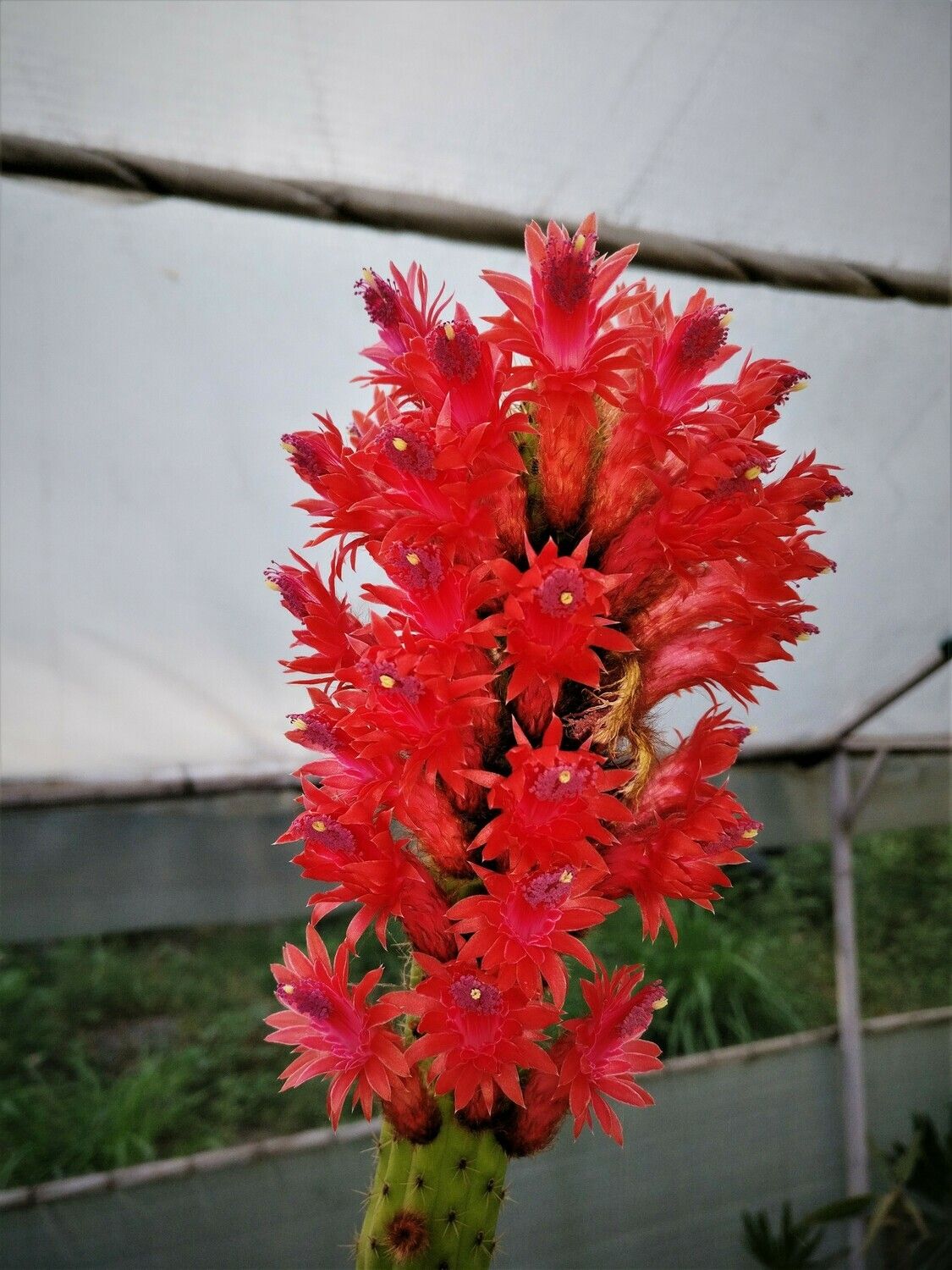
Bolivicereus samaipatanus (Cleistocactus samaipatanus) Clone A
Product Details
Crimson Fountain: Bolivicereus samaipatanus 'Clone A'
A premium select clone distinguished by its prolific, architectural stems and vibrant hummingbird-pollinated blooms.
- Origin & History of Name: The genus name Bolivicereus combines "Bolivia" with the Latin cereus (wax candle), referencing its upright growth habit. The specific epithet samaipatanus honors its discovery near Samaipata, Bolivia. While often reclassified under Cleistocactus (Greek kleistos, meaning closed), collectors maintain the Bolivicereus name to distinguish these more open-flowered, semi-procumbent species.
- Morphology: This "Clone A" selection features slender, columnar stems with approximately 14–17 low costae (ribs). The epidermis is a bright, vibrant green, densely covered in short, golden-brown radial spines that give the plant a shimmering texture. Unlike many Cleistocactus, its zygomorphic flowers are wide-opening, funnel-shaped, and a brilliant scarlet-red.
- Habitat & Origin: This is a wild species native to the rocky cliffs and dry forests of Santa Cruz, Bolivia, at elevations of 1,000–2,000 meters. As a lithophytic plant in nature, it is highly resilient. Our specimens are nursery-propagated via sustainable stem cuttings to prevent habitat depletion and ensure "Clone A" genetic purity.
- Cultivation Profile:
- Substrate: Use a highly porous, mineral-based mix (60% grit/pumice, 40% organic matter). In the Indian subcontinent, ensure high drainage to survive the monsoon.
- Light: Full morning sun to bright indirect light. In North Indian summers, provide 30-50% shade to prevent epidermal scorching during peak heat.
- Water/Dormancy: Water thoroughly when the substrate is dry. In South India, maintain a steady cycle; in North India, enter a dry dormancy from November to February to trigger spring blooming.
- Scientific/Historical Anecdote: The species was famously described by the influential Bolivian botanist Martín Cárdenas in 1951. It is considered a "bridge" species in cactus evolution, as its flowers evolved specifically to accommodate the long beaks of Andean hummingbirds, leading to its unique slanted, tube-like floral structure.


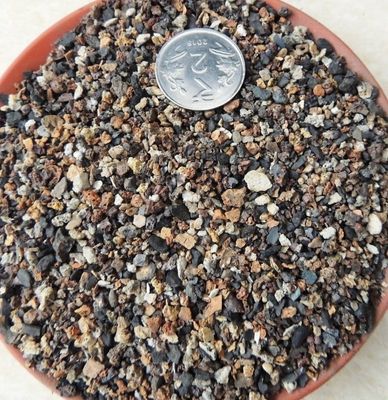
Cactus & Succulent Planting Mix COARSE (aka Cactus Soil Mix or Succulent Soil Mix)
Cactus & Succulent Planting Mix COARSE (aka Cactus Soil Mix or Succulent Soil Mix)
Washed, Free-Draining Mineral Mix for Cactus & Succulents
SKU MNS003
₹44.85
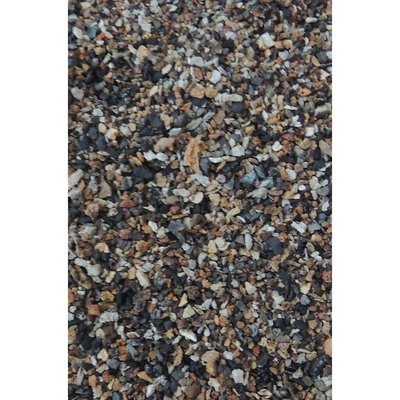
Cactus & Succulent Planting Mix FINE (aka Cactus Soil Mix or Succulent Soil Mix)
Cactus & Succulent Planting Mix FINE (aka Cactus Soil Mix or Succulent Soil Mix)
Fine-Grain Potting Mix for Cactus & Succulent Roots
SKU MNS001
₹39.85
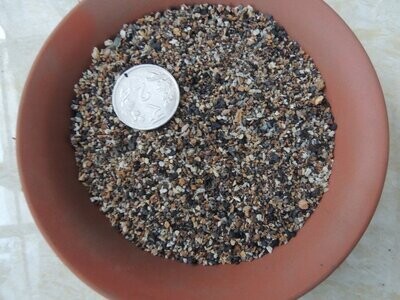
Cactus Seed Planting Mix
Cactus Seed Planting Mix
Sterile, Fine-Grain Media for Cactus & Succulent Seeds
SKU MNS005
₹74.85