

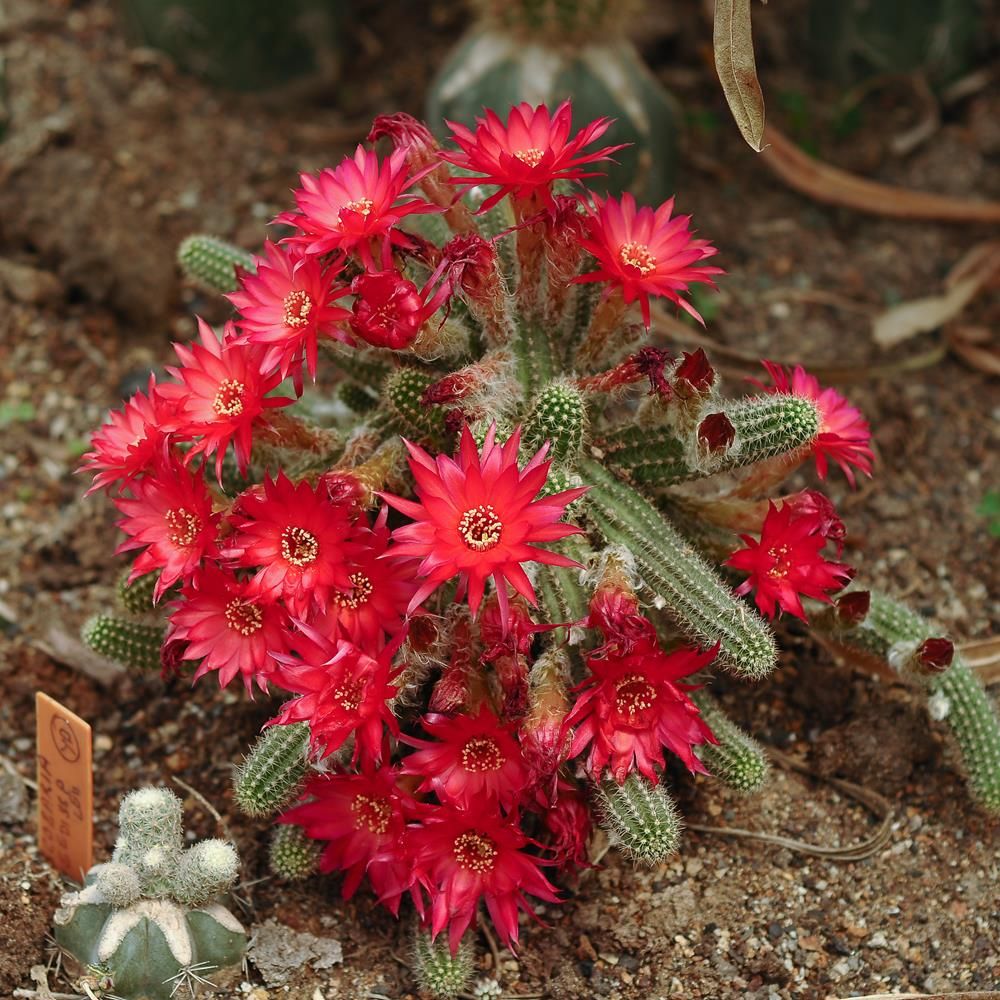
Chamaecereus hybrid 'Tristar' (Peanut Cactus With Red Pointed Petals)
Product Details
Radiant Resilience: Chamaecereus hybrid 'Tristar' A rare architectural marvel featuring vibrant, star-shaped blooms that elevate any xeric collection.
- Origin & History of Name: The genus name Chamaecereus is derived from the Greek chamai (on the ground/lowly) and the Latin cereus (wax candle), describing its prostrate, cylindrical growth habit. The cultivar name 'Tristar' refers to the unique tripartite aesthetic of its floral display: the pointed petal shape, the intense red saturation, and the geometric precision of the bloom's arrangement. It was bred to distinguish itself from the standard orange-flowered C. silvestrii.
- Morphology: This succulent features elongated, finger-like stems known as costae (ribs), which are densely covered in soft, white bristly spines.
Unlike the wild species, 'Tristar' is prized for its determinate blooming, producing terminal flowers with lanceolate, pointed petals. The epidermis is a matte light green, providing a high-contrast backdrop for its saturated red pigmentation during the flowering season. - Habitat & Origin: The 'Tristar' is a specialized cultivar; it does not exist in the wild. It is a hybrid descendant of Chamaecereus silvestrii, which is native to the high-altitude regions of Tucumán, Argentina. This hybrid is produced through sustainable greenhouse propagation, ensuring no wild populations are disturbed for commercial trade.
- Cultivation Profile:
- Substrate: A strictly mineral-based mix (60% grit/perlite/pumice, 40% organic matter). In the Indian climate, ensure high porosity to prevent root rot during monsoons.
- Light: Bright, filtered sunlight. In the Indian subcontinent, provide 40-50% shade during peak summer afternoons to prevent epidermal scorching.
- Water/Dormancy: Follow a soak-and-dry method. Restrict water entirely from November to February to induce winter dormancy, which is essential for stimulating flower buds for the spring.
- Scientific/Historical Anecdote: The parent species, Chamaecereus silvestrii, was first described by botanist Spegazzini in 1905. For decades, it was considered a monotypic genus (containing only one species) until molecular phylogenetics recently suggested it be nested within Echinopsis. 'Tristar' represents the pinnacle of a century of selective breeding aimed at refining the "Peanut Cactus" from a botanical curiosity into a floral powerhouse.
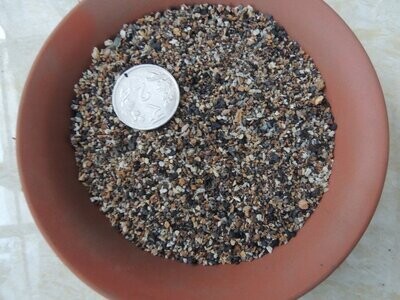
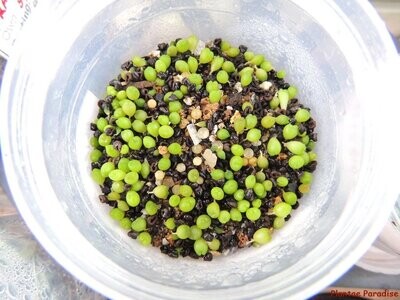
Cactus Seed Planting Mix
Cactus Seed Planting Mix
Sterile, Fine-Grain Media for Cactus & Succulent Seeds
SKU MNS005
₹74.85
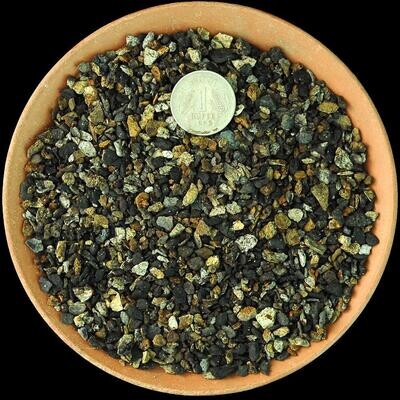
Cactus & Succulent Planting Mix COARSE (aka Cactus Soil Mix or Succulent Soil Mix)
Cactus & Succulent Planting Mix COARSE (aka Cactus Soil Mix or Succulent Soil Mix)
Washed, Free-Draining Mineral Mix for Cactus & Succulents
SKU MNS003
₹44.85

