

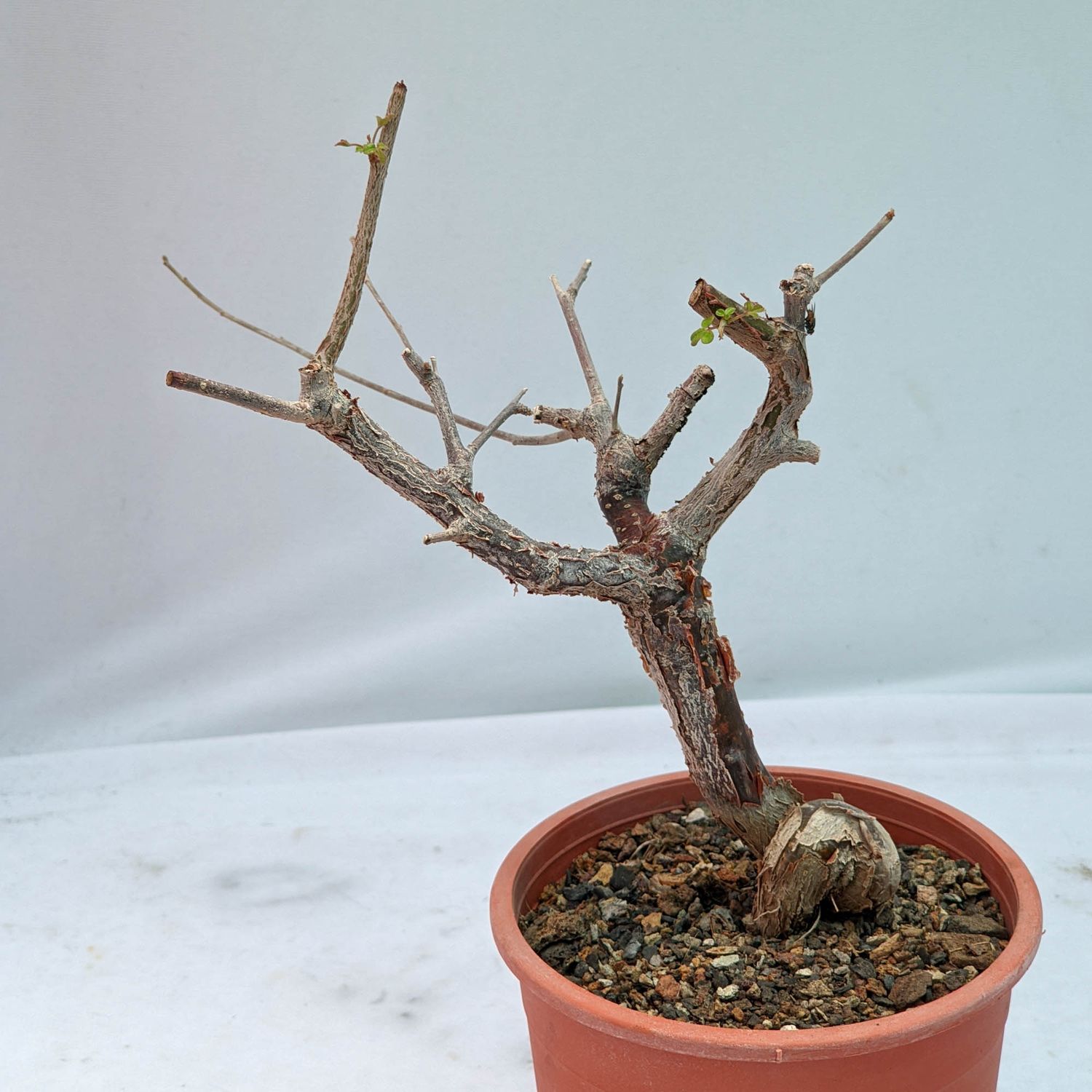
Commiphora orbicularis
Product Details
Ancient Resilience: Commiphora orbicularis
A rare pachycaul specimen sought by connoisseurs for its sculptural peeling bark and distinctive rounded foliage.
- Origin & History of Name: The genus name Commiphora is derived from the Greek kommi (gum) and phero (to bear), referencing the aromatic resins typical of the family. The specific epithet orbicularis stems from the Latin orbiculus, meaning "small disk," which accurately describes the circular or orbicular shape of its leaflets. It was formally described within the Burseraceae family, the same lineage as Frankincense and Myrrh.
- Morphology: This species is a pachycaul shrub or small tree characterized by a swollen, water-storing trunk. It features a papery epidermis that exfoliates in translucent flakes to reveal a green, photosynthetic underlayer. The foliage consists of pinnate leaves with strikingly round, succulent leaflets. Unlike many other members of the genus, C. orbicularis maintains a compact, highly architectural growth habit.
- Habitat & Origin: This is a wild species endemic to the xeric (dry) shrublands of Ethiopia and Somalia. It grows in limestone-rich soils and rocky outcrops. Our specimens are ethically sourced and propagated to ensure that wild populations in the Horn of Africa remain undisturbed and sustainable.
- Cultivation Profile:
- Substrate: Use an ultra-gritty, mineral-based mix (e.g., 70% volcanic rock, pumice, or baked clay haydite and 30% sandy loam). Excellent drainage is mandatory to prevent caudex rot.
- Light: Requires full sun to high-intensity filtered light. In the Indian subcontinent, it performs best in South-facing positions; however, protect the base from extreme heat radiation during North Indian "Loo" wind conditions.
- Water/Dormancy: Water sparingly during the summer growing season. This plant is strictly deciduous; it will drop its leaves in winter. During this dormancy (November–March), withhold water entirely to mimic its natural dry-season cycle.
- Scientific/Historical Anecdote: The genus Commiphora has been traded for over 4,000 years, with its resin once valued more highly than gold. While C. orbicularis is prized today for its aesthetics, its close relative Commiphora myrrha was the primary source of ancient Myrrh. Botanists find C. orbicularis particularly fascinating because its "peeling" bark is actually a survival mechanism—the thin, papery layers trap air to insulate the trunk against the scorching desert sun.