

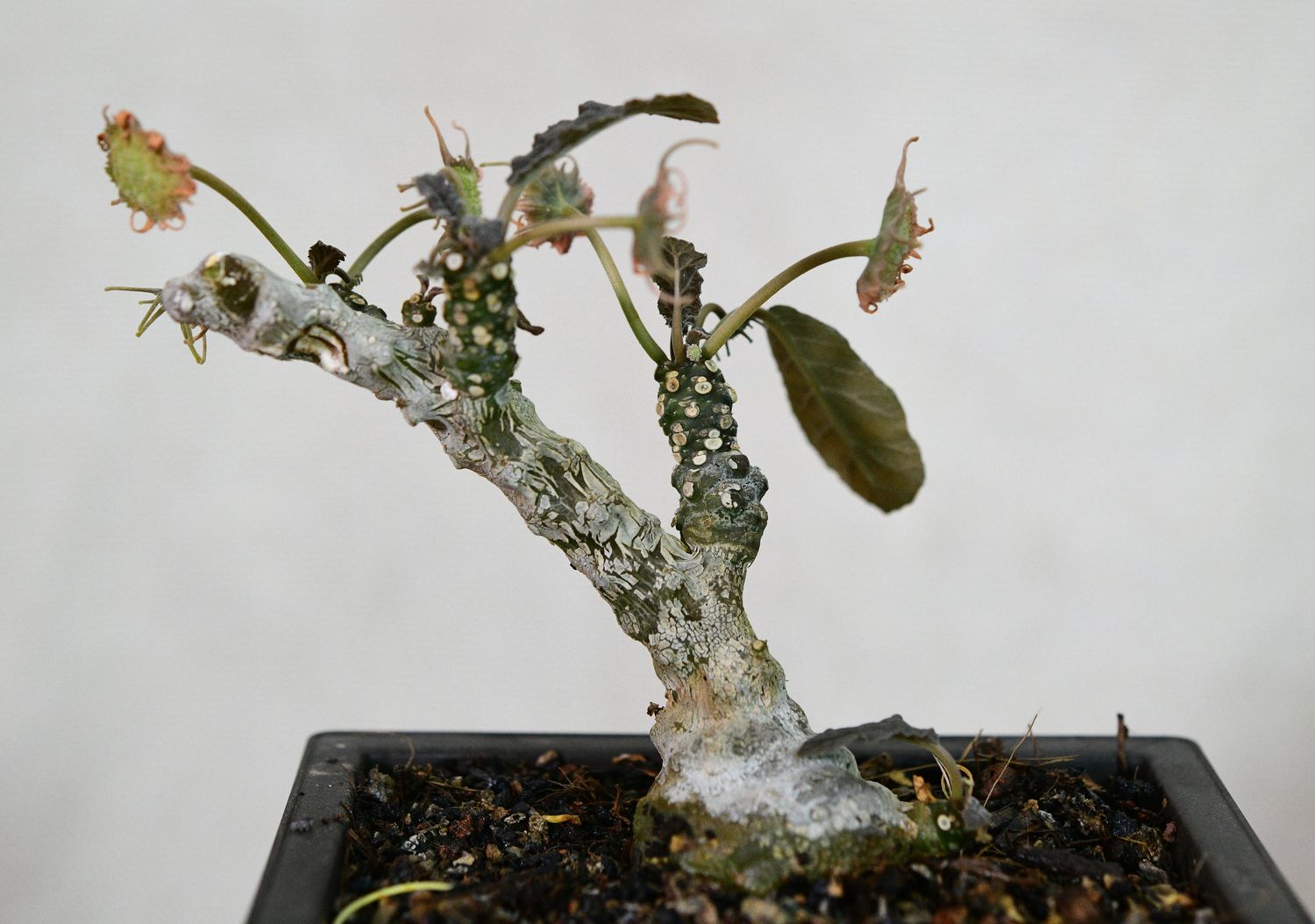
Dorstenia foetida
Product Details
The Alien Star: Dorstenia foetida
A living architectural sculpture that bridges the gap between exotic succulent and prehistoric curiosity.
- Origin & History of Name: The genus name honors German physician and botanist Theodor Dorsten (1492–1552).
The species epithet foetida is Latin for "fetid" or "stinking," referring to the slightly pungent, medicinal scent the plant’s sap or tiny flowers can emit when handled or crushed. It was formally described in the late 18th century as the genus gained recognition for its unusual "inside-out" flowering structures. - Morphology: This succulent moraceae features a thick, dark green to mahogany caudex (swollen stem) that stores water.
Its most striking feature is the hypanthodium, a flattened, star-shaped disk that holds the flowers. Unlike traditional blooms, the reproductive organs are embedded in this disk. It utilizes an explosive seed dispersal mechanism, where pressurized tissue "pults" seeds several feet away when ripe. - Habitat & Origin: This is a wild species native to Eastern Africa (Ethiopia, Somalia, Kenya) and the Arabian Peninsula. It thrives in rocky, arid terrains. Our specimens are nursery-grown from seed to ensure the preservation of wild populations and long-term sustainability.
- Cultivation Profile:
- Substrate: Use a strictly mineral-based mix (60% grit/pumice/perlite and 40% coarse sand or cinder). Avoid standard garden soil which retains too much moisture in humid Indian climates.
- Light: Requires bright indirect light or morning sun.
In the Indian summer, provide 50% shade to prevent the caudex from scorching. - Water/Dormancy: Water deeply only when the medium is completely dry. During the monsoon and winter, significantly reduce water as the plant may enter dormancy and drop its leaves; keeping it dry prevents root rot.
- Scientific/Historical Anecdote: The Dorstenia genus is a close relative of the common Fig (Ficus).
While a fig is essentially a flower turned inside out into a ball (syconium), the Dorstenia flower is the intermediate evolutionary step—a flat, open platform that reveals the "inner workings" of a fig to the open air.