Uncover a hidden jewel for your indoor oasis – the Drimiopsis maculata variegata. This enchanting bulbous perennial offers a captivating display of unique foliage, blending the natural artistry of spots with the painterly streaks of variegation. Far from a common houseplant, it's a testament to nature's subtle beauty, promising to add a touch of exotic elegance and fascinating texture to any plant collection with its easy-going charm.
1. Origin of Name
The genus name, Drimiopsis, is derived from the Greek word "drimos," meaning "forest" or "copse," combined with "opsis," meaning "appearance" or "like." This suggests its typical habitat preference for shaded, wooded areas or its resemblance to another genus, Drimia (also in the Asparagaceae family). The species epithet, maculata, comes from the Latin word "maculatus," meaning "spotted" or "blotched," which perfectly describes the distinctive patterns found on its leaves. The botanist J.G. Baker formally described Drimiopsis maculata in the late 19th century, categorizing it within the large and diverse family Asparagaceae (formerly often placed in the Hyacinthaceae or Liliaceae). The additional term "variegata" is Latin for "variegated" or "streaked with different colors," and in this case, specifically refers to the horticultural form that displays areas of cream, yellow, or white coloration alongside the normal green. This specific 'variegata' form is a cultivated selection, cherished for its enhanced ornamental appeal.
2. Origin of Plant
The parent species, Drimiopsis maculata, is native to the forested and savanna regions of Southern and Eastern Africa. It thrives in the understory of woodlands, on forest floors, and in grasslands, often found in dappled shade or partial sun, in well-drained, humus-rich soils. Its range extends across countries like South Africa, Eswatini (Swaziland), Mozambique, and Zimbabwe. As a bulbous perennial, it is well-adapted to survive periods of drought by retreating into its underground bulb. The 'variegata' form, while originating from this wild species, is a horticultural selection, meaning it was discovered or selectively bred in cultivation to emphasize its striking variegated foliage, rather than being a naturally occurring wild variant with its own specific geographic origin. Its discovery and subsequent cultivation reflect the ongoing fascination with African flora among botanists and plant enthusiasts alike.
3. Description
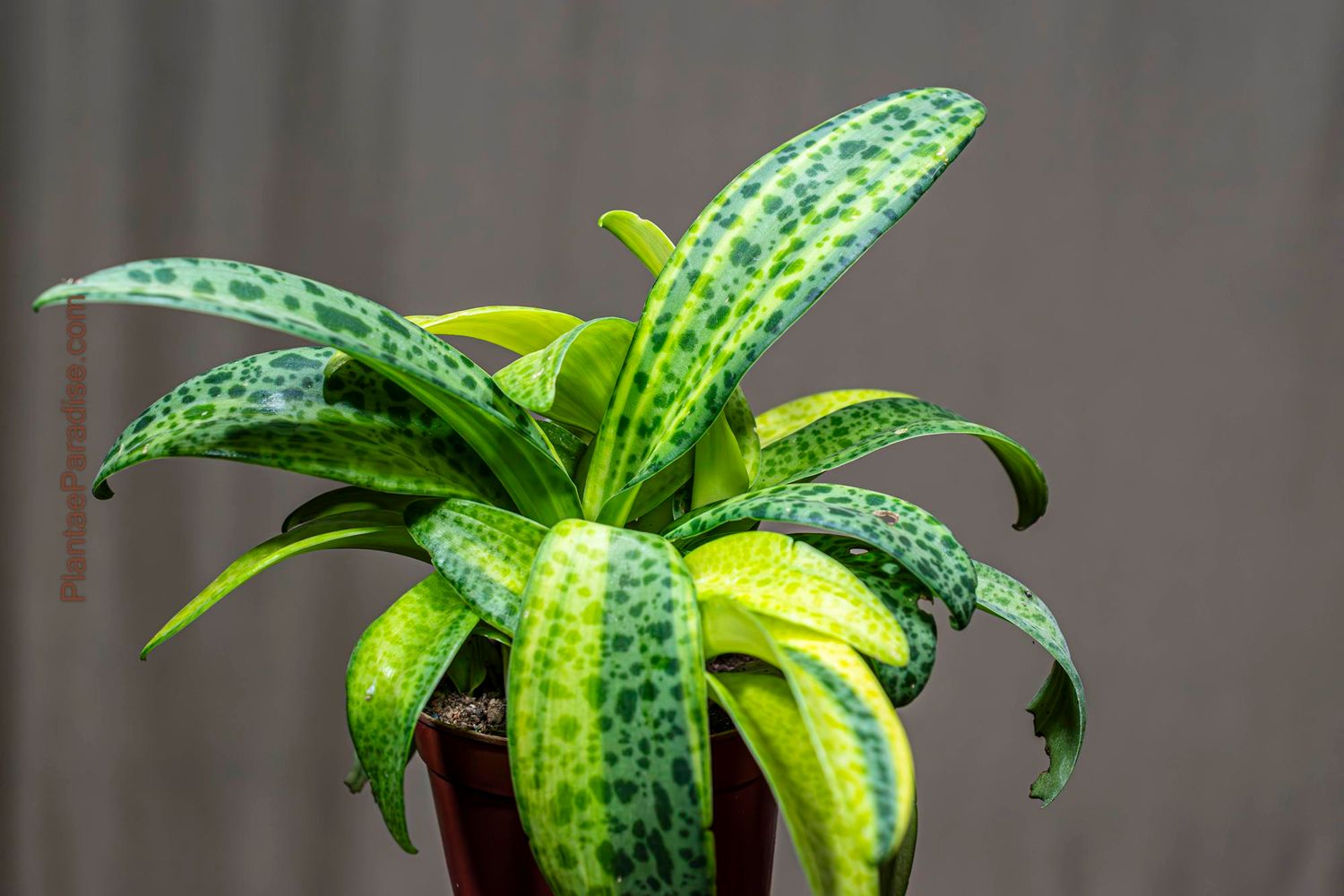
The Drimiopsis maculata variegata is a truly captivating plant, primarily prized for its stunning foliage. It grows as a compact, bulbous perennial, producing a cluster of elegant leaves from a small, often visible, green bulb. The leaves are typically lance-shaped to somewhat heart-shaped, fleshy, and can reach lengths of 10-20 cm (4-8 inches). The most distinctive feature is their intricate patterning: the leaves display a vivid green background heavily adorned with dark green to purplish-black spots and blotches – the "maculata" aspect. Added to this natural artistry is the striking variegation, with irregular streaks and patches of creamy white or pale yellow meandering across the leaf surface. This combination of spots and variegation creates a dynamic and highly ornamental display, making each leaf a unique work of art. In spring or summer, mature plants produce slender, erect flower spikes bearing small, inconspicuous, star-shaped white to pale green flowers. While the flowers are not the primary ornamental feature, they add a delicate charm.
4. Conservation Status
The wild species, Drimiopsis maculata, is not currently listed as threatened or endangered on the IUCN Red List, as it is relatively common and widespread throughout its native African range. As 'variegata' is a horticultural form selected for its unique leaf patterns, it does not have a separate conservation status in the wild. All plants of Drimiopsis maculata variegata are propagated in cultivation, ensuring their availability to enthusiasts without impacting wild populations. By choosing cultivated varieties, you are supporting sustainable horticulture and helping to reduce any potential pressure on the natural habitats of such species.
5. Care
The Drimiopsis maculata variegata is a wonderfully easy-care plant, making it suitable for both beginners and experienced collectors.
- Watering: Water moderately during the growing season (spring to autumn), allowing the top inch or two of soil to dry out between waterings. Reduce watering significantly in winter when the plant may go semi-dormant; water just enough to prevent the leaves from shriveling. Overwatering, especially during cooler months, can lead to bulb rot.
- Soil: Requires a well-draining, rich potting mix. A standard houseplant mix amended with some perlite, coarse sand, or bark for improved drainage and aeration is ideal.
- Light: Prefers bright, indirect light. While it can tolerate lower light conditions, its variegation and spots will be most vibrant in good light. Avoid direct, harsh sunlight, which can scorch the leaves.
- Temperature: Thrives in average room temperatures, ideally between 18-27°C (65-80°F). It is not frost-tolerant and should be protected from temperatures below 10°C (50°F).
- Tips: This plant appreciates moderate to high humidity. Grouping it with other plants or placing it on a pebble tray can help. It can be easily propagated by separating offsets that form around the mother bulb. Fertilize sparingly with a balanced liquid fertilizer during the growing season.
6. Engaging Anecdote
The charm of Drimiopsis maculata variegata lies in its remarkable camouflage, a strategy often employed by understory plants in its native African habitats. The spots on its leaves are sometimes theorized to mimic the dappled light filtering through a forest canopy, or even to resemble the patterns of insects or disease, potentially deterring herbivores. This, combined with its striking variegation, makes it a master of visual deception, a truly "living painting." Furthermore, as a bulbous perennial, it represents nature's efficient engineering. The bulb acts as a natural storage unit, allowing the plant to patiently wait out dry periods, only to re-emerge with renewed vigor when conditions are favorable. This resilience and understated beauty make Drimiopsis maculata variegata a true "hidden gem" of the plant world. It brings a piece of the vibrant and mysterious African undergrowth into your home, a constant reminder of the intricate beauty found in adapting to life's challenges.