

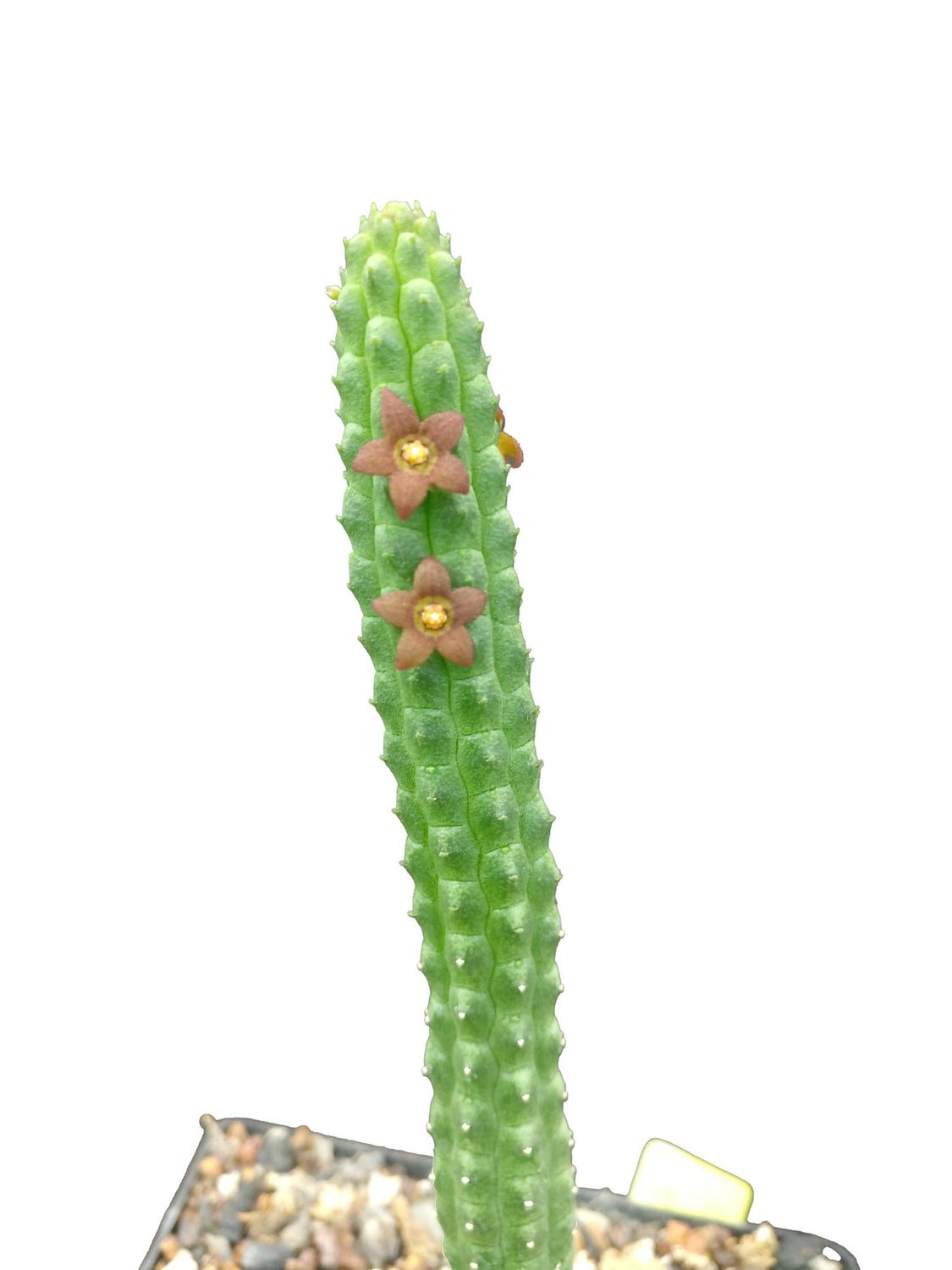
Echidnopsis cereiformis
Product Details
Geometric Marvel: Echidnopsis cereiformis
Add a touch of prehistoric intrigue to your collection with this rare, serpent-like succulent from the Horn of Africa.
- Origin & History of Name: The genus name Echidnopsis is derived from the Greek echidna (viper) and opsis (appearance), referring to the plant's snake-like stems.
The specific epithet cereiformis translates to "wax-like" or "candle-shaped," a nod to its upright, cylindrical growth habit. It was formally described in 1871 by the English botanist Sir Joseph Hooker. - Morphology: This leafless succulent features procumbent, dull green to brownish stems divided into small, hexagonal tubercles. These 8–10 costae (ribs) create a distinct tessellated texture across the epidermis. In late summer, it produces small, star-shaped flowers that emerge directly from the stem, ranging from dark burgundy to bright yellow.
- Habitat & Origin: This is a wild species native to the arid regions of Ethiopia, Eritrea, Yemen, and Saudi Arabia. It typically grows in the shade of acacia bushes at moderate altitudes. All specimens should be sourced from nursery-propagated stock to protect wild populations from over-harvesting.
- Cultivation Profile:
- Substrate: Use a strictly mineral-based mix (70% grit/pumice/perlite and 30% organic matter) to prevent root rot.
- Light: Thrives in bright, indirect light.
In the Indian subcontinent, provide 40–50% shade during peak summer afternoons to prevent sunscald. - Water/Dormancy: Water thoroughly when the substrate is bone-dry during the growing season. In monsoon and winter, reduce watering significantly; the plant enters a semi-dormancy and requires high ventilation to combat humidity.
- Scientific/Historical Anecdote: Unlike many of its relatives in the Stapeliad group (the "carrion flowers"), Echidnopsis cereiformis flowers often lack the intense, foul odor associated with fly-pollinated succulents. Instead, their scent is subtle or even slightly sweet, making them far more "indoor-friendly" than their larger-flowered cousins.
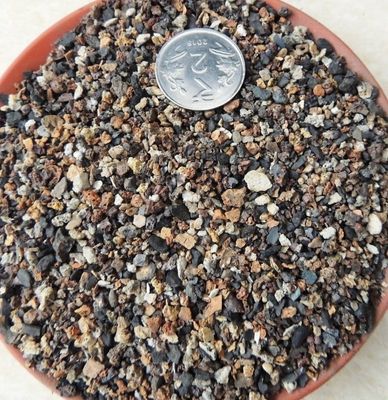
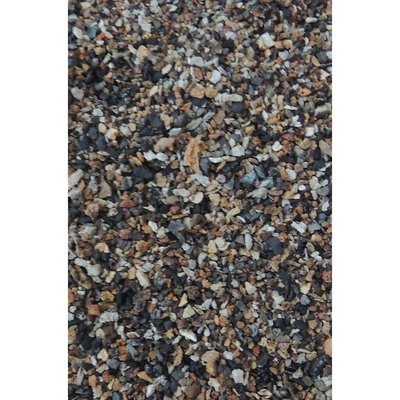
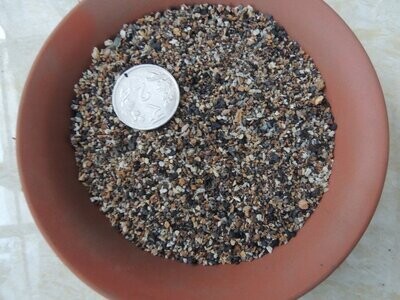
Cactus & Succulent Planting Mix FINE (aka Cactus Soil Mix or Succulent Soil Mix)
Cactus & Succulent Planting Mix FINE (aka Cactus Soil Mix or Succulent Soil Mix)
Fine-Grain Potting Mix for Cactus & Succulent Roots
SKU MNS001
₹39.85
New
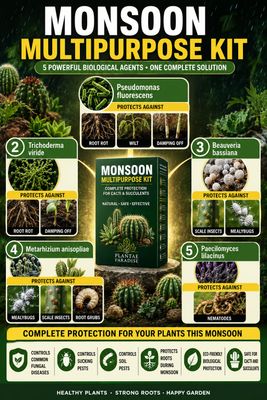
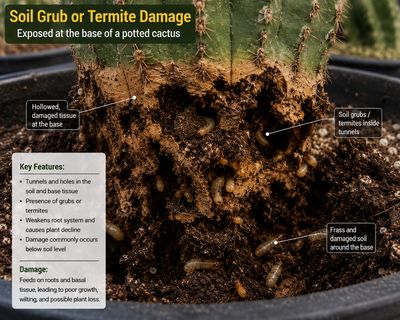
Monsoon Guardian Kit (5 in 1)
Monsoon Guardian Kit (5 in 1)
Complete 5-in-1 biological protection kit for cacti & succulents
SKU MNS024
₹850.00
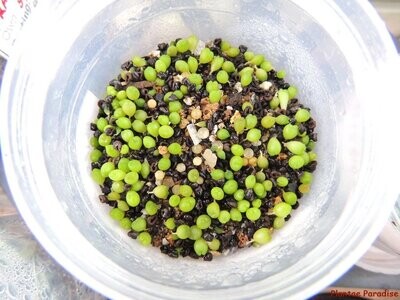
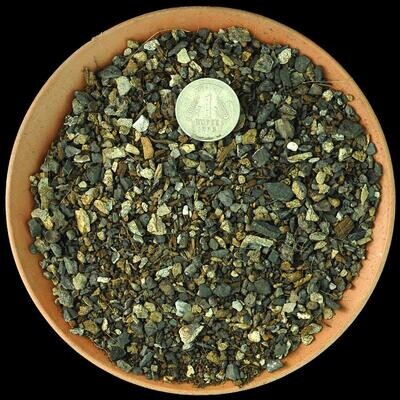
Cactus Seed Planting Mix
Cactus Seed Planting Mix
Sterile, Fine-Grain Media for Cactus & Succulent Seeds
SKU MNS005
₹74.85