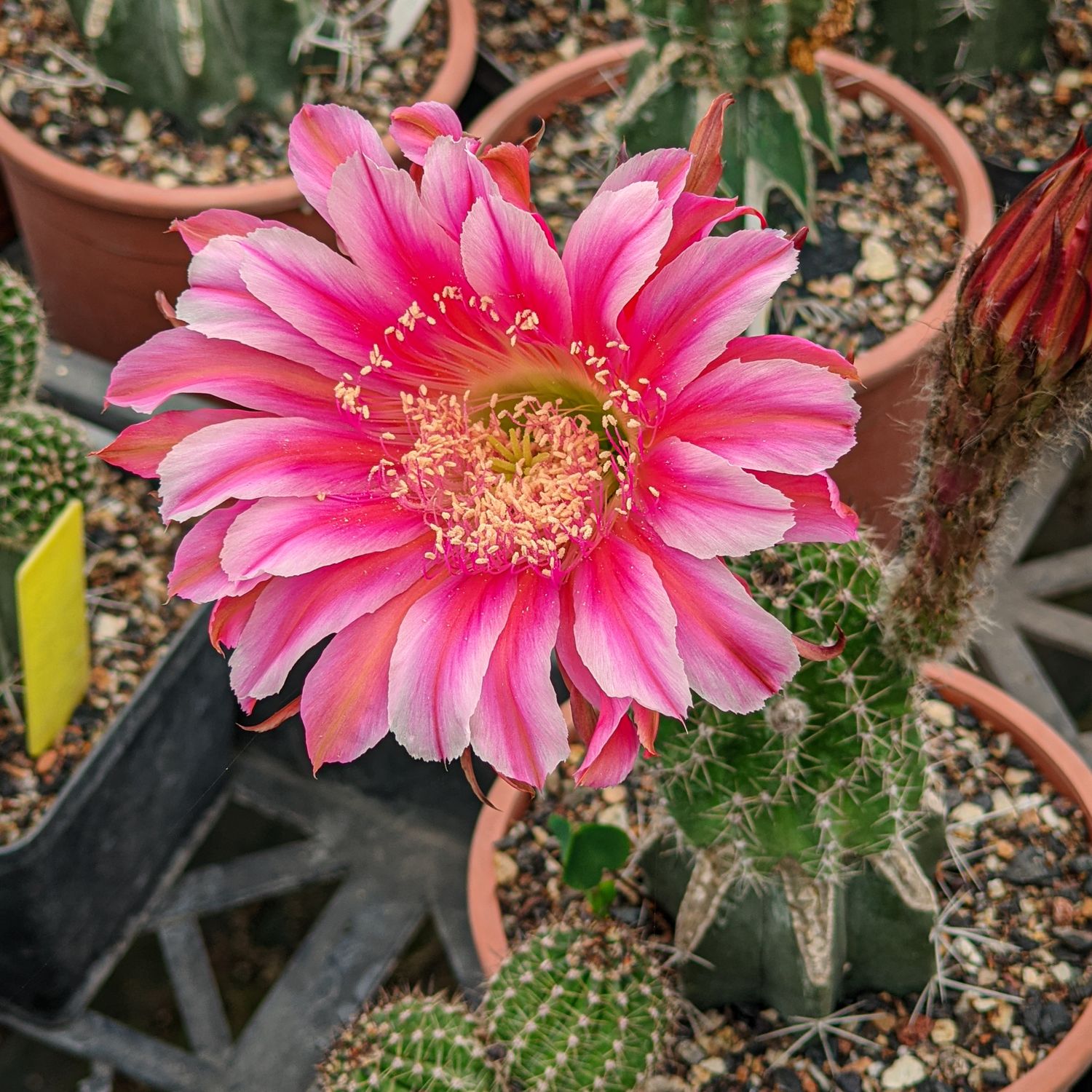
A flower that looks lit from within — layered petals blazing from deep magenta at the throat to soft blush-pink at the tips, crowded with a golden starburst of stamens. This Echinopsis hybrid, grower-labeled '9/9,' is proof of just how far modern hybridizing has pushed the humble "Easter Lily Cactus."
1. Origin of Name
Echinopsis comes from the Greek echinos ("hedgehog" or "sea urchin") combined with opsis ("appearance" or "resembling") — literally "hedgehog-like," a reference to the spiny, rounded bodies typical of the genus. The genus has absorbed several once-separate groups over the decades, including Lobivia, Trichocereus, Helianthocereus, and others, as botanists reclassified them based on genetic relationships — which is why you'll see such enormous variety of shapes and flower forms all filed under one genus name today. The designation "9/9" isn't a formally registered cultivar name in the way something like Echinopsis 'Pink Diamond' or 'Big Bertha' is; it's a grower's or hybridizer's own seedling code, the kind of shorthand collectors use to track a specific cross or selection out of a batch of seedlings before (or instead of) giving it a proper trade name. This is extremely common in the Echinopsis hybrid world, where hobbyists and small nurseries produce thousands of one-off seedling crosses each year, and only a fraction ever get named and released more widely — the rest circulate under numbers, codes, or the grower's personal shorthand, exactly like this one.
2. Origin of Plant
The wild species behind today's Echinopsis hybrids originate across central South America — Argentina, Bolivia, Peru, Paraguay, Brazil, and Uruguay — growing in a range of habitats from rocky highlands to scrubby lowland terrain. Echinopsis species have been in cultivation since the 1800s, but the extravagant, large-flowered hybrids like this one are a more recent development: beginning in the early 20th century, hybridizers in California, Arizona, and Europe began deliberately crossing different Echinopsis (and related, now-merged genera) to chase bigger, brighter, and more colorful flowers. That breeding work continues today among specialist collectors worldwide, constantly producing new seedling crosses — plants like this "9/9" are a direct product of that ongoing, decades-long hobbyist tradition.
3. Description
This hybrid puts on an unmistakable show: a fully double-ranked flower opening to several inches across, with slender, pointed petals arranged in a dense, layered rosette. The color builds in gradient from a rich, saturated hot-pink-to-red base near the throat out to a paler, almost white-pink at the petal tips, with a few outer segments showing a warm coral-orange flush along their edges. At the center, a dense cluster of pale creamy-yellow stamens surrounds a central style, creating a bright contrasting core that draws the eye straight to the middle of the bloom. The stem itself is typical of Echinopsis hybrids — a ribbed, spiny, globular-to-columnar body that stays relatively modest in size and often clusters over time, existing mainly as the stage for these outsized flowers. As with most Echinopsis, individual blooms are short-lived, generally opening for a day or two before fading, but a well-grown plant can throw off wave after wave of flowers through the growing season.
4. Conservation Status
The wild Echinopsis species that make up this hybrid's ancestry are broadly common and not considered threatened, though as with many South American cacti, habitat pressure exists in parts of their range. As a cultivated hybrid, "9/9" itself has no wild population and exists purely as a garden and collector plant, propagated through offsets or cuttings by hobbyists and small nurseries.
5. Care
- Light: Bright light to full morning sun, with some protection from harsh, all-day afternoon sun in very hot climates to prevent scorching.
- Water: Water deeply, then allow the soil to dry out before watering again. These hybrids tolerate — and often appreciate — a bit more regular moisture during active growth than most cacti, but always back off in winter.
- Soil: A well-draining, fertile cactus mix works best; unlike many desert cacti, Echinopsis hybrids benefit from slightly richer soil and monthly feeding with a balanced fertilizer during the growing season.
- Temperature: Hardy to roughly 15–20°F (-6 to -9°C) depending on the specific cross, but best kept frost-free and moved to a bright, cool, dry spot over winter to encourage healthy dormancy.
- Bloom tips: Watch for fuzzy, blueberry-sized buds forming along the ribs in spring — once they start swelling, warmth and water can bring them into full bloom within days, often opening at night or in the early morning.
A Story Worth Telling
Every Echinopsis hybrid with a name you recognize — 'Pink Diamond,' 'Big Bertha,' 'Salmon Queen' — started out exactly like this one: an anonymous seedling from a cross, tracked only by a number or code while the grower waited to see what it would become. Most never get further than that label. The handful that do go on to earn a real name are the ones whose flowers stopped a collector in their tracks — which, going by the photo, is a fair bet for what might eventually happen to '9/9' too.