Echinopsis hybrid 'Maria Piazza' (Schick 1373-52)
A showstopper Echinopsis hybrid bred by legendary hybridizer Robert Schick, 'Maria Piazza' produces enormous, ruffled blooms up to 6 inches across in a rich purplish-pink with a glowing white throat. Compact, freely offsetting, and famously easy to grow, it's the kind of cactus that turns a windowsill into an event for a few unforgettable days each spring.
Origin of Name
'Maria Piazza' is a cultivar name, not a botanical species name, and its story is a small piece of California nursery history. The hybrid was bred by Robert Schick, an American hybridizer who, working with the Huntington Botanical Gardens' International Succulent Introductions (ISI) program, introduced 128 named Echinopsis hybrids between 1986 and 2004 — building on the pioneering hybridizing work of Harry Johnson, whose color catalogs had stirred interest in these plants from the 1930s through the 1970s. Schick's seedling, bred under the working number 1373-52, was originally slated to be named simply 'Maria.' That name, however, turned out already to be in use by another breeder, so Schick renamed it in full to honor Maria Piazza, who at the time owned the well-known succulent nursery Cactus by Mueller. According to the record kept by the Huntington, Piazza had picked this particular seedling as her personal favorite from among the many flowering hybrids Schick had on offer — a distinction that earned the plant its permanent name. It was formally distributed through the ISI catalog as ISI 97-19 (Huntington Botanical Gardens accession HBG 80605).
The genus name Echinopsis itself is older and purely descriptive: German botanist Joseph Gerhard Zuccarini coined it from the Greek echinos ("hedgehog" or "sea urchin") and -opsis ("appearance," "looking like"), a nod to the dense, spiny, globe-shaped bodies of the plants he was describing. He intended the genus to sit taxonomically between Echinocactus and Cereus. The name later caused some confusion with the unrelated thistle genus Echinops, prompting at least one 19th-century botanist to propose (unsuccessfully) an alternative name — but Echinopsis stuck, and today the genus (after absorbing former genera like Trichocereus and Lobivia through 20th- and 21st-century reclassification) is one of the most hybridized groups in the whole cactus family.
Origin of Plant
Unlike a wild species, 'Maria Piazza' has no natural habitat of its own — it's a garden-bred cultivar, the product of deliberate crosses made among cultivated Echinopsis parent plants at Robert Schick's breeding program in Southern California, associated with the Huntington Botanical Gardens' Desert Garden. Its wild ancestry, however, traces straight back to South America: the Echinopsis group draws its genetics from species native to Argentina, Bolivia, Peru, Brazil, Paraguay, and Uruguay, where they grow across desert grasslands, scrubby hillsides, and sandy or rocky slopes. Schick and other 20th-century hybridizers drew on this deep wild gene pool — combining traits from large-flowered, columnar "torch cactus" relatives and smaller globular species — to breed for bigger blooms, brighter colors, and more compact, garden-friendly growth habits, of which 'Maria Piazza' is a fine example.
Description
'Maria Piazza' is grown chiefly for its flowers, but the plant itself is a neat, well-behaved grower. It forms a globular, deep-green stem that reaches roughly 4 inches (10 cm) in diameter, ribbed and studded with areoles bearing central spines to about 1⅛ inches (3 cm) long. It offsets freely from the base, quickly building into a tidy clustering clump of rounded stems — attractive on its own even before it blooms.
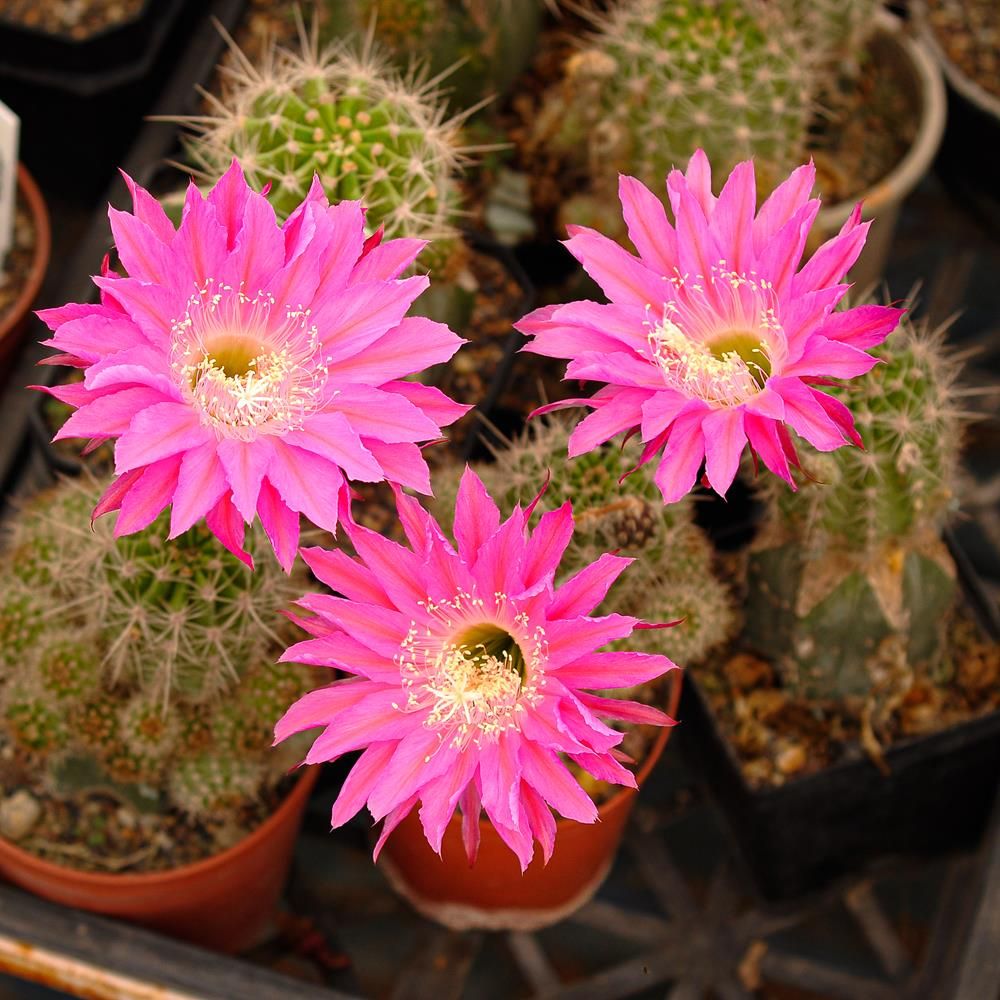
The real event is the flower. Each bloom opens to an impressive 6 inches (15 cm) across, with lance-linear, ruffled petals that curl slightly inward (botanically "involute"). The color is a rich, saturated purplish-pink, each petal marked with a darker pinkish-red midrib, opening into a bright white throat at the center. Purplish-pink filaments surround a white stigma that extends slightly beyond the petals. Like most Echinopsis flowers, individual blooms are short-lived — often open for only a day or two — but a well-grown plant produces flushes of them through the spring, each one a genuine showpiece.
Conservation Status
As a cultivated hybrid rather than a wild species, 'Maria Piazza' has no IUCN conservation listing of its own — it exists only in cultivation and is in no danger of disappearing as long as it remains popular with growers (which, decades after its introduction, it still is). Its wild Echinopsis ancestors are, for the most part, not considered threatened, though as with all cacti, international trade in wild-collected material is regulated under CITES Appendix II. Choosing nursery-propagated hybrids like this one is always the responsible way to add a plant like this to your collection.
Care
Light: Bright light is essential for good flowering — a sunny south- or west-facing windowsill indoors, or a spot with several hours of direct sun outdoors. Some protection from the most intense afternoon summer sun helps prevent scorching.
Watering: Water thoroughly during the active growing season (spring through early autumn), allowing the soil to dry out completely between waterings. Reduce watering significantly in winter, keeping the plant nearly dry while it rests — overwatering in cool weather is the most common way to lose an Echinopsis to rot.
Soil: A fast-draining, mineral-rich cactus mix is a must — a standard cactus potting soil amended with extra pumice, perlite, or coarse sand keeps roots healthy and helps prevent rot.
Temperature: Grows best in warm conditions and tolerates typical summer heat easily. It prefers to be kept above about 5°C (41°F) in winter, though a dry, dormant plant can handle brief cooler dips; protect from frost.
General tips: Offsets can be removed once they've developed roots of their own, left to callus for a few days, and potted up to start new plants. Repot every couple of years as the clump fills its container, and feed with a diluted, low-nitrogen cactus fertilizer during the growing season to encourage strong flowering.
An Interesting Note
There's something quietly charming about how this plant got its name. Robert Schick raised dozens of seedlings from his breeding crosses each year, and this one was simply going to be called 'Maria' — until he discovered another hybridizer had already claimed that name. Rather than starting over, he turned to Maria Piazza, the nurserywoman who ran Cactus by Mueller and who had singled out this very seedling as her favorite among the many Schick had in bloom, and gave the plant her full name instead. It's a small story, but a telling one: the Huntington's own curator, John Trager, once praised Schick's naming choices as "well thought out," often tying names to a plant's character or to a personal story worth remembering — exactly the kind of detail that turns a cactus into a piece of horticultural history.