

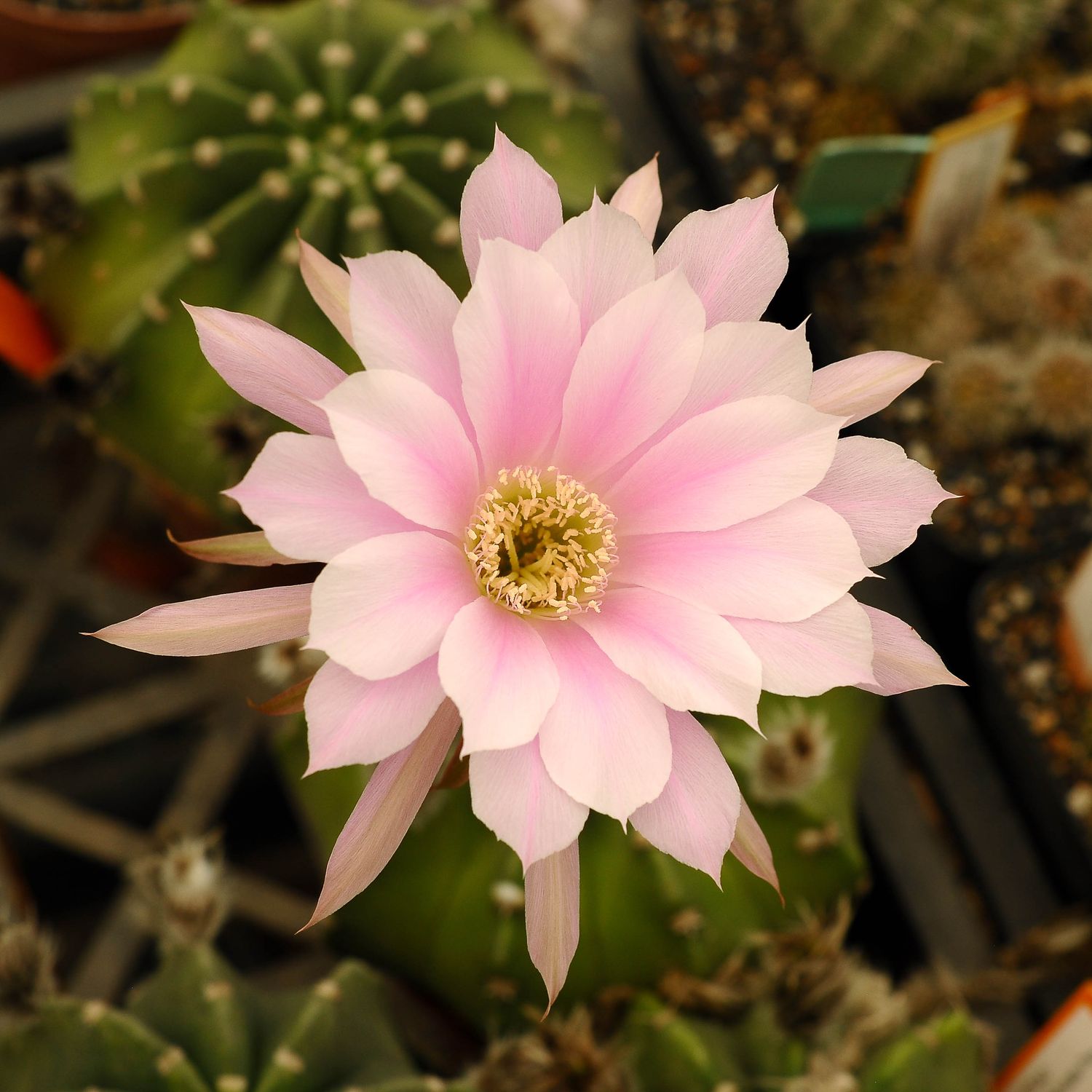
Echinopsis subdenudata Fuzzy Navel Pink Flower
Product Details
Pastel Elegance: Echinopsis subdenudata 'Fuzzy Navel'
A high-demand collector's specimen featuring rare multi-layered pastel pink blooms on a signature spineless body.
- Origin & History of Name: The species name subdenudata is Latin for "nearly naked," referring to the plant's lack of traditional spines. The cultivar name 'Fuzzy Navel' is a whimsical commercial descriptor for the prominent, woolly white areoles that resemble tufts of cotton. The genus Echinopsis translates from Greek as "hedgehog-like," though this variety is prized specifically for its smooth, tactile surface.
- Morphology: This cactus features a globose, dark-green epidermis divided by 8–12 deep costae (ribs). It is technically subdenudate, meaning the spines are nearly absent, replaced by large, fuzzy white felt-like areoles. The flower is infundibuliform (funnel-shaped), displaying multiple layers of pastel pink petals with distinct white margins and a dense, creamy central core of pollen-bearing stamens.
- Habitat & Origin: While the base species Echinopsis subdenudata is native to the lowlands of Bolivia and Paraguay, 'Fuzzy Navel' is a specialized cultivar selected for its unique floral pigmentation and enhanced areole fuzz. This plant is nursery-grown via sustainable offsets, ensuring the protection of wild Bolivian xerophytic habitats.
- Cultivation Profile:
- Substrate: Requires a porous, mineral-heavy mix (70% grit/perlite/pumice and 30% compost). Avoid heavy clay soils which retain lethal moisture during the Indian monsoon.
- Light: Thrives in morning sunlight with afternoon filtered shade. In the Indian subcontinent, direct 12:00 PM–4:00 PM sun can cause permanent scarring to the spineless epidermis.
- Water/Dormancy: Implement a seasonal watering schedule. Drench thoroughly when the substrate is bone-dry during March–October. Maintain a completely dry dormancy from November to February to ensure the development of pink floral buds.
- Scientific/Historical Anecdote: Echinopsis subdenudata is often called the "Easter Lily Cactus" because of its massive, fragrant nocturnal blooms. Scientifically, the species is a marvel of evolutionary adaptation; by losing its spines, it relies on its deep ribs to shade itself and its woolly areoles to collect minute amounts of atmospheric moisture, making it exceptionally resilient despite its delicate appearance.
Cactus Seed Planting Mix
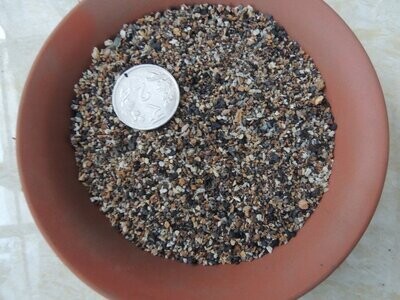
Cactus Seed Planting Mix
Sterile, Fine-Grain Media for Cactus & Succulent Seeds
SKU MNS005
₹74.85


Cactus & Succulent Planting Mix COARSE (aka Cactus Soil Mix or Succulent Soil Mix)
Cactus & Succulent Planting Mix COARSE (aka Cactus Soil Mix or Succulent Soil Mix)
Washed, Free-Draining Mineral Mix for Cactus & Succulents
SKU MNS003
₹44.85
New


Monsoon Guardian Kit (5 in 1)
Monsoon Guardian Kit (5 in 1)
Complete 5-in-1 biological protection kit for cacti & succulents
SKU MNS024
₹850.00