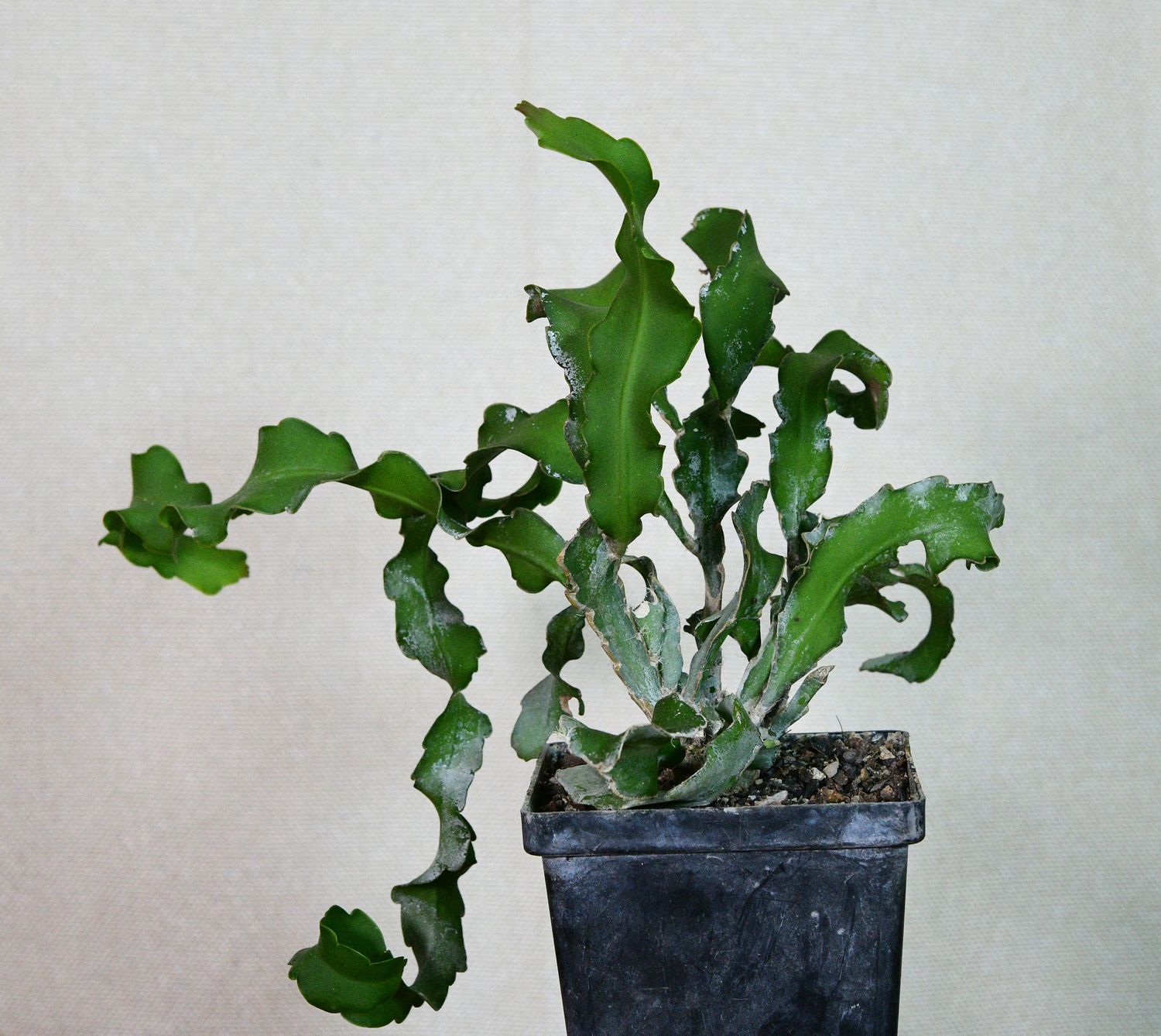
Epiphyllum guatemalense monstrose "Curly Locks" (Curly Orchid Cactus)
A jungle cactus that grows nothing like a cactus at all — no spines, no rigid columns, just wide ribbon-like stems that coil, kink, and corkscrew their way out of the pot in every direction. This is the "monstrose" (mutated) form of the Guatemalan orchid cactus, prized by collectors for exactly the tangled, sculptural growth pictured here, and capable of producing enormous fragrant white blooms that open only after dark. An easy, forgiving houseplant that doubles as a genuine conversation piece.
Origin of Name
The genus name Epiphyllum was coined by English botanist Adrian Hardy Haworth in 1812, built from the Greek epi ("upon") and phyllon ("leaf"). It's a slightly misleading name born from an honest mistake: early botanists looking at these cacti saw flowers apparently sprouting directly from a flat green "leaf" and named the genus accordingly. In fact there are no true leaves at all — what looks like a leaf is a flattened, photosynthetic stem (a cladode), and the flowers emerge from areoles along its scalloped edges, the same structures that produce spines on more typical cacti.
The species epithet guatemalense simply means "of Guatemala," honoring the country where the plant was first collected and described. It was formally published as Epiphyllum guatemalense in 1913 by American botanists Nathaniel Lord Britton and Joseph Nelson Rose, the same pair responsible for describing much of the Cactaceae family in their landmark four-volume monograph. Like many jungle cacti, its classification has shifted over the decades — it has also been treated as a variety or subspecies of Epiphyllum phyllanthus and, more recently, of Epiphyllum hookeri — but "guatemalense" has stuck as the name growers and nurseries know it by.
The "Curly Locks" of this particular plant refers to its "monstrose" form — a naturally occurring mutation in which the normally flat, straight-growing stems twist and curl erratically as they grow. Somewhere along the way, a grower spotted a wild-mutated stem on an ordinary E. guatemalense, took cuttings, and propagated it onward — every curly-locked plant in cultivation today descends from clones of that original mutant, since the twisted growth habit doesn't reliably reproduce from seed.
Origin of Plant
The straight-stemmed parent species is native to the humid tropical forests of southern Mexico, Guatemala, and Honduras, where it grows as an epiphyte — rooting not in soil but in the leaf litter and moss caught in the crooks of tree branches, using its aerial roots to cling to bark high in the forest canopy. Like other jungle cacti, it thrives in the dappled, filtered light beneath a rainforest canopy rather than the harsh, exposed sun of a desert, and its broad, flattened stems are an adaptation for photosynthesizing efficiently in that shadier environment. The monstrose "Curly Locks" form itself has no wild population — it exists only as a cultivated mutation, first noticed and propagated by growers rather than found growing wild.
Description
A sprawling, spineless, epiphytic cactus with thick, fleshy, flattened stems that twist and curl in tight, unpredictable coils rather than growing straight — exactly the tangled, arching growth shown here, with new curling stem tips still unfurling from the base. Mature plants reach roughly 60–150 cm (2–5 feet), trailing or climbing, which makes them especially well suited to hanging baskets where the curling stems can cascade freely. Given enough maturity and the right conditions, it produces spectacular flowers: large, white to creamy blooms up to 15 cm (6 inches) across on a long slender floral tube, opening only at night and typically lasting just a single evening before closing for good by morning. Pollinated flowers are followed by oval, bright pink, edible fruit.
Conservation Status
The wild parent species is not currently listed as threatened, though like many epiphytic rainforest cacti it depends on standing forest canopy, and deforestation across its range in Central America represents an ongoing, if unquantified, pressure on wild populations. The monstrose "Curly Locks" form has no wild population to assess at all — it survives entirely through cultivation and propagation by growers, which makes buying a nursery-grown plant like this one the only way to own one.
Care
Light: Bright, indirect light — a spot near an east or filtered south/west window suits it well. Avoid intense direct midday sun, which can scorch the flattened stems; too little light, on the other hand, will suppress flowering.
Watering: Water when the top inch or so of soil has dried out, keeping the plant evenly moist but never waterlogged during the growing season. Ease off in winter, watering only enough to keep the stems from shriveling.
Soil: A loose, well-draining but moisture-retentive epiphytic mix — orchid bark, perlite, and a little standard potting soil or cactus mix combined — mimics the leaf litter it would root into in the wild.
Temperature & Humidity: Prefers warm conditions and appreciates higher humidity, as befits its rainforest origins; protect it below about 10°C (50°F). A slightly cooler, drier spell in late winter can help trigger flowering.
General tips: This plant flowers best when a little pot-bound, so resist repotting too often — do it only once roots are visibly crowded, and ideally right after a bloom cycle finishes. Feed with a balanced fertilizer through the growing season, switching to a bloom-boosting, lower-nitrogen formula as flowering season approaches. Its trailing, curling stems make it a natural choice for a hanging basket where the "monstrose" form can really show off.
An Interesting Note
In the wild, the straight-growing ancestor of this plant relies on an unusual pollination partnership: its enormous white flowers open only after dark specifically to attract night-flying moths and bats, which can spot the pale, glowing blooms in low light far more easily than daytime insects could. The Curly Locks form carries that same flowering trait, but every twisted stem on every plant sold today traces back to a single wild mutation — a one-off genetic accident that a grower noticed, cut, rooted, and shared, turning a chance curl into an entire cultivated variety that can now only be continued by cutting, never regrown true from seed.