

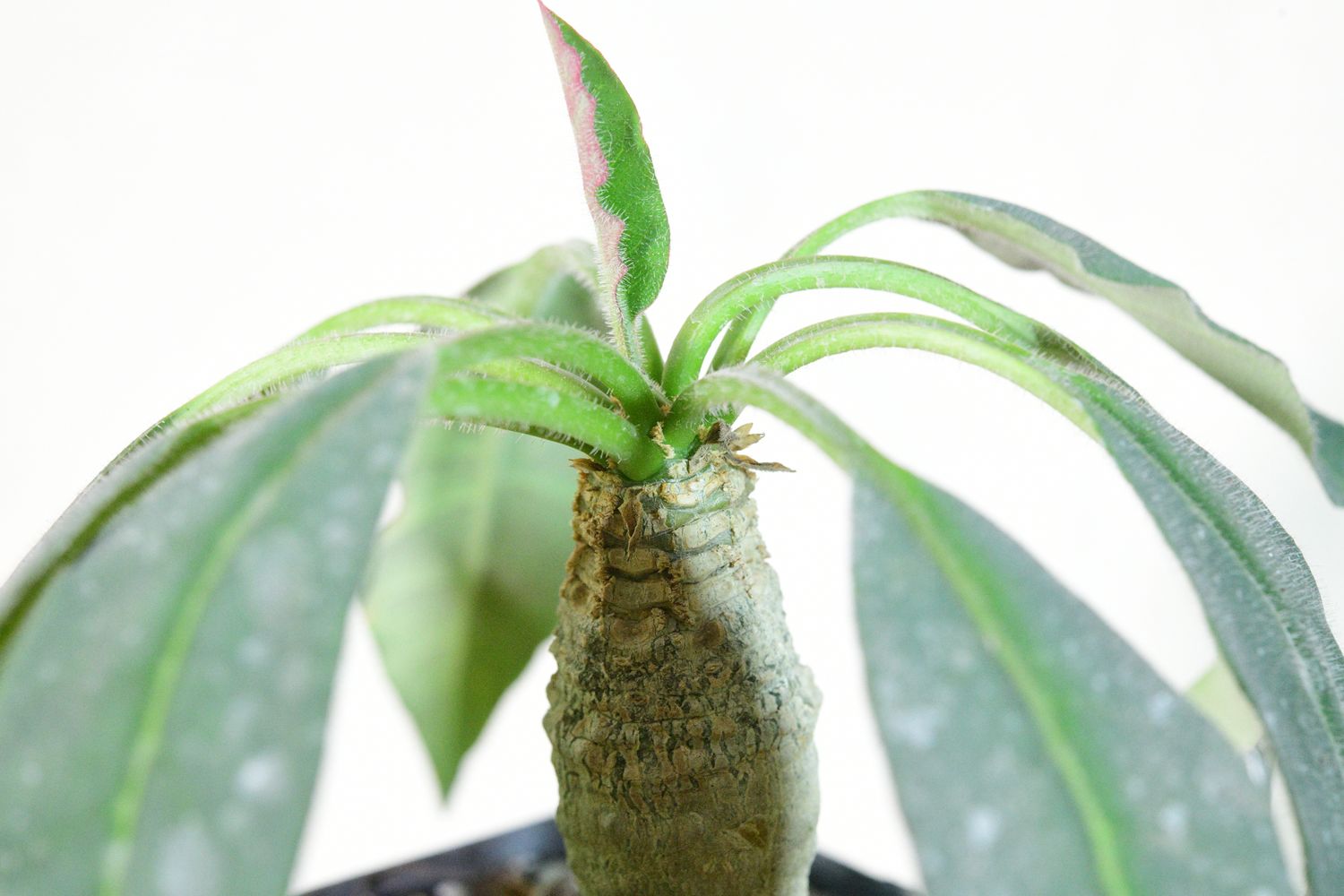
Euphorbia ankarensis
Product Details
Madagascar’s Crown Jewel: Euphorbia ankarensis
A critically endangered architectural masterpiece, coveted by collectors for its prehistoric silhouette and velvet foliage.
- Origin & History of Name: The genus name Euphorbia honors Euphorbus, the Greek physician to King Juba II of Numidia, who reportedly used the milky latex of these plants for medicinal purposes.
The specific epithet ankarensis is derived from the Ankarana Reserve in northern Madagascar, the limestone-rich region where the species was first identified and described by botanists such as Urs Eggli. - Morphology: This succulent features a cylindrical caudex (a thickened stem for water storage) covered in persistent leaf scars. Unlike many desert cacti, it bears a crown of large, ovate leaves with a distinctive velutinous (velvety) texture and visible venation. Its cyathia (specialized inflorescences) are bell-shaped and hang in delicate clusters, typically displaying brownish-pink hues protected by specialized bracts.
- Habitat & Origin: This is a wild species endemic to the Ankarana Massif in Madagascar.
It grows in tropical dry forests among limestone "tsingy" formations. Due to habitat loss, it is listed as Critically Endangered on the IUCN Red List. Ethical sellers prioritize plants grown from seed in nurseries to ensure the sustainability of wild populations. - Cultivation Profile (Indian Context):
- Substrate: Use a strictly mineral-based mix. A ratio of 70% inorganic material (pumice, crushed brick, or perlite) to 30% organic matter is ideal to prevent root rot during Indian monsoons.
- Light: Requires bright, filtered light. In the Indian subcontinent, protect the plant from harsh 12:00 PM – 4:00 PM direct sun, which can scorch the foliage; a 50% shade net is recommended.
- Water/Dormancy: Water thoroughly when the substrate is dry during the summer. During the winter (dormancy), significantly reduce watering as the plant drops its leaves. Avoid watering during high-humidity rainy spells if the airflow is poor.
- Scientific/Historical Anecdote: Euphorbia ankarensis is a "lithophyte," meaning it has evolved to grow directly on or in the crevices of rocks. Scientists find the genus Euphorbia fascinating because it exhibits convergent evolution; though they look like Cactaceae (New World cacti), they evolved their succulent forms entirely independently in the Old World, identifiable by their unique caustic milky sap.
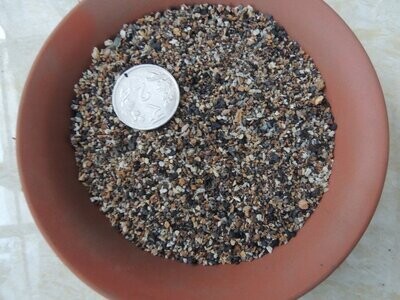
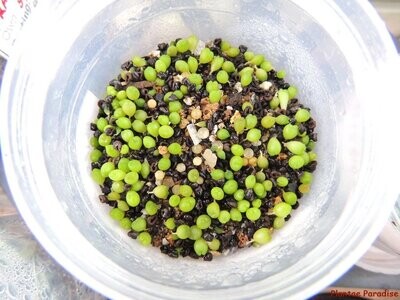
Cactus Seed Planting Mix
Cactus Seed Planting Mix
Sterile, Fine-Grain Media for Cactus & Succulent Seeds
SKU MNS005
₹74.85

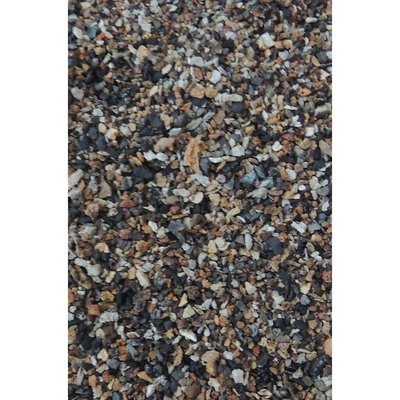
Cactus & Succulent Planting Mix FINE (aka Cactus Soil Mix or Succulent Soil Mix)
Cactus & Succulent Planting Mix FINE (aka Cactus Soil Mix or Succulent Soil Mix)
Fine-Grain Potting Mix for Cactus & Succulent Roots
SKU MNS001
₹39.85

