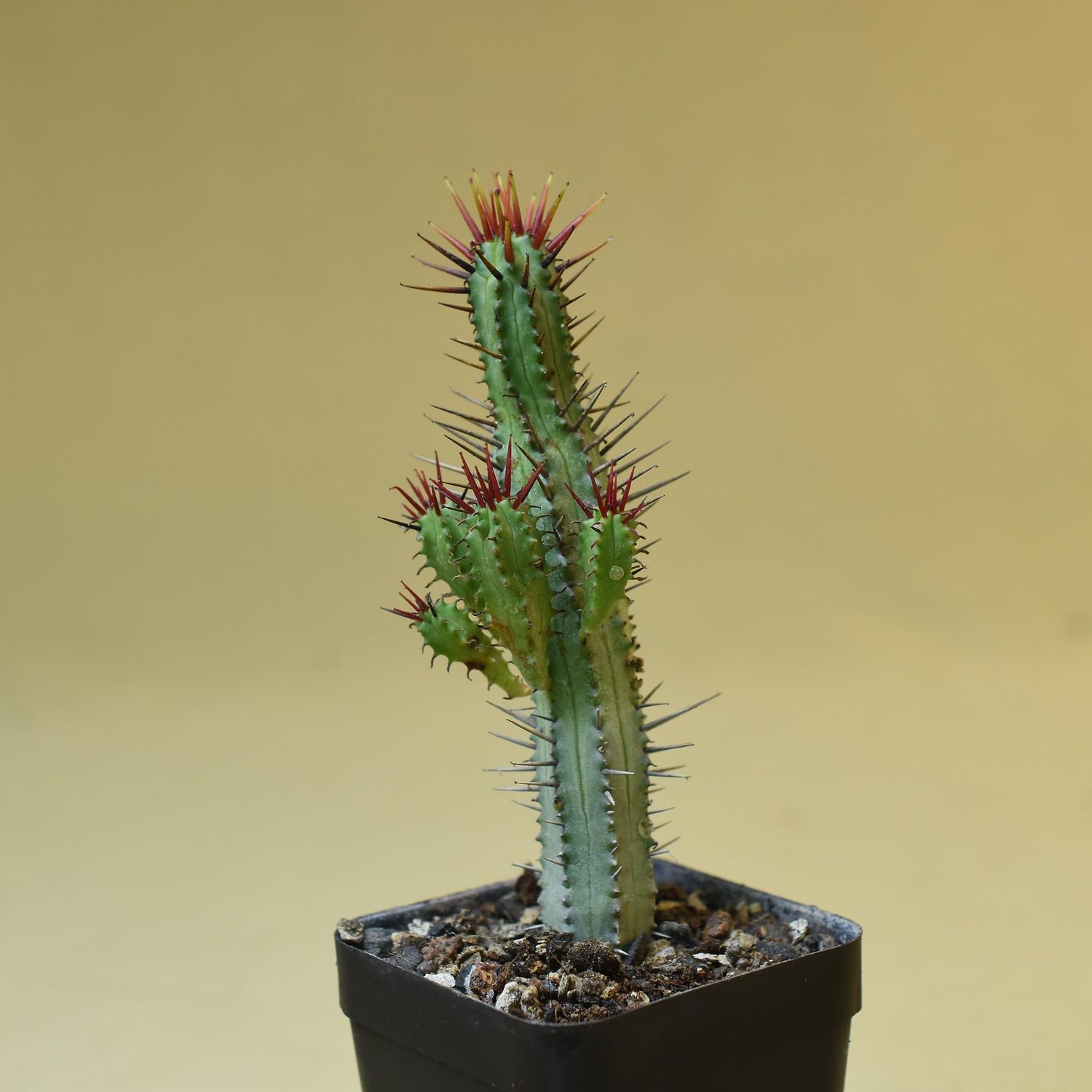
Euphorbia enopla (Short Red Spines)
Product Details
Crimson Thorn Star: Euphorbia enopla
A striking architectural succulent defined by its vibrant, ruby-red faux spines and sculptural clumping habit.
- Origin & History of Name: The genus name Euphorbia honors Euphorbus, the Greek physician to King Juba II of Numidia, who reportedly used the plant's milky sap for medicinal purposes.
- Morphology: This succulent features multi-branched, ribbed stems with a rich green epidermis.
- Habitat & Origin: This is a wild species native to the Eastern Cape Province of South Africa. It thrives in rocky outcrops and scrublands. Our specimens are ethically sourced through greenhouse propagation, ensuring no wild populations are disturbed for commercial trade.
- Cultivation Profile:
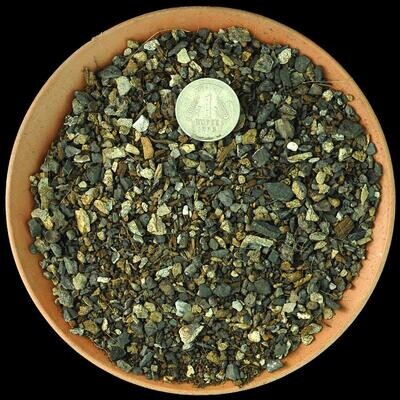
- Substrate: Requires a coarse, mineral-based mix (60% gravel or scoria, 40% sandy loam). Excellent drainage is mandatory to survive the Indian monsoon.
- Light: Thrives in full sun to bright partial shade. In the Indian subcontinent, morning sun is best; provide afternoon shade during peak summer to maintain the vivid red color of the peduncles.
- Water/Dormancy: Water thoroughly when the soil is dry during the growing season (March–October). In winter, enter a period of dry dormancy; water sparingly once a month to prevent stem shriveling.
- Scientific/Historical Anecdote: Euphorbia enopla is a classic example of convergent evolution.
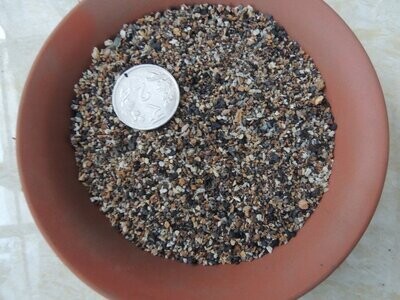
Cactus & Succulent Planting Mix COARSE (aka Cactus Soil Mix or Succulent Soil Mix)
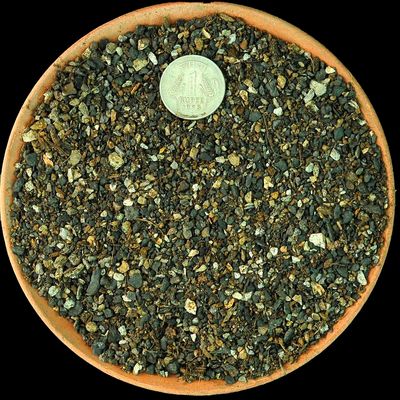
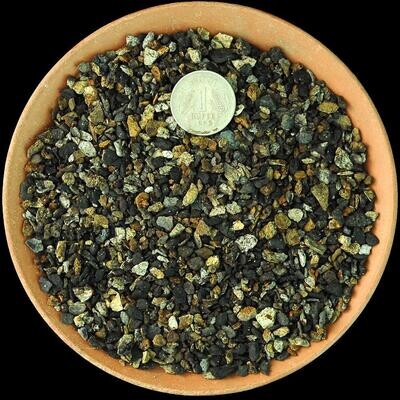
Cactus & Succulent Planting Mix COARSE (aka Cactus Soil Mix or Succulent Soil Mix)
Washed, Free-Draining Mineral Mix for Cactus & Succulents
SKU MNS003
₹40.51
Cactus Seed Planting Mix
Cactus Seed Planting Mix
Sterile, Fine-Grain Media for Cactus & Succulent Seeds
SKU MNS005
₹70.51