

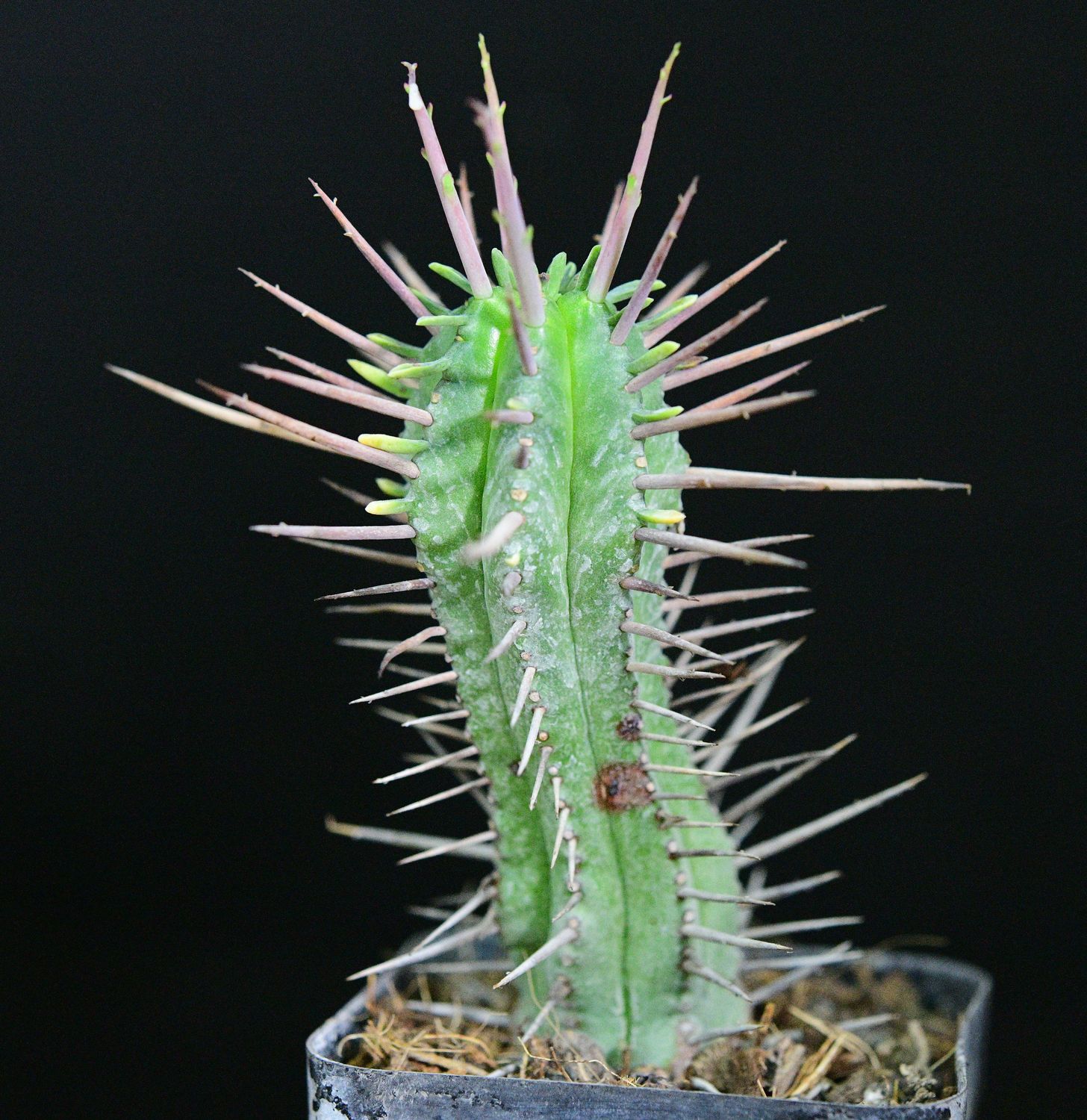
Euphorbia ferox
Product Details
Spiky Sophistication: Euphorbia ferox
A sculptural masterpiece for the connoisseur, prized for its fierce purple spines and architectural symmetry.
- Origin & History of Name: The genus name Euphorbia honors Euphorbus, the Greek physician to King Juba II of Mauritania, who famously used the plant's milky latex for medicinal purposes.
The specific epithet ferox is Latin for "ferocious" or "fierce," a direct reference to the dense, formidable spines that armor the plant’s stems. - Morphology: This succulent features a globose to columnar epidermis that offsets to form dense clusters. Its most striking feature is the "spines," which are actually persistent peduncles (dried flower stalks) that have hardened into colorful thorns.
The plant grows in ribbed costae (vertical ridges), creating a geometric pattern that serves as a natural defense mechanism against herbivores. - Habitat & Origin: Euphorbia ferox is a wild species native to the Great Karoo region of South Africa.
It thrives in rocky, arid landscapes where it is accustomed to intense sun and minimal rainfall. Our specimens are nursery-grown via sustainable propagation practices to ensure no pressure is placed on wild populations. - Cultivation Profile:
- Substrate: Use a strictly mineral-based mix (60% grit like fine gravel or pumice, 40% organic matter). Avoid standard potting soil which retains too much moisture in the humid Indian climate.
- Light: Requires bright, direct sunlight for at least 6 hours. In extreme Indian summers (above 40°C), provide slight afternoon shade to prevent epidermal scorching.
- Water/Dormancy: Water deeply only when the medium is bone-dry. During the monsoon and winter dormancy, reduce watering to once a month or less to prevent root rot.
- Scientific/Historical Anecdote: While it looks remarkably like a cactus, this is an example of convergent evolution. Despite being unrelated to Cactaceae, Euphorbia ferox evolved a similar succulent form and protective spines to survive in nearly identical desert environments—a biological "twin" from a completely different family tree.
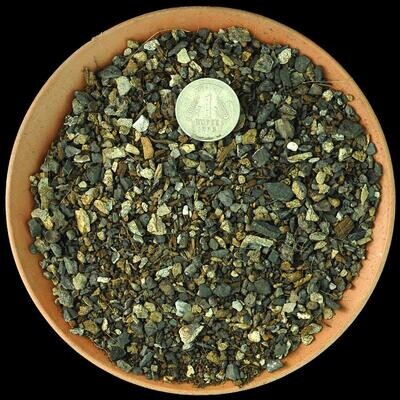
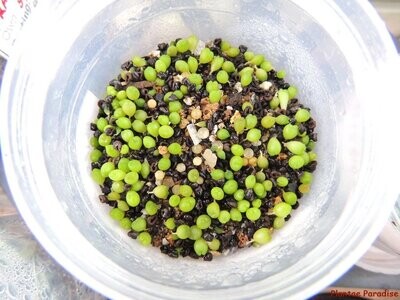
Cactus Seed Planting Mix
Cactus Seed Planting Mix
Sterile, Fine-Grain Media for Cactus & Succulent Seeds
SKU MNS005
₹74.85
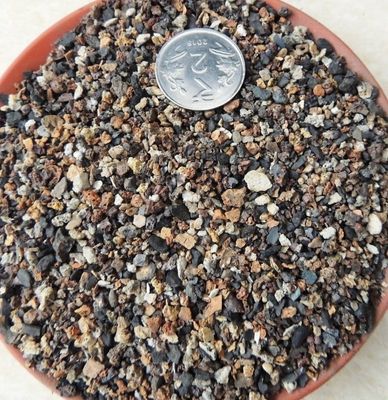
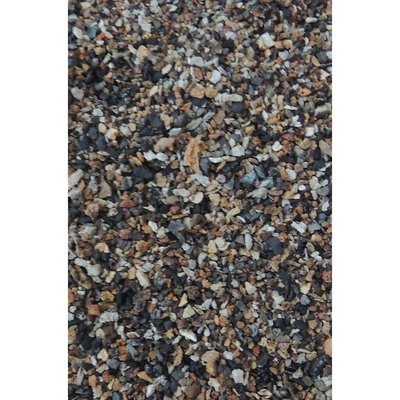
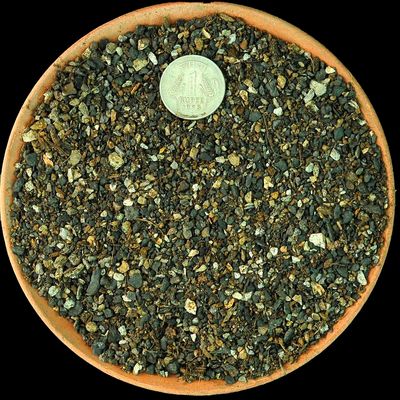
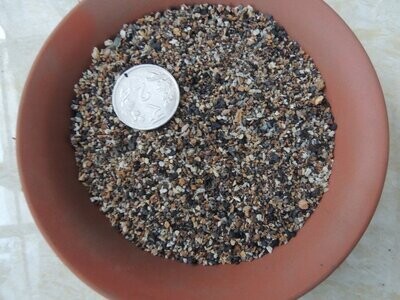
Cactus & Succulent Planting Mix FINE (aka Cactus Soil Mix or Succulent Soil Mix)
Cactus & Succulent Planting Mix FINE (aka Cactus Soil Mix or Succulent Soil Mix)
Fine-Grain Potting Mix for Cactus & Succulent Roots
SKU MNS001
₹39.85