

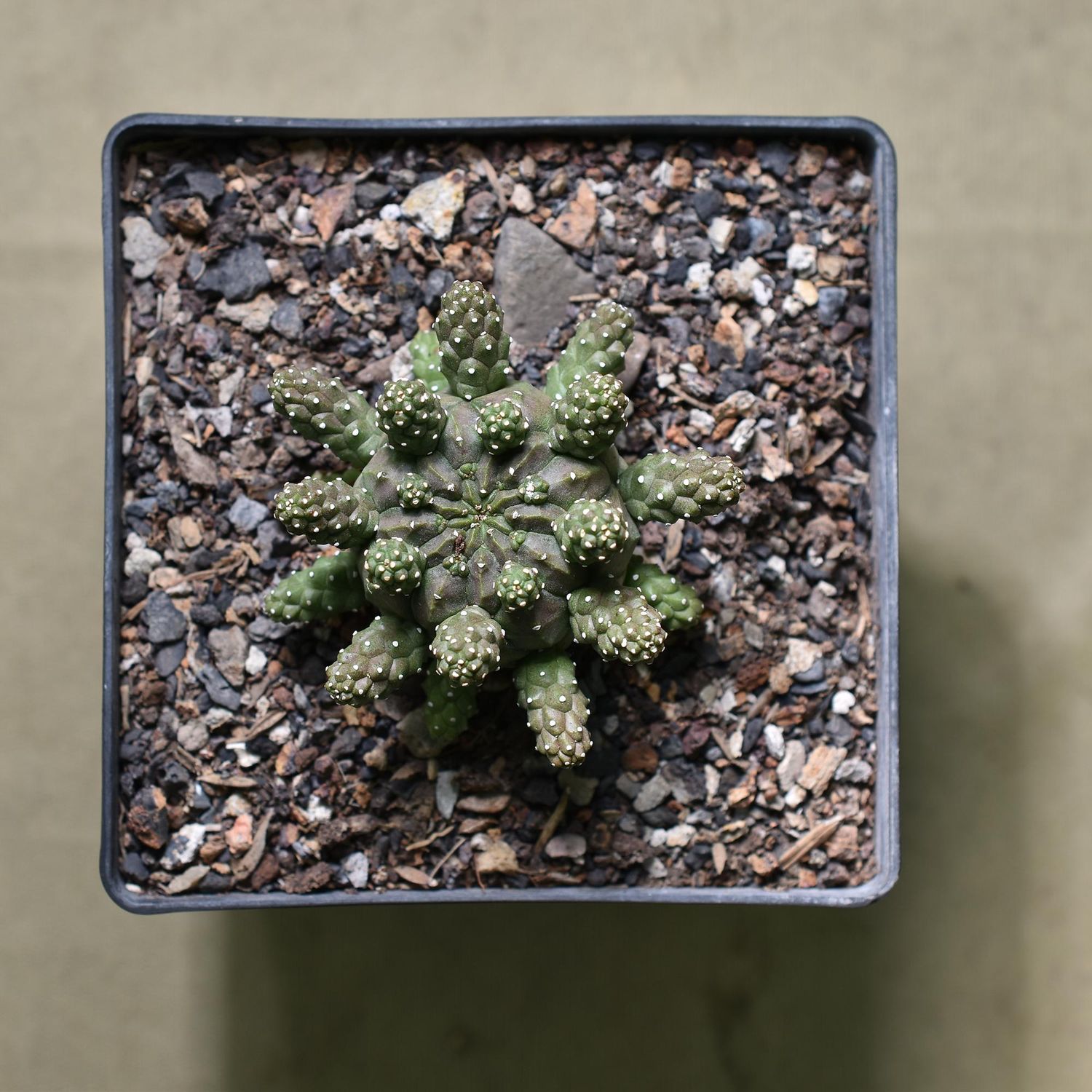
Euphorbia gamkensis
Product Details
Rare Caudiciform Collector's Gem: Euphorbia gamkensis
A sculptural masterpiece from the Great Karoo, this rare dwarf succulent is a must-have for the connoisseur of unique geometric flora.
- Origin & History of Name: The genus name Euphorbia honors Euphorbus, the Greek physician to King Juba II of Numidia, who reportedly used the plant's milky sap for medicinal purposes. The specific epithet gamkensis refers to the Gamka River in South Africa, the primary locality where this species was first identified and described by botanist Peter Vincent Bruyns in 1999.
- Morphology: This species is a geophytic succulent featuring a central, subterranean caudex (storage organ) from which numerous short, cylindrical tubercles (branch-like structures) radiate.
- Habitat & Origin: Euphorbia gamkensis is a wild species endemic to the Western Cape Province of South Africa. It grows in extremely arid, rocky terrain. All specimens offered are nursery-grown from seed to ensure the protection of wild populations and adhere to CITES sustainability protocols.
- Cultivation Profile:
- Substrate: Use a strictly mineral-based mix consisting of 70% gritty material (crushed leca, pumice, or fine gravel) and 30% organic matter. In the Indian climate, ensure the pot is porous (terracotta is preferred).
- Light: Requires bright, indirect sunlight. In India, provide 40-50% shade during the intense summer months (April–June) to prevent epidermal scorching.
- Water/Dormancy: Water sparingly during the growing season when the substrate is completely dry. In the monsoon, protect from rain to avoid root rot. During winter dormancy, withhold water almost entirely.
- Scientific/Historical Anecdote: For decades, this plant remained "hidden" in plain sight, often misidentified as Euphorbia nelsonii or Euphorbia gatbergensis due to its similar radial growth. It wasn't until DNA analysis and detailed floral dissections in the late 1990s that it was recognized as a distinct species, proving that even well-traveled botanical regions still hold secrets.
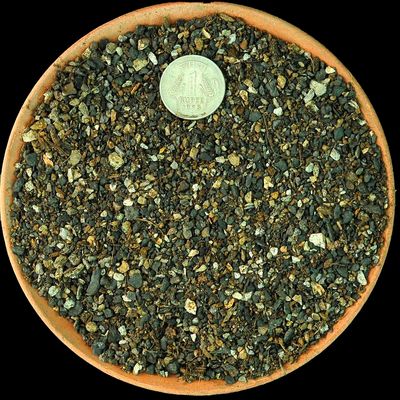
Cactus Seed Planting Mix
Cactus Seed Planting Mix
Sterile, Fine-Grain Media for Cactus & Succulent Seeds
SKU MNS005
₹70.51

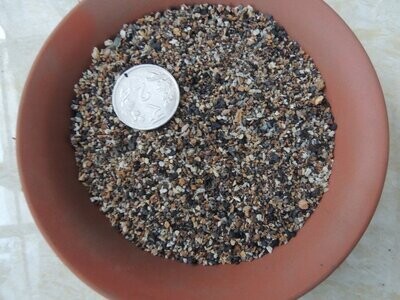
Cactus & Succulent Planting Mix FINE (aka Cactus Soil Mix or Succulent Soil Mix)
Cactus & Succulent Planting Mix FINE (aka Cactus Soil Mix or Succulent Soil Mix)
Fine-Grain Potting Mix for Cactus & Succulent Roots
SKU MNS001
₹35.51
