

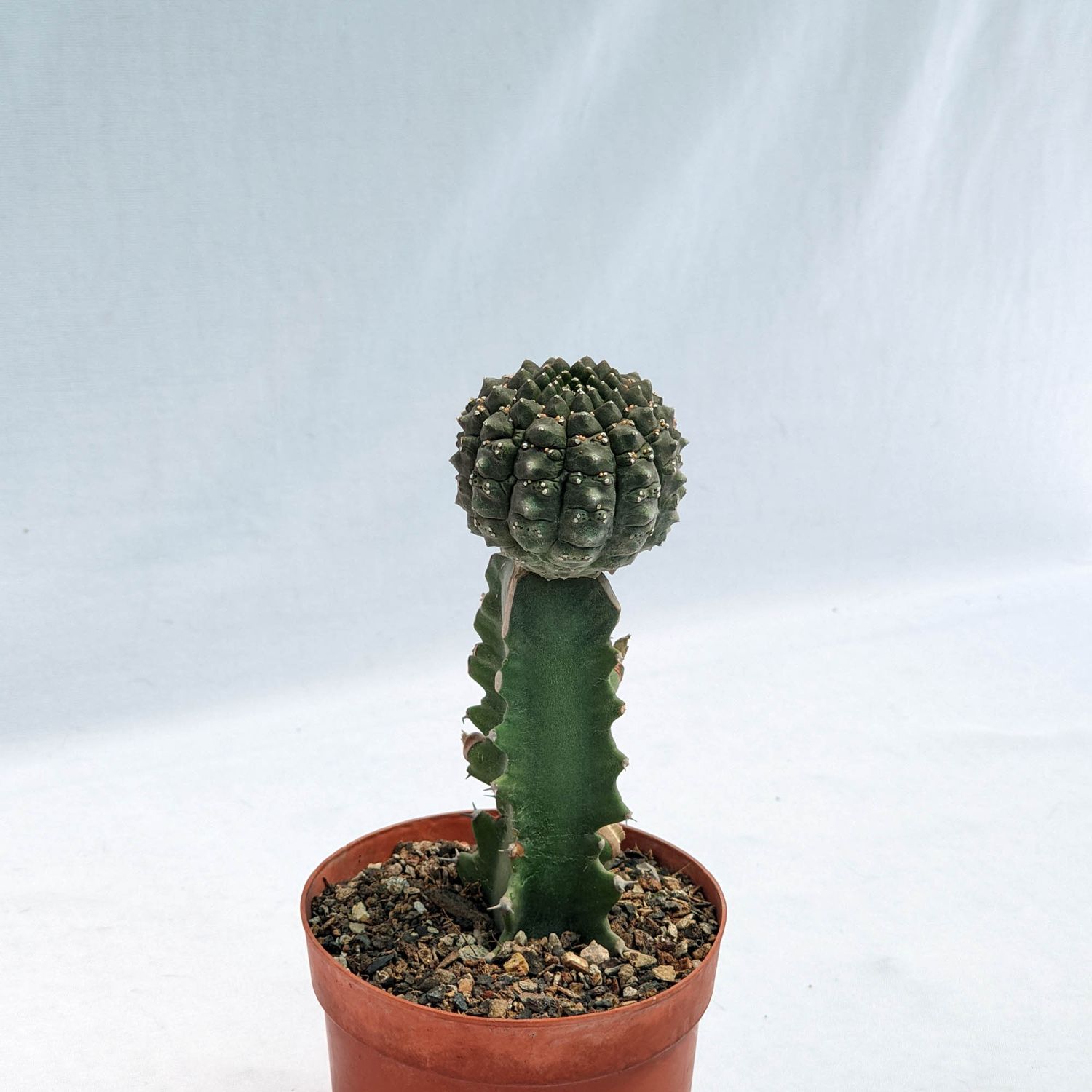
Euphorbia gymnocalycioides Grafted
Product Details
The Living Sculpture: Euphorbia gymnocalycioides
A masterpiece of botanical mimicry, this rare succulent is the ultimate prize for collectors seeking geometric perfection.
- Origin & History of Name: The genus name Euphorbia honors Euphorbus, the Greek physician to King Juba II of Numidia. The specific epithet gymnocalycioides is a botanical descriptor meaning "resembling a Gymnocalycium." It was formally described in 1984 by botanists Susan Carter and Michael Gilbert, highlighting the remarkable convergent evolution where this spurge evolved to visually imitate a South American cactus.
- Morphology: This species is characterized by a globose, non-branching body with a deeply textured epidermis that ranges from olive green to greyish-brown. It features distinct costae (vertical ribs) divided into prominent tubercles, which creates its cactus-like appearance. Unlike many of its relatives, it lacks long spines, instead producing tiny, inconspicuous cyathia (specialized floral structures) at the apex.
- Habitat & Origin: Euphorbia gymnocalycioides is a wild species endemic to a very localized area in the Sidamo Province of southern Ethiopia. It grows in limestone-rich, rocky terrains. Due to its restricted range and slow growth, it is highly protected; commercial specimens are strictly produced via sustainable nursery-grown seeds or grafting to preserve wild populations.
- Cultivation Profile:
- Substrate: Use a strictly mineral-based mix consisting of 70% inorganic material like pumice, perlite, or fine gravel and 30% organic matter to ensure rapid drainage.
- Light: In the Indian subcontinent, provide bright, indirect light. Avoid direct midday summer sun in regions like Rajasthan or Maharashtra to prevent scorching of the epidermis.
- Water/Dormancy: Water sparingly during the growing season (March–September) only when the medium is bone dry. Maintain strict dryness during the monsoon and winter months to prevent root rot in high-humidity zones.
- Scientific/Historical Anecdote: For years after its discovery, Euphorbia gymnocalycioides was considered a "holy grail" of succulent collecting due to its extreme scarcity in cultivation. It is a prime example of convergent evolution, where two unrelated plant families (Euphorbiaceae in Africa and Cactaceae in the Americas) evolved nearly identical forms to survive in similar arid niches.
New


Monsoon Guardian Kit (5 in 1)
Monsoon Guardian Kit (5 in 1)
Complete 5-in-1 biological protection kit for cacti & succulents
SKU MNS024
₹850.00



Cactus & Succulent Planting Mix FINE (aka Cactus Soil Mix or Succulent Soil Mix)
Cactus & Succulent Planting Mix FINE (aka Cactus Soil Mix or Succulent Soil Mix)
Fine-Grain Potting Mix for Cactus & Succulent Roots
SKU MNS001
₹39.85
