

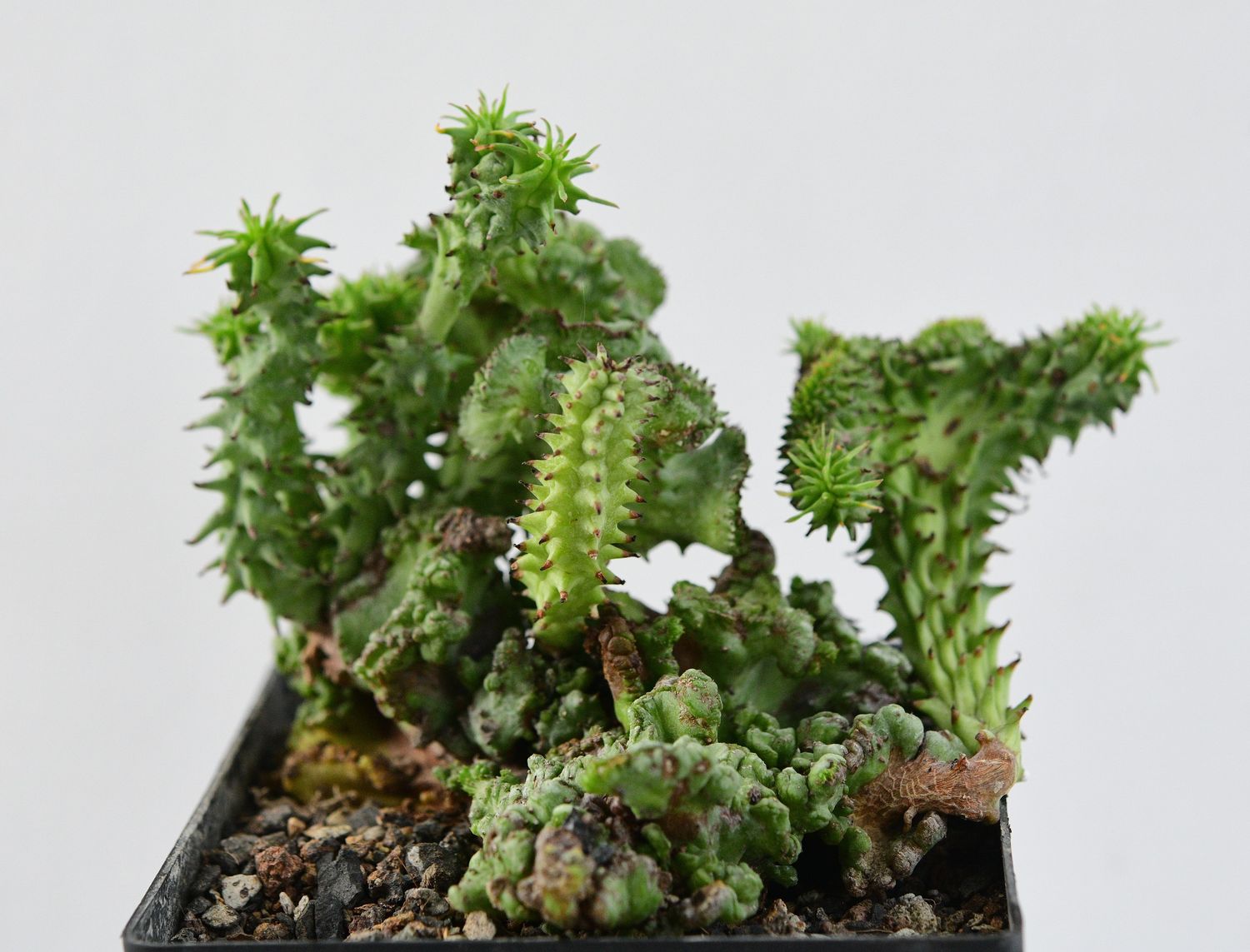
Euphorbia horrida f inermis f crest
Product Details
Sculptural Geometry: Euphorbia horrida f. inermis f. crest
A rare, spineless mutation of the African Polyacantha, prized by collectors for its undulating, brain-like growth habit and architectural presence.
- Origin & History of Name: The genus Euphorbia was named by King Juba II of Numidia (c. 50 BCE) after his Greek physician, Euphorbus, who used the caustic latex for medicinal purposes. The specific epithet horrida stems from the Latin for "bristly" or "rough," referring to the species' typical spines.
However, this specific form is labeled inermis (Latin for "unarmed") because it lacks spines, and f. crest (fasciation) denotes the genetic mutation where the growing point stretches into a fan-like ridge rather than a cylinder. - Morphology: This plant exhibits fasciation, a condition where the apical meristem (growth tip) becomes elongated, resulting in a convoluted, wavy structure. Unlike the standard columnar species, this form features a smooth, glaucous-green epidermis with a waxy coating to prevent desiccation. The costae (ribs) are compressed into tight, sculptural folds, creating a dense, "crested" silhouette that is entirely unique to each individual specimen.
- Habitat & Origin: This is a cultivated mutation (cultivar). While the parent species, Euphorbia horrida, is native to the Eastern Cape province of South Africa, the inermis crested form is a product of selective greenhouse propagation. As a succulent produced through vegetative grafting or cuttings rather than wild poaching, it is a highly sustainable choice for modern collectors.
- Cultivation Profile:
- Substrate: Use a strictly mineral-based mix. In the Indian climate, a ratio of 70% inorganic grit (crushed brick, pumice, or perlite) to 30% organic matter is vital to prevent root rot during high humidity.
- Light: Requires bright, indirect sunlight. In South Asia, provide 40–50% green shade netting during peak summer (April–June) to avoid scorching the epidermis, while allowing direct morning sun.
- Water/Dormancy: Follow a "soak and dry" method. Withhold water almost entirely during the winter dormancy (December–February) and the peak of the monsoon season to account for ambient atmospheric moisture.
- Scientific/Historical Anecdote: Euphorbia horrida is a classic example of convergent evolution.
Despite its striking resemblance to the North American Astrophytum (Cactaceae), it is entirely unrelated. It evolved its ribbed, succulent water-storage system in the African deserts completely independently of the cactus family—a phenomenon scientists call "homoplasy," where different lineages evolve similar traits to survive similar environments.
New

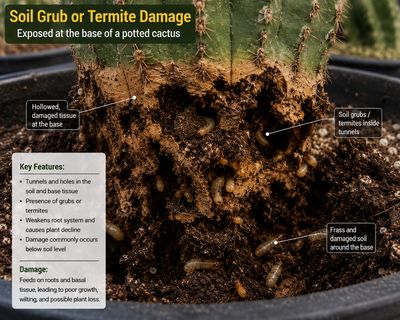
Monsoon Guardian Kit (5 in 1)
Monsoon Guardian Kit (5 in 1)
Complete 5-in-1 biological protection kit for cacti & succulents
SKU MNS024
₹850.00

Cactus & Succulent Planting Mix COARSE (aka Cactus Soil Mix or Succulent Soil Mix)
Cactus & Succulent Planting Mix COARSE (aka Cactus Soil Mix or Succulent Soil Mix)
Washed, Free-Draining Mineral Mix for Cactus & Succulents
SKU MNS003
₹44.85

