

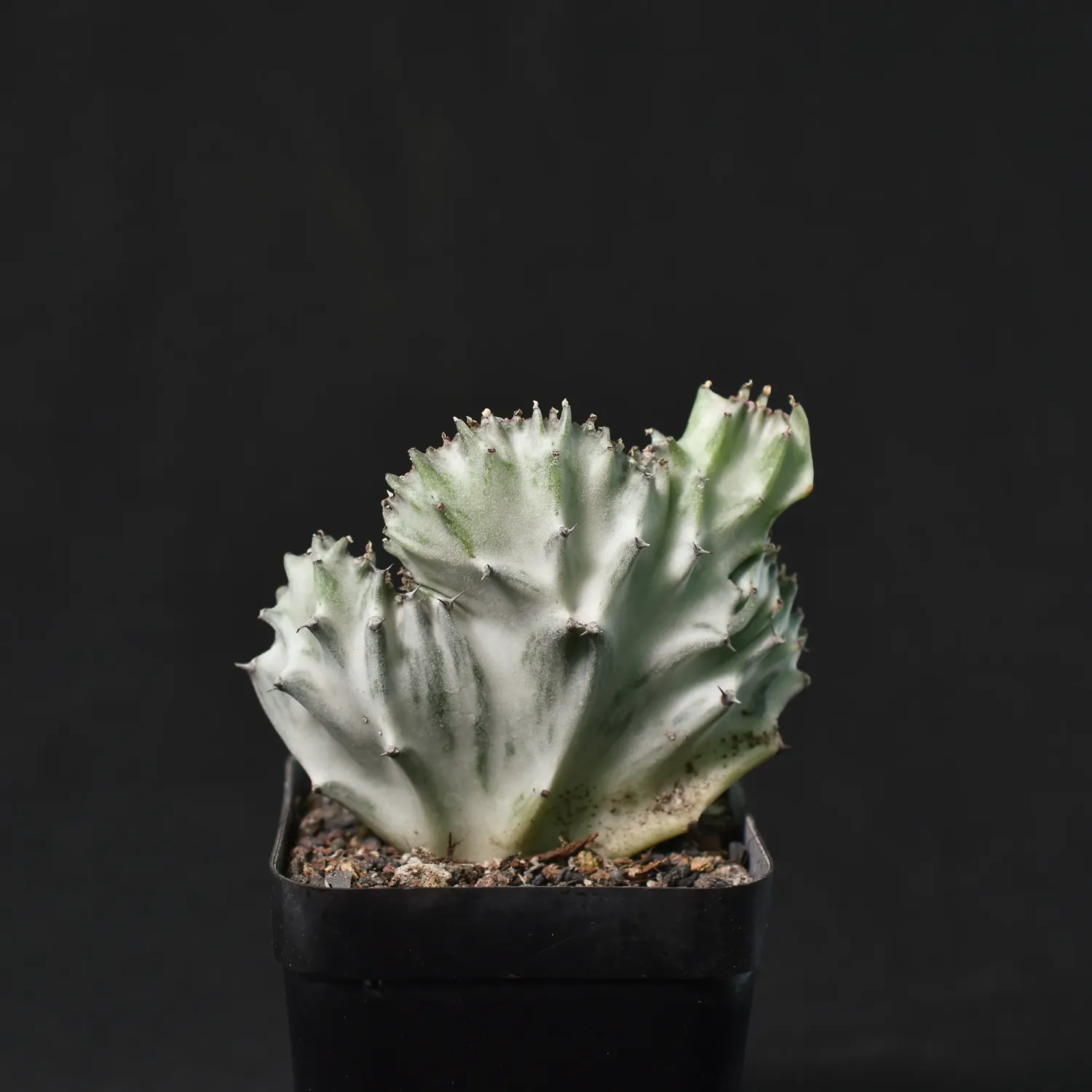
Euphorbia lactea crest Grafted
Product Details
Sculptural Splendor: Euphorbia lactea f. cristata
A living piece of architectural art, this rare crested succulent transforms any space with its unique, coral-like silhouette.
- Origin & History of Name: The genus Euphorbia was named by King Juba II of Numidia in honor of his Greek physician, Euphorbus, around 12 BCE.
- Morphology: This plant displays a fan-shaped growth habit known as fasciation. Unlike the standard upright species, the epidermis (outer skin) of the crest ripples into intricate folds. It often features silver-grey variegation along the costae (ribs), and the edges are lined with short, sharp spines.
- Habitat & Origin: The crested form is a cultivar and rarely occurs in the wild.
- Cultivation Profile:
- Substrate: Use a strictly mineral-based mix (coarse sand, perlite, and crushed brick or pumice) with minimal organic matter to prevent root rot in humid Indian climates.
- Light: Thrives in bright, indirect sunlight.
- Water/Dormancy: Water deeply only when the substrate is bone-dry.
- Scientific/Historical Anecdote: While this plant looks like a cactus, it is actually more closely related to Poinsettias. Its "milky" sap contains diterpene esters, which the plant evolved as a sophisticated chemical defense system against herbivores.
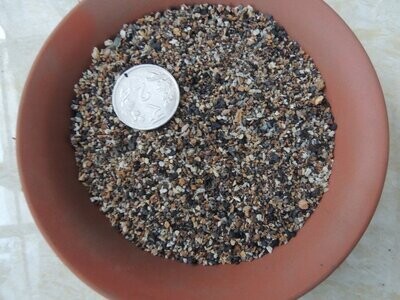
Cactus Seed Planting Mix
Cactus Seed Planting Mix
Sterile, Fine-Grain Media for Cactus & Succulent Seeds
SKU MNS005
₹70.51

Cactus & Succulent Planting Mix COARSE (aka Cactus Soil Mix or Succulent Soil Mix)
Cactus & Succulent Planting Mix COARSE (aka Cactus Soil Mix or Succulent Soil Mix)
Washed, Free-Draining Mineral Mix for Cactus & Succulents
SKU MNS003
₹40.51

