

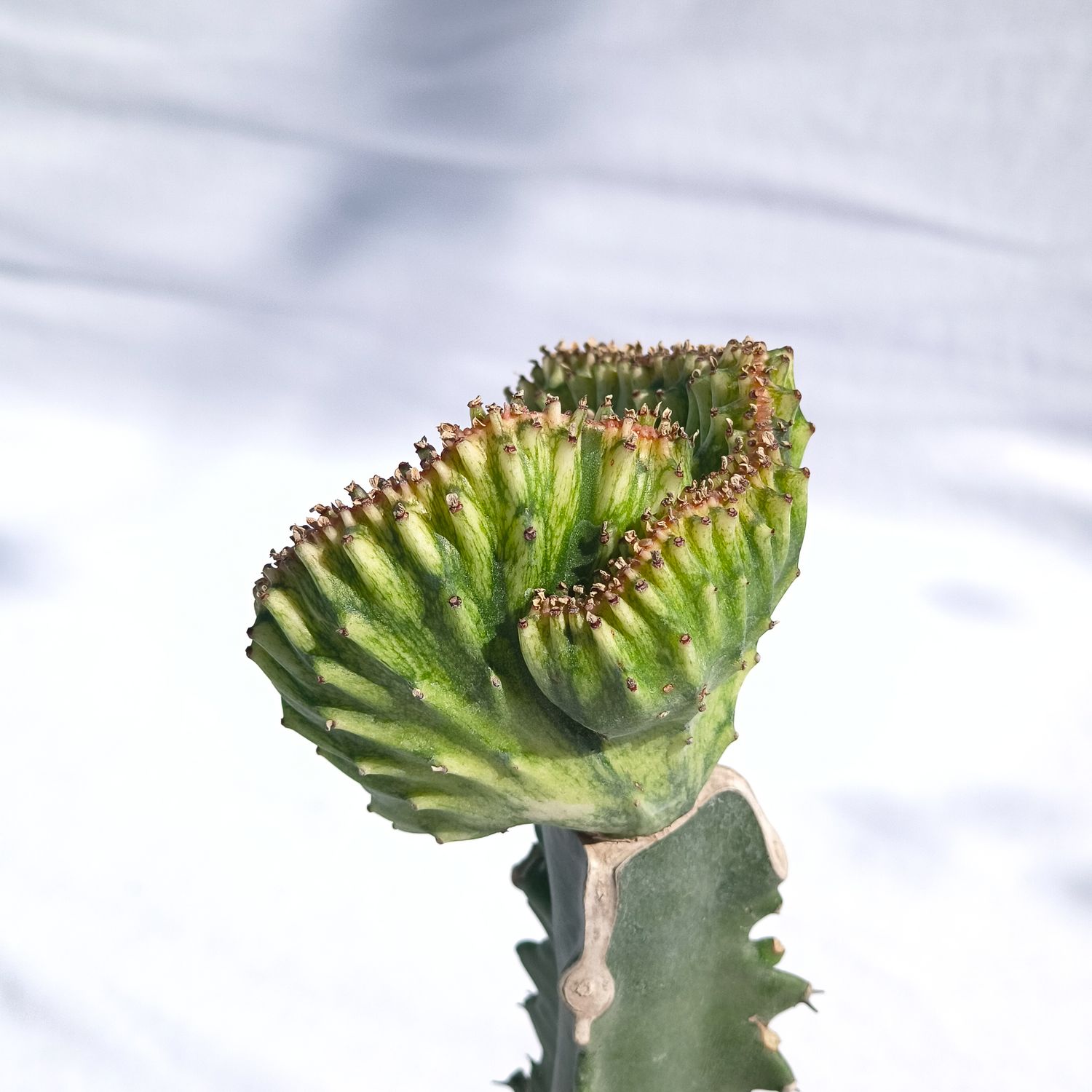
Euphorbia mayurnathanii var. crest
Product Details
The Sculptural Rarity: Euphorbia mayurnathanii var. crest
A botanical masterpiece for the serious collector, this crested marvel transforms a rare Indian endemic into a living piece of abstract art.
- Origin & History of Name: The species is named in honor of P.V. Mayurnathan, a prominent Indian botanist and former curator at the Madras Museum who authored "The Wild Flowers of the Madras Presidency."
- Morphology: This specimen exhibits fasciation, resulting in a convoluted, wavy "brain-like" structure. The epidermis is a rich waxy green, often developing a woody "corking" texture at the base as it matures. Unlike the standard upright columns, the crested form suppresses traditional costae (ribs), instead folding into dense, fleshy ridges protected by small, twin spines.
- Habitat & Origin: The base species, Euphorbia mayurnathanii, is a narrow endemic originally found in the Palakkad Gap of Kerala, India. It is famously considered "Extinct in the Wild" (EW) by many botanical surveys, with the entire global population now existing solely in cultivation.
- Cultivation Profile:
- Substrate: Use a strictly mineral-based mix (70% grit/pumice/leca, 30% organic matter). Avoid standard garden soil which retains too much humidity in the Indian climate.
- Light: Thrives in bright, indirect sunlight.
- Water/Dormancy: Water deeply only when the medium is completely bone-dry. During the monsoon, restrict water entirely if humidity is high to prevent fungal rot. The plant enters a semi-dormant state in the peak of winter.
- Scientific/Historical Anecdote: Euphorbia mayurnathanii is often cited as a "Lazarus species" in botanical circles. For decades, it was known to science only through three original specimens collected from a single ledge in Kerala. Because it disappeared from its original habitat shortly after discovery, every plant in existence today—including this crested mutation—is a descendant of those few original plants saved by botanists.
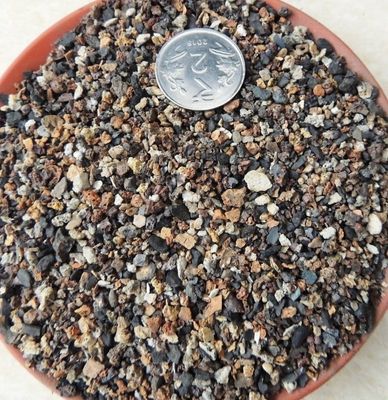
Cactus & Succulent Planting Mix FINE (aka Cactus Soil Mix or Succulent Soil Mix)
Cactus & Succulent Planting Mix FINE (aka Cactus Soil Mix or Succulent Soil Mix)
Fine-Grain Potting Mix for Cactus & Succulent Roots
SKU MNS001
₹35.51
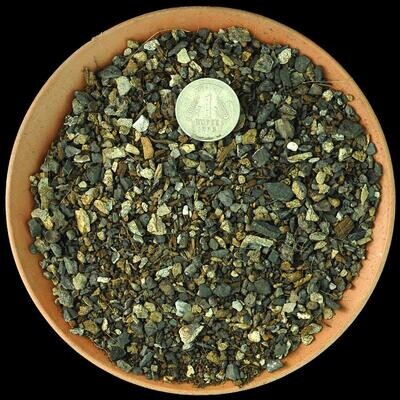
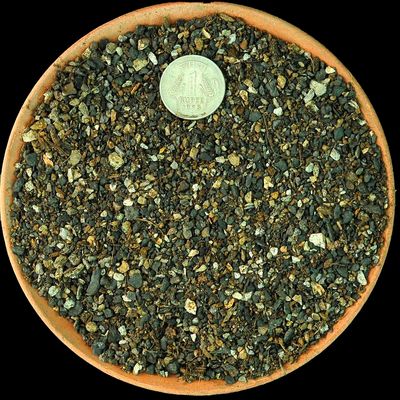
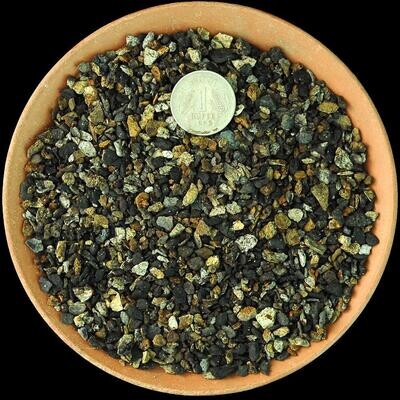
Cactus & Succulent Planting Mix COARSE (aka Cactus Soil Mix or Succulent Soil Mix)
Cactus & Succulent Planting Mix COARSE (aka Cactus Soil Mix or Succulent Soil Mix)
Washed, Free-Draining Mineral Mix for Cactus & Succulents
SKU MNS003
₹40.51