

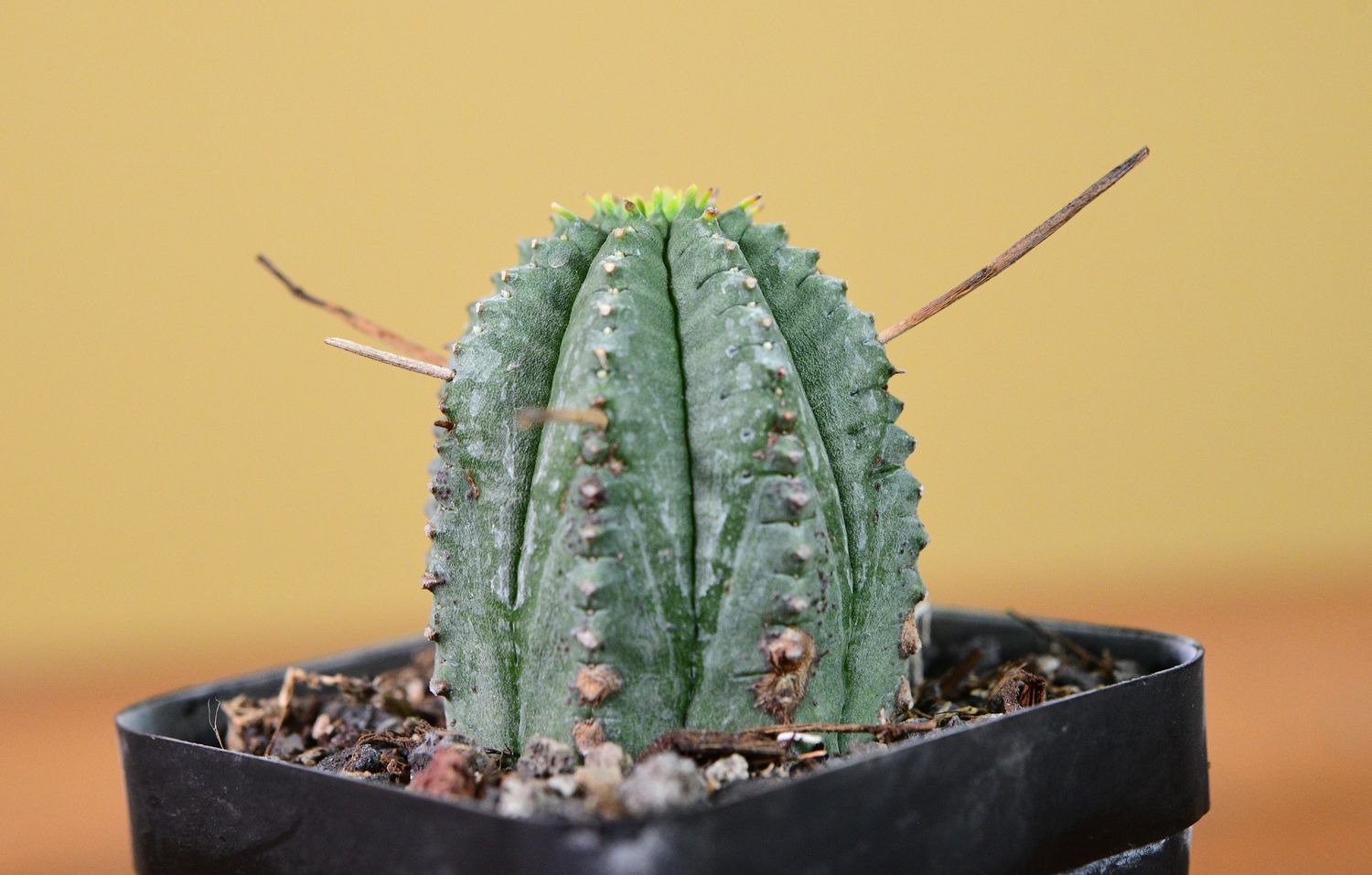
Euphorbia meloformis
Product Details
Geometric Perfection: Euphorbia meloformis
A living marvel of radial symmetry, this globose succulent offers a minimalist aesthetic for the advanced collector.
- Origin & History of Name: The genus Euphorbia was named by King Juba II of Numidia after his Greek physician, Euphorbus, in the 1st century BCE. The specific epithet meloformis is derived from the Latin melo (melon) and formis (shape), directly referencing its distinct, rounded appearance.
It was first described by the botanist William Aiton in 1789, following early European exploration of Southern Africa. - Morphology: This species is a dioecious (male or female) succulent characterized by a spherical, depressed stem. Its epidermis features a subtle banded pattern of light and dark green, or occasionally purple hues.
The plant possesses 8 to 12 prominent costae (ribs) marked by small, blunt tubercles. A defining feature is the persistence of dried, branched peduncles (flower stalks) which remain on the plant, creating a protective, "nest-like" crown over the apex. - Habitat & Origin: Euphorbia meloformis is a wild species endemic to the Eastern Cape Province of South Africa. It thrives in rocky, arid karroid scrubland. All specimens provided are nursery-grown from seed to ensure botanical sustainability and to prevent the poaching of wild populations, which are increasingly threatened in their native habitat.
- Cultivation Profile:
- Substrate: Requires an open mineral-based mix (coarse sand, grit, and perlite). Avoid peat-heavy mixes which retain excessive moisture during the Indian monsoon.
- Light: Thrives in bright, indirect light or filtered sunlight.
In the Indian subcontinent, protection from the harsh midday sun in April and May is critical to prevent epidermal scorching. - Water/Dormancy: Strictly follow the "dry-out" method. Reduce water significantly during the winter months and high-humidity monsoon periods. Ensure excellent ventilation to prevent fungal pathogens common in tropical climates.
- Scientific/Historical Anecdote: Euphorbia meloformis is a classic example of convergent evolution.
Despite its striking resemblance to the North American Astrophytum (Cactus family), it is entirely unrelated. It evolved its spherical shape independently as the most efficient way to maximize water storage while minimizing the surface area exposed to the scorching African sun.
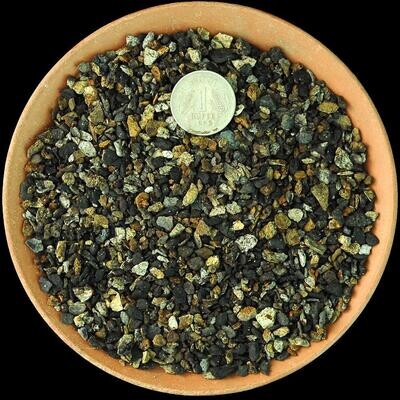
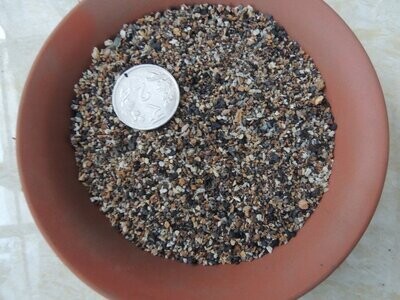
Cactus & Succulent Planting Mix COARSE (aka Cactus Soil Mix or Succulent Soil Mix)
Cactus & Succulent Planting Mix COARSE (aka Cactus Soil Mix or Succulent Soil Mix)
Washed, Free-Draining Mineral Mix for Cactus & Succulents
SKU MNS003
₹44.85
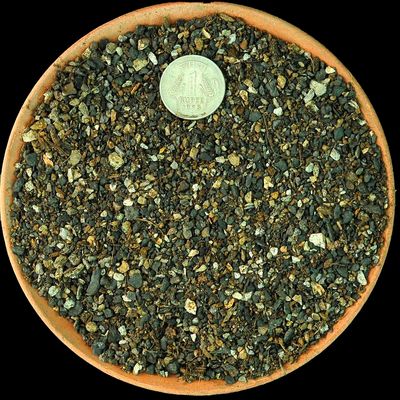
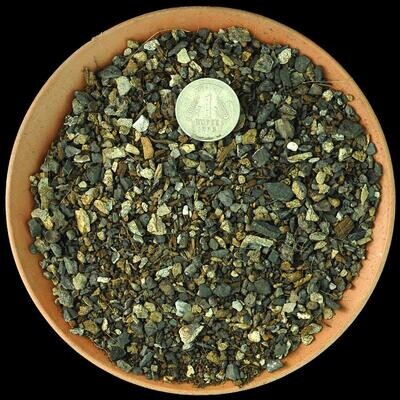
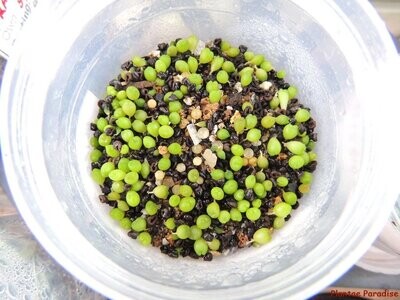
Cactus Seed Planting Mix
Cactus Seed Planting Mix
Sterile, Fine-Grain Media for Cactus & Succulent Seeds
SKU MNS005
₹74.85