

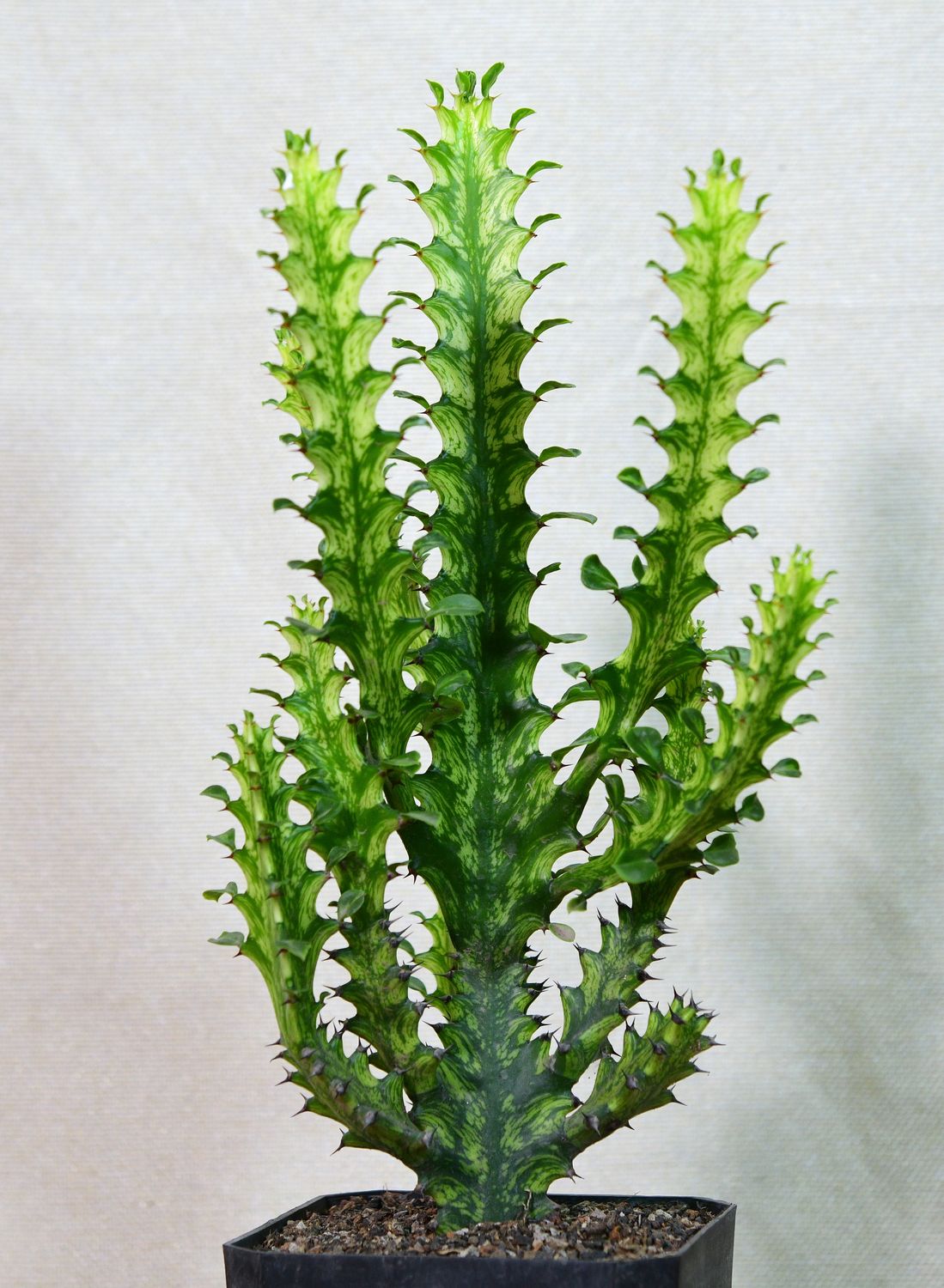
Euphorbia trigona 'Mint Creme'
Product Details
Sculptural Elegance: Euphorbia trigona 'Mint Creme'
This rare, ghost-like cultivar offers a sophisticated architectural silhouette with striking creamy variegation perfect for modern interiors.
- Origin & History of Name: The genus name Euphorbia honors Euphorbus, the Greek physician to King Juba II of Numidia, who reportedly used the plant’s caustic latex for medicinal purposes.
The species name trigona stems from the Latin tri- (three) and gonos (angle), referring to its three-sided stems. The cultivar name 'Mint Creme' describes the specific mutation where chlorophyll is reduced, leaving a pale, minty-white hue. - Morphology: This succulent shrub is defined by its vertical costae (ribs) which feature distinct variegation where the epidermis lacks deep green pigment, resulting in creamy-white marbling. It produces small, teardrop-shaped leaves along the ridges, though its primary aesthetic is the structural, upright stem punctuated by pairs of sharp thorns (stipular spines).
- Habitat & Origin: While the base species Euphorbia trigona is native to West Africa (specifically Gabon to Angola), 'Mint Creme' is a cultivar—a product of selective breeding and stabilization of a variegated mutation. Our specimens are propagated via cuttings from established mother plants, ensuring a sustainable supply that protects wild populations.
- Cultivation Profile:
- Substrate: Use a strictly mineral-based mix (coarse sand, perlite, and volcanic grit) with minimal organic matter to prevent root rot.
- Light: Requires bright, indirect light.
In the Indian subcontinent, avoid direct midday summer sun which can scorch the pale variegation; east or west-facing balconies are ideal. - Water/Dormancy: Water thoroughly only when the medium is bone-dry.
During the monsoon and winter months, the plant enters dormancy; reduce watering to once every 4–6 weeks to match the high humidity/low growth cycle.
- Scientific/Historical Anecdote: Despite its common name "African Milk Tree," it is not a cactus but a member of the spurge family. A fascinating biological trait of the genus is its convergent evolution; Euphorbia species in Africa evolved to look almost identical to American cacti because they faced the same harsh, arid environmental pressures, despite being unrelated.
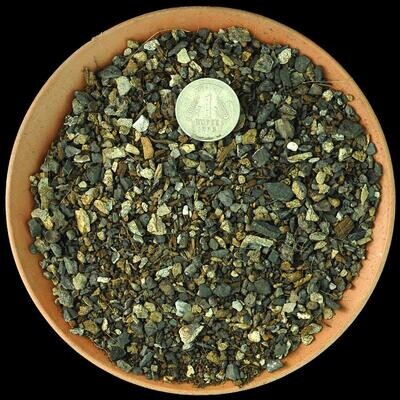
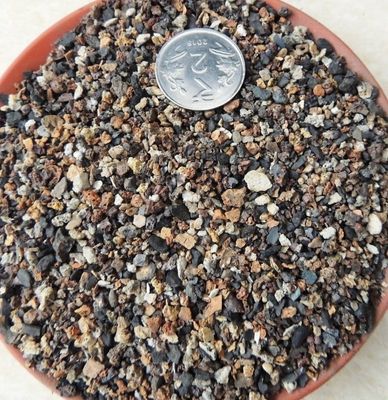

Cactus & Succulent Planting Mix FINE (aka Cactus Soil Mix or Succulent Soil Mix)
Cactus & Succulent Planting Mix FINE (aka Cactus Soil Mix or Succulent Soil Mix)
Fine-Grain Potting Mix for Cactus & Succulent Roots
SKU MNS001
₹39.85

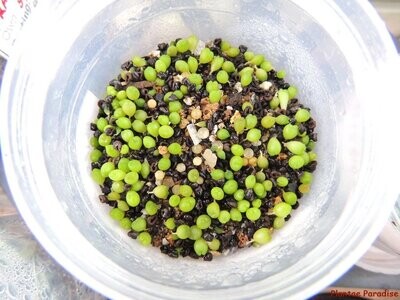
Cactus Seed Planting Mix
Cactus Seed Planting Mix
Sterile, Fine-Grain Media for Cactus & Succulent Seeds
SKU MNS005
₹74.85
New


Monsoon Guardian Kit (5 in 1)
Monsoon Guardian Kit (5 in 1)
Complete 5-in-1 biological protection kit for cacti & succulents
SKU MNS024
₹850.00