

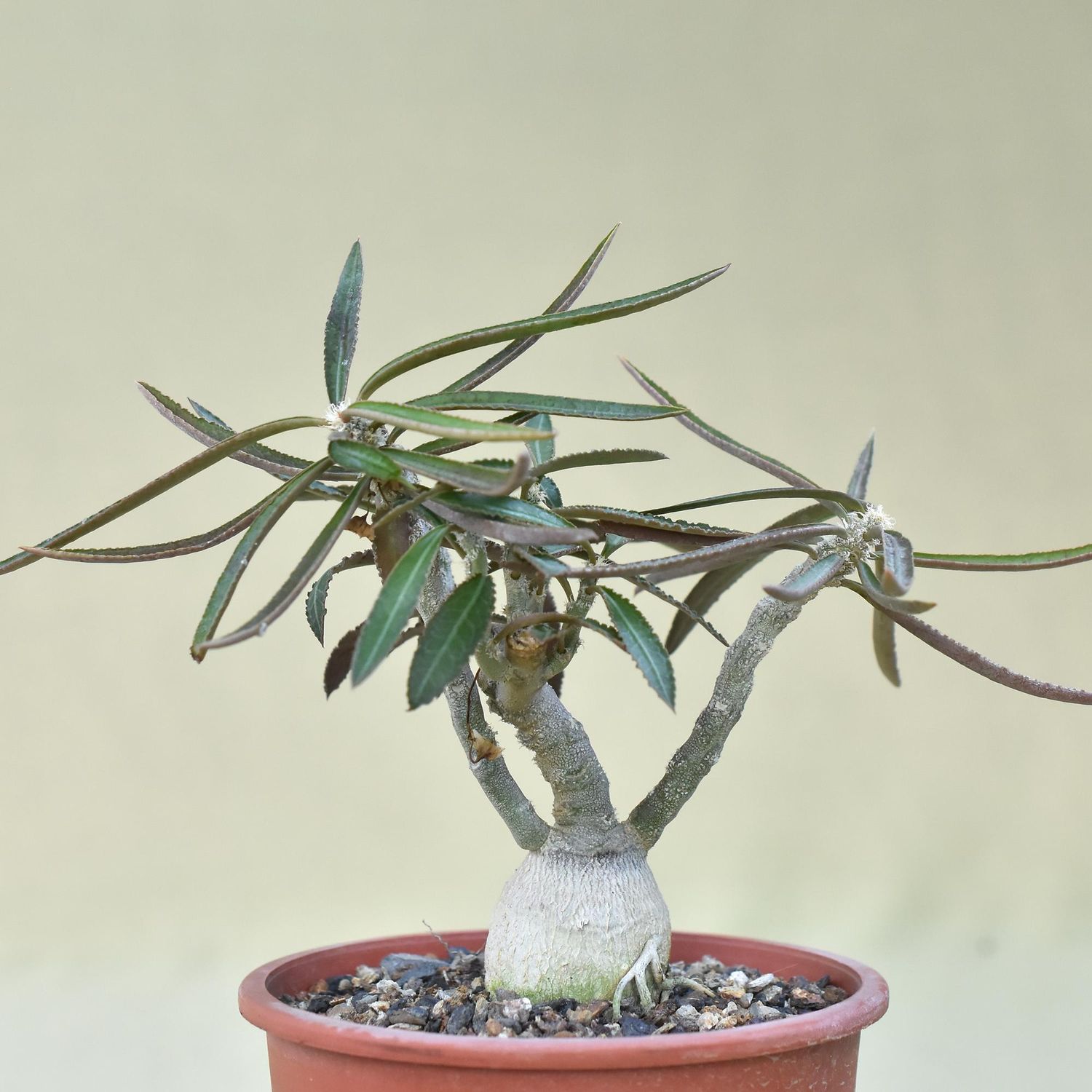
Euphorbia waringiae
Product Details
Architectural Rarety: Euphorbia waringiae
A sculptural masterpiece from the spiny forests, prized by connoisseurs for its intricate geometric form and extreme rarity.
- Origin & History of Name: The genus name Euphorbia honors Euphorbus, the Greek physician to King Juba II of Numidia, who reportedly used the sap for medicinal purposes.
- Morphology: Euphorbia waringiae is a slow-growing, geophytic succulent characterized by a thick, subterranean caudex (water-storage organ). It produces slender, grey-brown branches lined with prominent stipular spines. The epidermis is textured and matte, often displaying subtle silver-grey tones. Unlike many leafy succulents, its photosynthetic activity is primarily concentrated in the stems, a specialized adaptation for moisture retention.
- Habitat & Origin: This is a wild species endemic to the arid, deciduous forests of Southwestern Madagascar. Due to its limited geographical range and habitat loss, it is considered rare in the wild. Our specimens are ethically sourced through nursery-propagated seeds and offsets to ensure conservation-minded trade and the protection of wild populations.
- Cultivation Profile:
- Substrate: Requires a strictly mineral-based mix. Use a ratio of 70% inorganic material (pumice, perlite, or crushed brick) to 30% organic matter to prevent root rot.
- Light: Thrives in bright, indirect sunlight. In the Indian subcontinent, protect from the harsh afternoon sun (12 PM – 4 PM), especially during peak summer, to avoid epidermal scorching.
- Water/Dormancy: Follow a "soak and dry" method. During the monsoon, significantly reduce watering due to high ambient humidity. The plant enters a dormancy phase in winter; keep the substrate nearly dry during this period to mimic its natural Malagasy cycle.
- Scientific/Historical Anecdote: The genus Euphorbia is scientifically famous for its cyathium, a unique "pseudanthium" or false flower.



Cactus & Succulent Planting Mix FINE (aka Cactus Soil Mix or Succulent Soil Mix)
Cactus & Succulent Planting Mix FINE (aka Cactus Soil Mix or Succulent Soil Mix)
Fine-Grain Potting Mix for Cactus & Succulent Roots
SKU MNS001
₹35.51

Cactus Seed Planting Mix
Cactus Seed Planting Mix
Sterile, Fine-Grain Media for Cactus & Succulent Seeds
SKU MNS005
₹70.51