

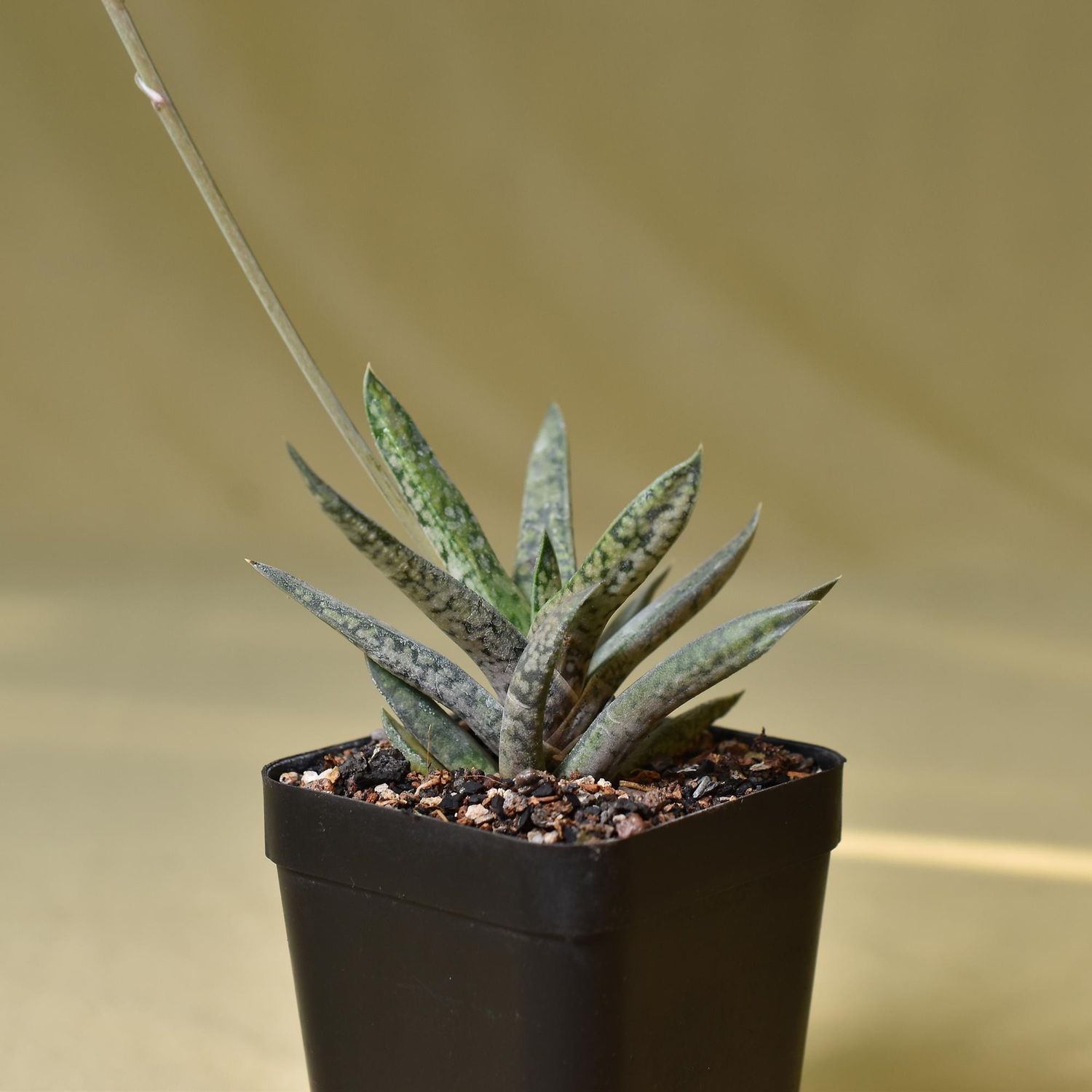
Gasteraloe bicolor var liliputana
Product Details
Tiny Titan: Gasteraloe bicolor var. liliputana
The smallest of its kind, this rare miniature hybrid offers architectural elegance in a pocket-sized form.
- Origin & History of Name The name is a botanical portmanteau of the parent genera Gasteria (derived from the Greek gaster, meaning "stomach," referring to the swollen flower base) and Aloe. The varietal name liliputana is a literary reference to the island of Lilliput from Jonathan Swift’s 1726 novel Gulliver's Travels, chosen by botanists to denote this variety's status as a true dwarf compared to its larger relatives.
- Morphology This succulent is characterized by its compact, stemless rosettes.
The epidermis is a deep, glossy green, densely mottled with white tuberculate spots. Unlike many hybrids that grow erratically, this variety maintains a neat, distichous (two-ranked) arrangement when young, eventually spiraling into a dense cluster. Its leaves are thick and lanceolate, ending in a soft, non-pungent tip. - Habitat & Origin Gasteraloe bicolor var. liliputana is a naturally occurring variety found in the Eastern Cape Province of South Africa.
While many Gasteraloe are man-made garden hybrids, this specific variety is a stable wild population. Our specimens are nursery-propagated via offsets to ensure the protection of wild populations and promote sustainable trade within the succulent community. - Cultivation Profile
- Substrate: Use a strictly mineral-based mix. A ratio of 70% inorganic material (pumice, crushed gravel, or perlite) to 30% organic matter (cocopeat) is ideal to prevent root rot in humid Indian climates.
- Light: Prefers bright, indirect light or filtered morning sun. In the Indian subcontinent, protect from harsh afternoon summer sun, which can bleach the foliage; a north or east-facing balcony is perfect.
- Water/Dormancy: Follow a "soak and dry" method. Water thoroughly, then allow the medium to dry completely. During the monsoon, reduce watering significantly. The plant enters a semi-dormant state during the peak heat of May and June; withhold fertilizers during this period.
5. Scientific/Historical Anecdote The parent genus Gasteria is often called "Ox Tongue" due to the rough texture of the leaves, but this specific variety was once classified separately as Gasteria liliputana. It was only later categorized under G. bicolor when taxonomists realized that its miniature stature was an environmental and genetic adaptation to the rocky crevices of its native habitat, where staying small provided a survival advantage against grazing animals.


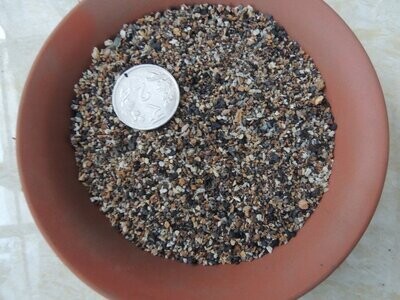
Cactus Seed Planting Mix
Cactus Seed Planting Mix
Sterile, Fine-Grain Media for Cactus & Succulent Seeds
SKU MNS005
₹74.85
New


Monsoon Guardian Kit (5 in 1)
Monsoon Guardian Kit (5 in 1)
Complete 5-in-1 biological protection kit for cacti & succulents
SKU MNS024
₹850.00