

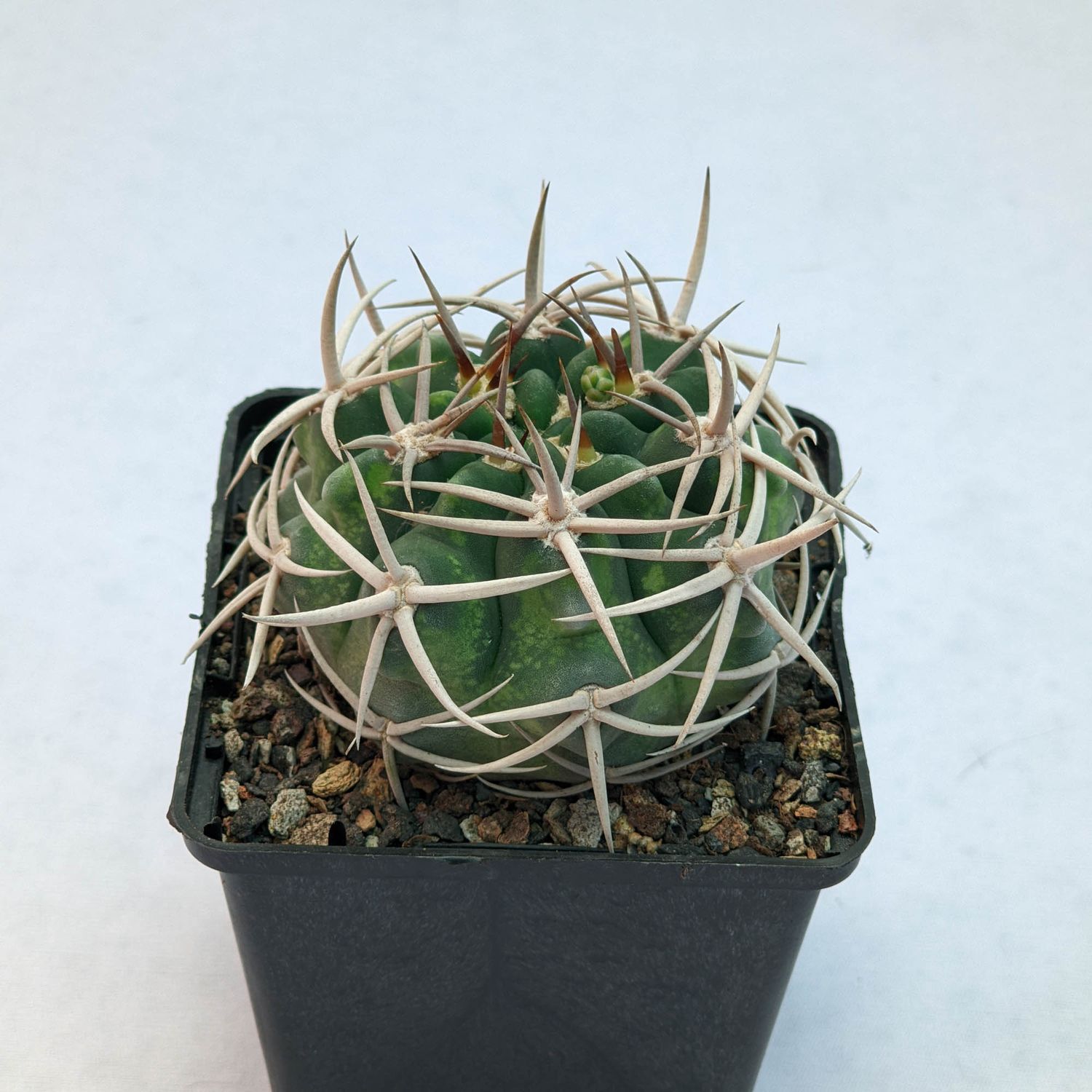
Gymnocalycium ferox (Gymnocalycium castellanosii)
Product Details
Rugged Elegance: Gymnocalycium ferox
A formidable collector’s centerpiece defined by its powerful, curved spines and slow-growing architectural precision.
- Origin & History of Name: The genus name Gymnocalycium is derived from the Greek gymnos (naked) and kalyx (bud), referring to the flower buds that lack hair or spines.
The species name ferox is Latin for "fierce" or "ferocious," highlighting its unusually thick, menacing spination. It was historically described as a subspecies of Gymnocalycium castellanosii, named in honor of Alberto Castellanos, a prominent 20th-century Argentine botanist. - Morphology: This solitary cactus features a globose (spherical) to depressed epidermis in shades of glaucous green or grey-blue. Its most striking feature is the costae (ribs), which are divided into prominent tubercles topped with large, woolly areoles. From these areoles emerge thick, inward-curving radial spines that can vary from bone-white to dark brown, providing a "caged" appearance that protects the plant from intense solar radiation.
- Habitat & Origin: Gymnocalycium ferox is a wild species native to the arid, rocky slopes of the Sierra de San Luis and Córdoba provinces in Argentina. Our specimens are nursery-grown from seed to ensure the conservation of wild populations, supporting sustainable horticultural practices and preventing habitat depletion.
- Cultivation Profile:
- Substrate: A strictly mineral-based mix is essential. Use a composition of 70% gritty material (pumice, perlite, or crushed brick) and 30% organic matter to prevent root rot in humid Indian climates.
- Light: Requires bright, indirect light.
In the Indian subcontinent, provide 40-50% shade cloth protection during peak summer afternoons to prevent epidermal scorching. - Water/Dormancy: Water thoroughly only when the medium is completely dry. During the monsoon, withhold water if humidity is extreme. In winter, enter a strict dry dormancy to mimic its high-altitude Argentine habitat.
- Scientific/Historical Anecdote: Gymnocalycium was one of the first cactus genera to gain widespread popularity in Europe during the 19th century because many species can flower at a very young age. G. ferox is particularly noted by botanists for its "ontogenetic" change—as the plant matures, its spines often become significantly thicker and more curved than those found on juvenile specimens, a defensive adaptation against grazing animals in its native scrublands.

Cactus & Succulent Planting Mix COARSE (aka Cactus Soil Mix or Succulent Soil Mix)
Cactus & Succulent Planting Mix COARSE (aka Cactus Soil Mix or Succulent Soil Mix)
Washed, Free-Draining Mineral Mix for Cactus & Succulents
SKU MNS003
₹44.85


New


Monsoon Guardian Kit (5 in 1)
Monsoon Guardian Kit (5 in 1)
Complete 5-in-1 biological protection kit for cacti & succulents
SKU MNS024
₹850.00