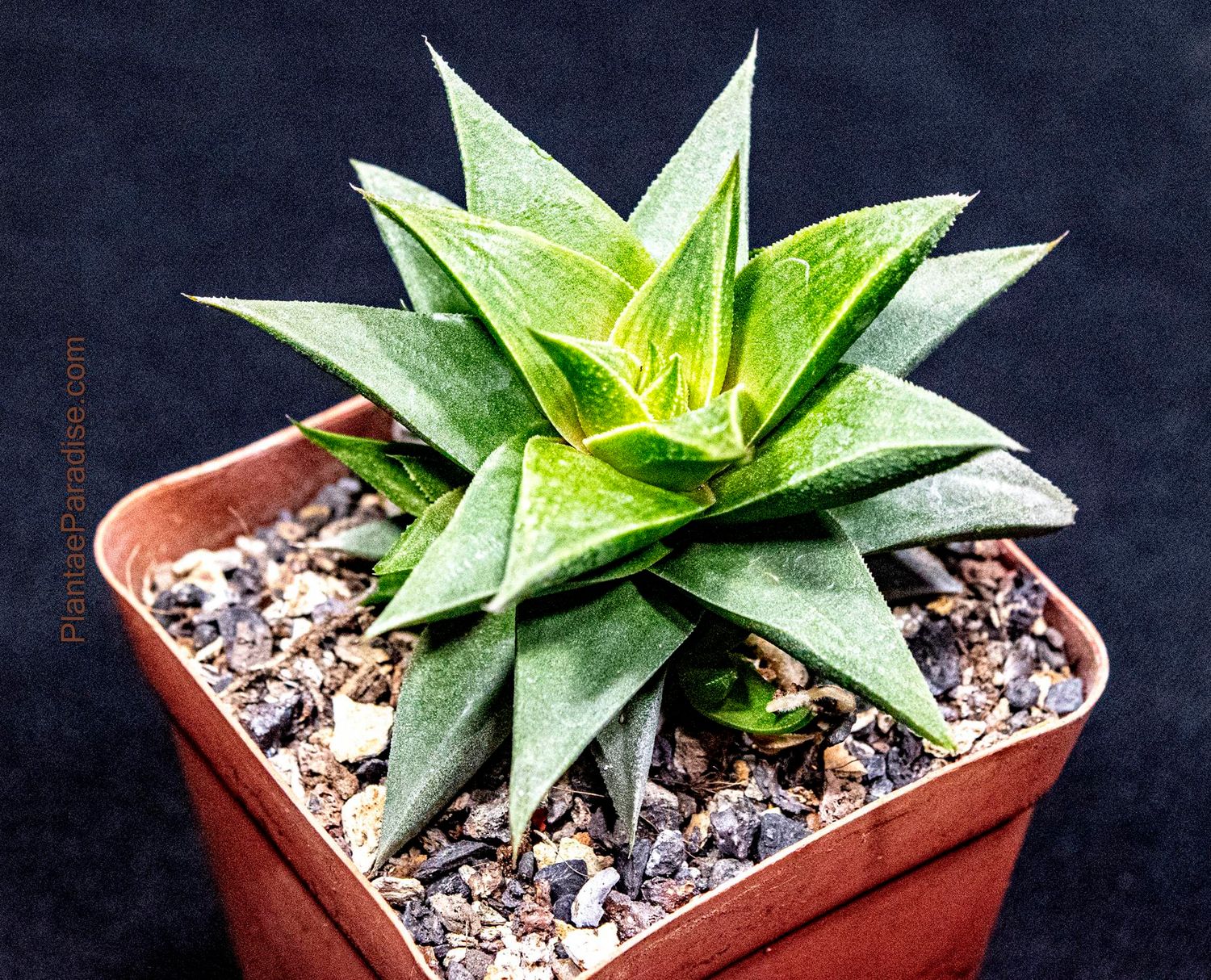
Bayliss in Scott 796 (PRE)
Origin of Name
Haworthia angustifolia var. baylissii is a variety within the Haworthia genus. The genus 'Haworthia' honors Adrian Hardy Haworth, a distinguished British botanist and entomologist. The species name 'angustifolia' is derived from Latin, meaning 'narrow-leaved', referring to the slender foliage of the plant. However, the wide leaf form as this is found only in Bayliss in Scott 796 Pretoria and thus named.
Technical Description of Plant
Haworthia angustifolia var. baylissii is notable for its compact and elegant growth habit. This succulent forms small rosettes of long, slender leaves that can grow up to 3-4 inches long. The leaves are typically a deep green color and may exhibit a slightly translucent quality near the tips. They are adorned with subtle white markings or striations, adding texture and visual interest. This variety tends to have a more upright growth compared to other Haworthias. It blooms with small, inconspicuous white flowers on slender stalks, though the primary appeal of the plant lies in its striking foliage.
Origin of Plant
Haworthia angustifolia var. baylissii is native to South Africa, particularly to regions with arid and semi-arid climates. These plants are adapted to grow in rocky or sandy soils, often in the shade of other vegetation, which helps protect them from direct sunlight.
Conservation Status
As of the latest information, Haworthia angustifolia var. baylissii is not listed as an endangered species. However, like many succulents, it is subject to threats such as habitat loss and illegal collection. Sustainable cultivation and propagation in nurseries are important for its conservation.
Care Instructions
Haworthia angustifolia var. baylissii thrives in bright, indirect light but should be shielded from intense direct sunlight, which can scorch the leaves. It prefers well-draining soil typical for succulents. Water moderately during the growing season, allowing the soil to dry out completely between waterings, and reduce watering in the winter. This plant is not frost-tolerant and should be protected from freezing temperatures. Fertilization is generally not necessary, but a light feeding with a succulent fertilizer can be done during the growing season if desired.