

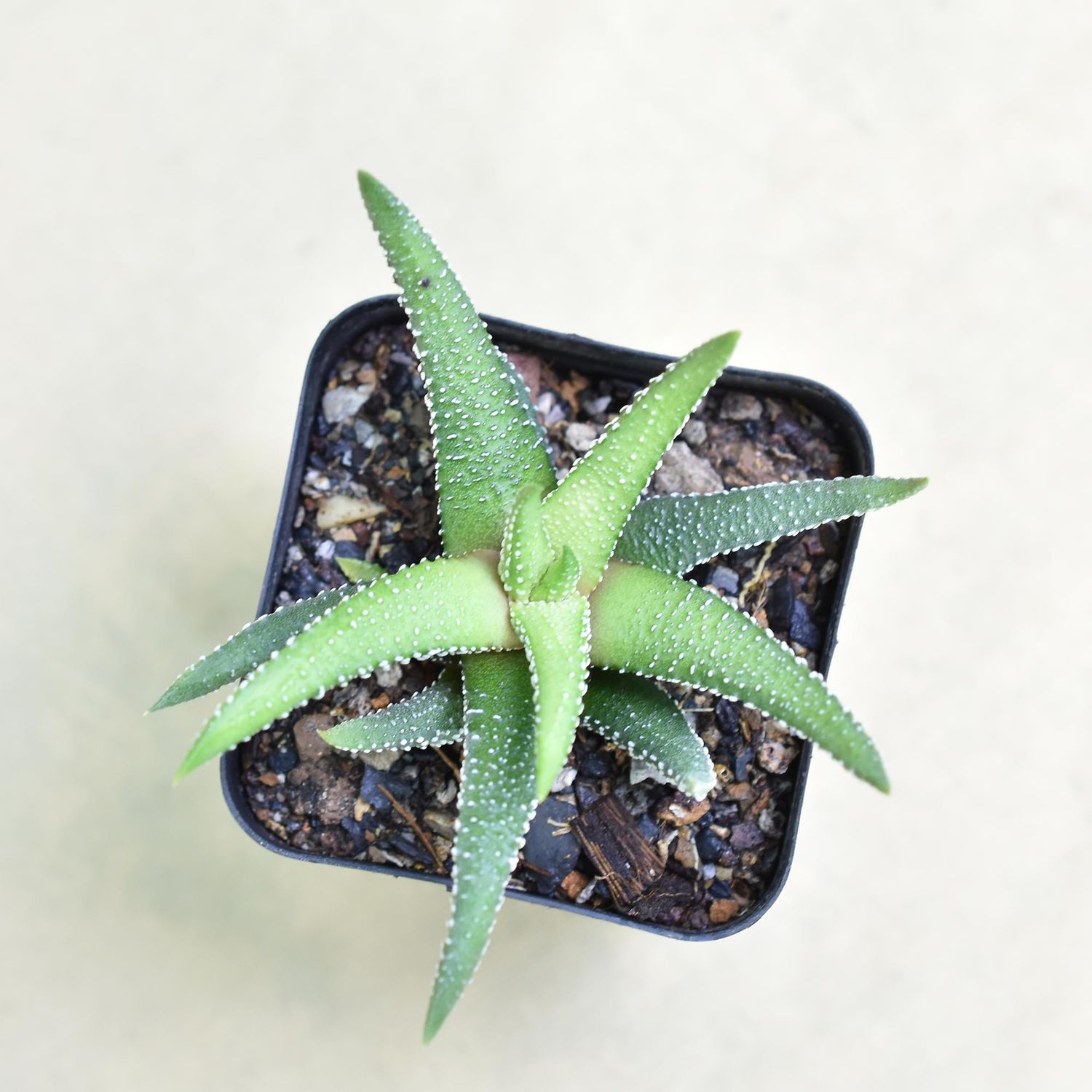
Haworthia attenuata 'Enon'
Product Details
Sculptural Elegance: Haworthia attenuata 'Enon'
An architectural marvel for the discerning collector, defined by its striking monochromatic contrast and resilient nature.
- Origin & History of Name The genus Haworthia honors British botanist Adrian Hardy Haworth (1767–1833), who contributed significantly to the classification of succulents.
The specific epithet attenuata is derived from the Latin attenuatus, meaning "tapered," referring to the long, pointed leaves. The cultivar name 'Enon' refers to its discovery near the Enon Conglomerate formation in South Africa, a region known for its unique geological deposits. - Morphology This variety is characterized by an upright, clustering rosette of lanceolate leaves. Its epidermis (outer skin) is a deep emerald green, densely adorned with raised, white tubercles (wart-like growths) that form distinct horizontal bands or "ribs." Unlike the standard species, 'Enon' exhibits a more compact growth habit and more pronounced, pearlescent variegation on the abaxial (underneath) surface of the leaves.
- Habitat & Origin Haworthia attenuata 'Enon' is a naturally occurring variety found in the Eastern Cape Province of South Africa.
It is not a lab-created hybrid but a distinct geographical form. Our specimens are propagated via offset division or sustainable tissue culture to ensure the protection of wild populations and the preservation of the local South African ecosystem. - Cultivation Profile
- Substrate: A strictly mineral-based mix (60% inorganic). Use a blend of coarse sand, pumice, or perlite with minimal organic matter to prevent root rot.
- Light: Bright, indirect light. In the Indian subcontinent, avoid direct midday summer sun which can cause "sun-stress" (reddening); an east-facing windowsill or a shaded balcony is ideal.
- Water & Dormancy: Water thoroughly only when the substrate is completely dry. During the high-humidity monsoon and the peak of summer heat, this plant enters a semi-dormant state; reduce watering frequency significantly to prevent fungal pathogens.
- Scientific/Historical Anecdote While they resemble miniature Aloes, Haworthia were only separated into their own genus in 1809. Interestingly, the white tubercles on 'Enon' aren't just decorative; scientists believe they may help the plant regulate temperature and break up intense sunlight, acting as a structural "sunscreen" in its arid native habitat.

Cactus Seed Planting Mix
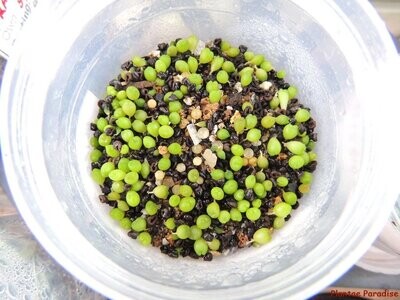
Cactus Seed Planting Mix
Sterile, Fine-Grain Media for Cactus & Succulent Seeds
SKU MNS005
₹74.85

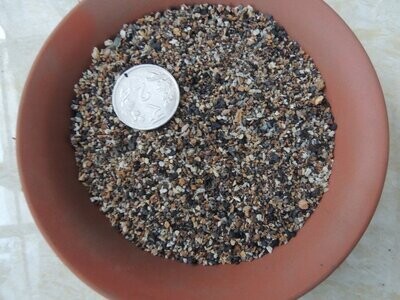
Cactus & Succulent Planting Mix COARSE (aka Cactus Soil Mix or Succulent Soil Mix)
Cactus & Succulent Planting Mix COARSE (aka Cactus Soil Mix or Succulent Soil Mix)
Washed, Free-Draining Mineral Mix for Cactus & Succulents
SKU MNS003
₹44.85
