Origin of Name
Haworthia reinwardtii var. coarctata is named after two significant figures in botany. The genus 'Haworthia' honors Adrian Hardy Haworth, a British botanist and entomologist. The species name 'reinwardtii' pays tribute to Caspar Georg Carl Reinwardt, a German-Dutch botanist who was a professor at the University of Leiden.. The variety name 'coarctata' comes from Latin, meaning 'pressed together', referring to the plant's growth habit. This nomenclature reflects the botanical heritage and characteristics of the plant.
Technical Description of Plant
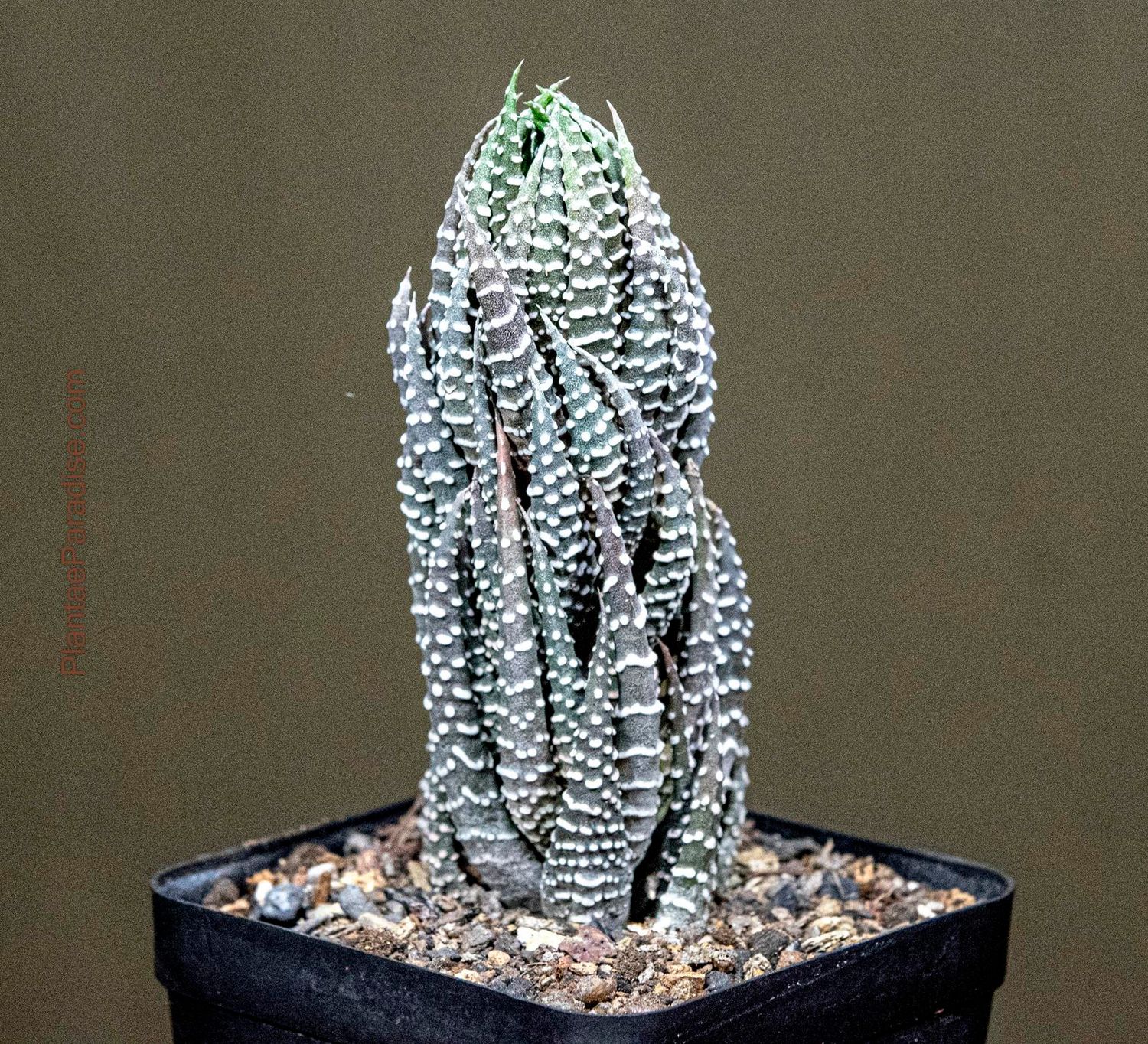
Haworthia reinwardtii var. coarctata is known for its distinctive, columnar growth form. This succulent forms tight clusters of cylindrical, dark green leaves that are stacked upon each other, creating a compact, vertical arrangement. The leaves are adorned with white tubercles, giving them a textured appearance. This variety tends to grow more upright and can become quite elongated compared to the main species. It blooms with small, inconspicuous white flowers that emerge on slender, elongated stems, though the primary appeal of this plant lies in its striking foliage.
Origin of Plant
Haworthia reinwardtii var. coarctata is native to the Eastern Cape Province of South Africa. It thrives in rocky and arid environments, often growing in the shade of rocks or other vegetation. Its growth form is an adaptation to these challenging conditions, allowing it to conserve water and space.
Conservation Status
Currently, Haworthia reinwardtii var. coarctata is not listed as endangered or threatened. However, like all succulents, it is subject to pressures such as habitat loss and illegal collection. Sustainable cultivation and trade practices are essential for its preservation.
Care Instructions
Haworthia reinwardtii var. coarctata prefers bright, indirect sunlight but should be protected from intense direct sun, which can scorch the leaves. It thrives in well-draining soil, typical for succulents. Water moderately, allowing the soil to dry out completely between waterings, and reduce watering in the winter months. This plant is not frost-hardy and should be protected from freezing temperatures. Fertilization is not crucial, but a diluted succulent fertilizer can be applied sparingly during the growing season.