Origin of Name
Haworthia tesselata 'Soft Skin Clone' is a specific cultivar of Haworthia tesselata. The species name 'tesselata' derives from Latin, meaning 'tessellated' or 'checkered', referring to the plant's patterned leaf appearance. The 'Soft Skin Clone' designation in the cultivar name highlights its distinctive leaf texture, which is softer compared to the standard Haworthia tesselata.
Technical Description of Plant
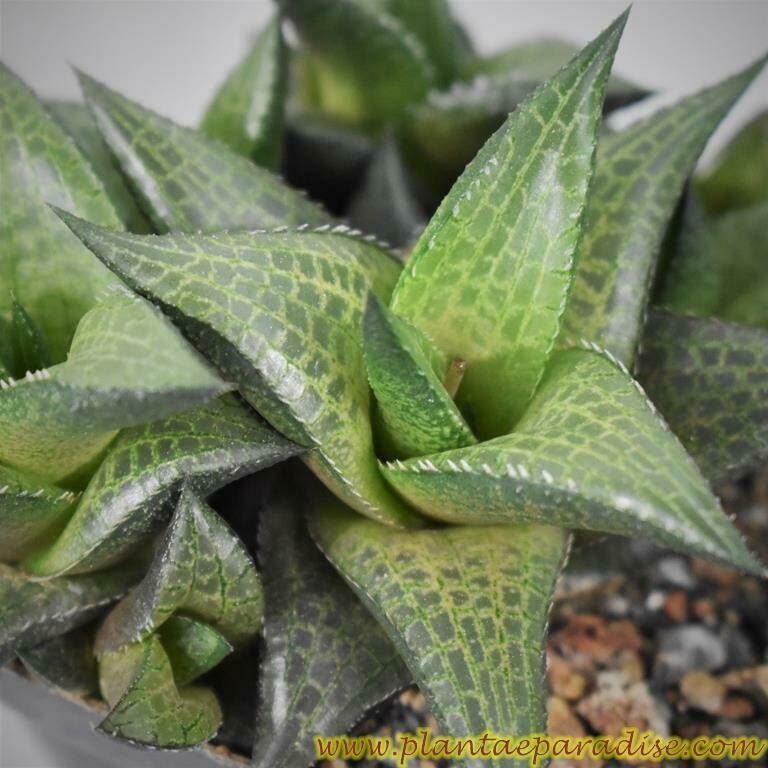
Haworthia tesselata 'Soft Skin Clone' is a small, rosette-forming succulent, usually growing up to 3-5 inches in height and diameter. The rosette comprises thick, fleshy, lanceolate leaves. These leaves are a deep green color and display a unique, tessellated pattern of lighter green or white markings, which gives the plant a mosaic-like appearance. The 'Soft Skin Clone' variety is particularly noted for its smoother, more supple leaf texture. The plant rarely blooms, but when it does, it produces small, inconspicuous white flowers on thin, elongated stems.
Origin of Plant
Haworthia tesselata is native to South Africa, particularly the Eastern Cape Province. The 'Soft Skin Clone' has been selectively cultivated for its unique leaf texture and patterning. These plants are adapted to semi-arid climates and typically grow in rocky substrates, often in shaded areas.
Conservation Status
As a cultivated variety, Haworthia tesselata 'Soft Skin Clone' does not have a specific conservation status. However, the cultivation of Haworthia varieties is important for conserving wild populations, which can be threatened by habitat loss and over-collection.
Care Instructions
Haworthia tesselata 'Soft Skin Clone' is an easy-to-care-for plant, suitable for beginners. It prefers bright, indirect light but should be protected from harsh direct sunlight, which can scorch the leaves. The plant thrives in well-draining soil and requires moderate watering, allowing the soil to dry completely between waterings. In winter, reduce watering to a minimum to prevent root rot. This succulent is not frost-tolerant and should be kept in a temperate environment. Fertilization is not essential, but a diluted succulent fertilizer can be applied sparingly during the active growing season.