Exotic Huernia with striking, star-like flowers and succulent, patterned stems—perfect for xeriscapes and succulent collections.", "1. Origin of Name": "The genus Huernia honors the 19th-century Dutch botanist Johannes Hueryn, who contributed to the study of succulents and mesembs. The species name echidnopsioides derives from Greek roots: 'echidna' meaning 'sea urchin' or 'spiny creature', and the suffix '-oides' meaning 'resembling' or 'like'. This name references the plant’s characteristic spiny, textured stems resembling a sea urchin’s surface. The specific epithet was first applied by botanist N.E. Brown based on its distinctive spiny appearance. Historically, it has also been confused with or labeled as Huernia mystax due to similar features, but recent classifications clearly distinguish it based on floral and stem characteristics, cementing its unique identity within the genus.",
"2. Origin of Plant": "Huernia echidnopsioides is native to the arid regions of Namibia and South Africa’s Namaqualand. It thrives on rocky slopes, gravelly desert plains, and shallow rocky soils, often in semi-shaded microhabitats. Discovered by early 20th-century explorers and botanists during expeditions focused on the succulent-rich deserts of southern Africa, it was formally described as part of botanical surveys conducted in the early 1900s. Its adaptability to harsh, rocky environments makes it a resilient and striking desert native that’s now cultivated worldwide by succulent enthusiasts."
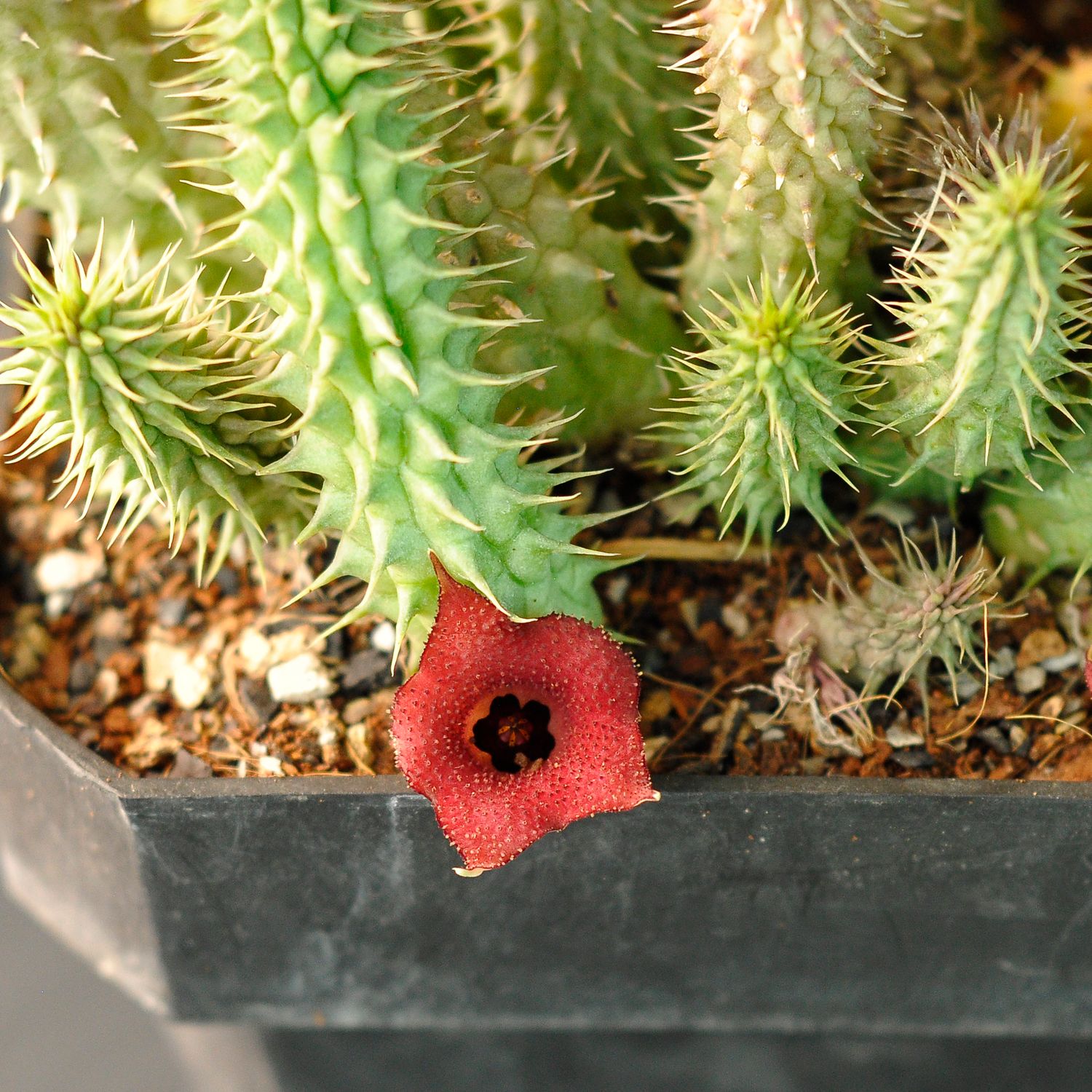
, "3. Description": "Huernia echidnopsioides forms low, spreading mat-like clumps composed of thick, succulent stems covered in tiny, spine-like tubercles that create a textured, almost prickly surface reminiscent of a sea urchin. The stems are usually gray-green with darker, patterned markings and densely covered with small, pointed tubercles, giving an overall spiny appearance. During its flowering season, it produces charming, star-shaped, five-petaled flowers—typically in shades of deep maroon, brown, or violet—that are often striped or speckled, attracting admiration for their intricate, delicate patterns. The plant’s unique, textured stems combined with its striking floral display make it a captivating xerophyte suitable for containers or rock garden settings."
, "4. Conservation Status": "Huernia echidnopsioides is not currently listed as threatened or endangered but is considered uncommon in its native habitat due to overcollection and habitat disturbance. As a cultivated succulent, it is propagated extensively in nurseries around the world, which helps reduce pressure on wild populations. Conservation efforts focus on habitat preservation and promoting propagation through nursery-grown plants."
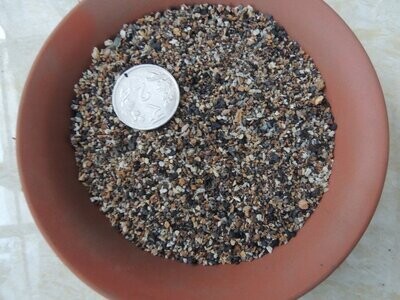
, "5. Care": "Light: Bright, direct sunlight or full sun for optimal coloration and flowering. Tolerates some direct afternoon sun in temperate zones. Watering: Low water needs; water deeply but infrequently, allowing soil to dry out completely between watering. Overwatering causes root rot. Soil: Use a gritty, fast-draining cactus or succulent mix enriched with pumice, perlite, or coarse sand. Temperature: Prefers warm temperatures, ideally between 60–85°F (16–29°C). Protect from frost and freezing temperatures at all times. Fertilizer: During active growth (spring and summer), feed lightly with a diluted succulent fertilizer monthly. Repotting: Every 2–3 years or when roots become crowded. Propagation: Mainly through stem cuttings or offsets; process takes a few weeks to root in dry, well-draining medium."
, "6. Interesting Anecdote": "Huernia species, including echidnopsioides, are often called 'Lifesaver Plants' due to their bright, attractive flowers that resemble colorful, edible candies. The plant’s unusual spiny stems and star-like blooms have inspired stories among desert travelers and succulent collectors, who regard it as a symbol of resilience and beauty thriving in extreme conditions. Historically, indigenous cultures in southern Africa valued its drought tolerance and ornamental appeal, often using its striking flowers as natural decoration or in traditional practices. Today, its unique appearance continues to fascinate gardeners and botanists alike, reminding us of nature’s ingenuity in adapting to arid environments." }