

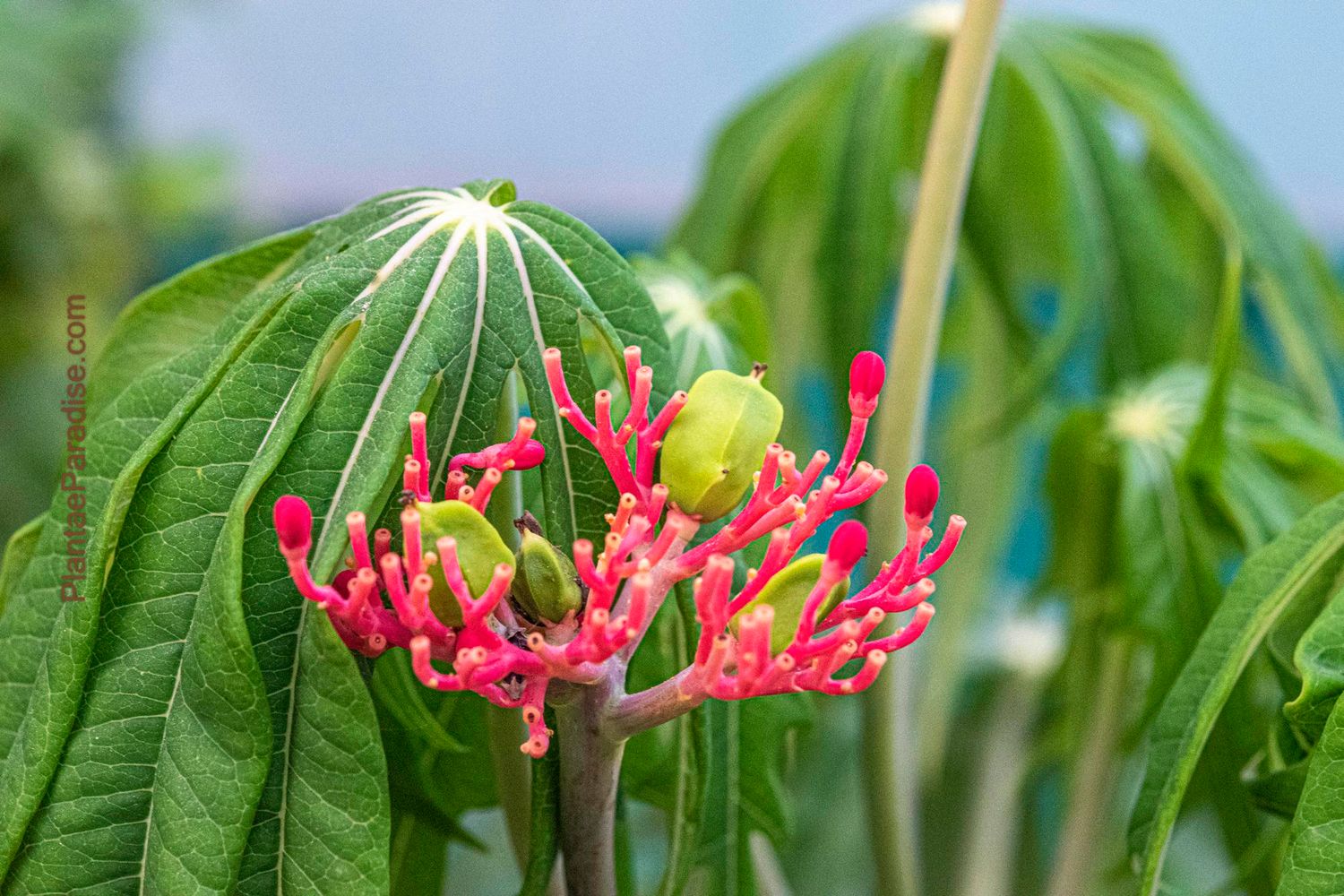
A shrub that turns bloodletting into ornament — deeply cut, fan-like leaves surrounding tight clusters of scarlet, coral-red flowers held high on long stalks, as if the plant were offering up a fistful of tiny red stars against its own green canopy.
Origin of Name
The genus name Jatropha comes from the Greek iatros (physician) and trophe (nutrition or food) — "physic," a name that reflects a medicinal reputation shared across the genus long before modern pharmacology got involved. The species epithet multifida is more literal: Latin multi- ("many") combined with a root meaning "split" or "cleft," describing the leaf blade's deep division into numerous narrow lobes — the plant's most immediately recognisable trait.
Jatropha multifida was named by Linnaeus himself in 1753, in the first edition of Species Plantarum — the foundational work of modern botanical nomenclature. Its formal type material is worth a small aside: rather than a pressed herbarium specimen, the accepted lectotype is an illustration from Johann Jacob Dillenius's Hortus Elthamensis (1732), a lavishly illustrated catalogue of the plants growing in James Sherard's garden at Eltham, England. In other words, Linnaeus's description of this Mexican and Caribbean native was anchored not to a wild-collected plant, but to a specimen already thriving in an English hothouse — a small reminder of just how quickly this species moved from the tropical Americas into European cultivation.
Origin of Plant
Jatropha multifida is native to the West Indies, Mexico, and the wider Caribbean basin, with a range extending south through Central America to Brazil and Paraguay, growing naturally in the semi-arid tropical lowlands from sea level up to around 1,400 metres. It has since naturalised well beyond that native range, establishing itself in southern Florida and southwestern Texas. Far more strikingly, it was carried into cultivation across the Old World tropics "long ago," in the words of one standard reference — introduced as an ornamental and hedge plant throughout Africa, the Indian subcontinent, China, and Southeast Asia, where it has been grown for so many generations that it now feels locally rooted in dozens of cultures with no botanical connection to its Mesoamerican origin at all.
Description
Coral plant is an evergreen or semi-deciduous, slightly succulent shrub or small tree with a loose, open, spreading crown, typically reaching 1.5 to 3 metres in cultivation, though it can grow as tall as 5–6 metres given ideal conditions. Its older stems are thick, somewhat succulent to softly woody, covered in smooth grey to brownish bark marked with raised lenticels, while new growth stays fresh green; any cut or damaged stem exudes a copious, caustic, poisonous milky sap. Beneath the surface, the plant relies on long, tuberous roots for water storage.
The leaves are the plant's real signature: long-stalked and deeply palmately divided into 7 to 11 narrow lobes, bright green above and noticeably paler, greyish beneath — giving the whole plant a light, lacy, almost fern-like silhouette despite its woody structure. Rising above this foliage on long peduncles are dichotomous cymes of small, bright coral-red to scarlet flowers, blooming through summer in temperate cultivation and more or less continuously in genuinely tropical conditions. Male and female flowers appear together within the same cluster, with male flowers considerably more numerous than female — a pattern of sexual dimorphism common across the genus. Pollinated flowers develop into a three-chambered (trilocular) capsule containing ellipsoidal seeds roughly 2 centimetres long.
Conservation Status
Jatropha multifida is assessed as Least Concern on the IUCN Red List, unsurprising for a species this widely naturalised and cultivated across multiple continents. It carries no CITES listing. In parts of its native range it is still harvested from wild populations for local medicinal use and oil, but its enormous cultivated presence worldwide means the species faces no meaningful conservation pressure.
Care
Light: Bright light to full sun; flowering and overall vigour both improve substantially with strong light exposure.
Watering: Water moderately during active growth, allowing the soil to dry between waterings; this is fundamentally a plant of semi-arid lowlands, and it demands excellent drainage even when grown in more humid climates.
Soil: A free-draining, gritty succulent or general tropical potting mix; waterlogged roots are the most common cause of decline in cultivation.
Temperature: No frost tolerance whatsoever — this is strictly a warm-climate or protected-cultivation plant, and cold snaps should be avoided entirely.
Handling: The sap is caustic and toxic, and the seeds are a genuinely powerful purgative if ingested — handle pruning cuts with care and keep the plant, particularly its seeds, away from children and pets.
General tips: Easily propagated from seed or cuttings, and generally low-maintenance once established, making it a popular hedge and specimen plant across the tropics despite its toxicity.
A Story Worth Telling
Few plants illustrate the reach of colonial-era horticultural trade quite like this one. A shrub native to a fairly narrow slice of Mexico, the Caribbean, and northern South America now carries common names in an almost absurd number of languages — malako farang in Thai, dau me do in Vietnamese, arbre corail in French, korallenbaum in German, wouèkè in Benin's Fon language, yodium in parts of Indonesia (literally "iodine," a nod to its use as a wound remedy). Even more striking is how consistently different, unconnected cultures arrived at the very same use for it: as a purgative and wound-healing agent, independently rediscovered from West Africa to Southeast Asia to its own native Mexico, where it remains officially listed in the Mexican Pharmacopoeia despite having fallen out of everyday traditional use. It's a rare case of a single ornamental hedge plant carrying nearly identical folk medicine wherever it went — proof that sometimes a plant's chemistry speaks the same language everywhere it lands, regardless of who's doing the listening.