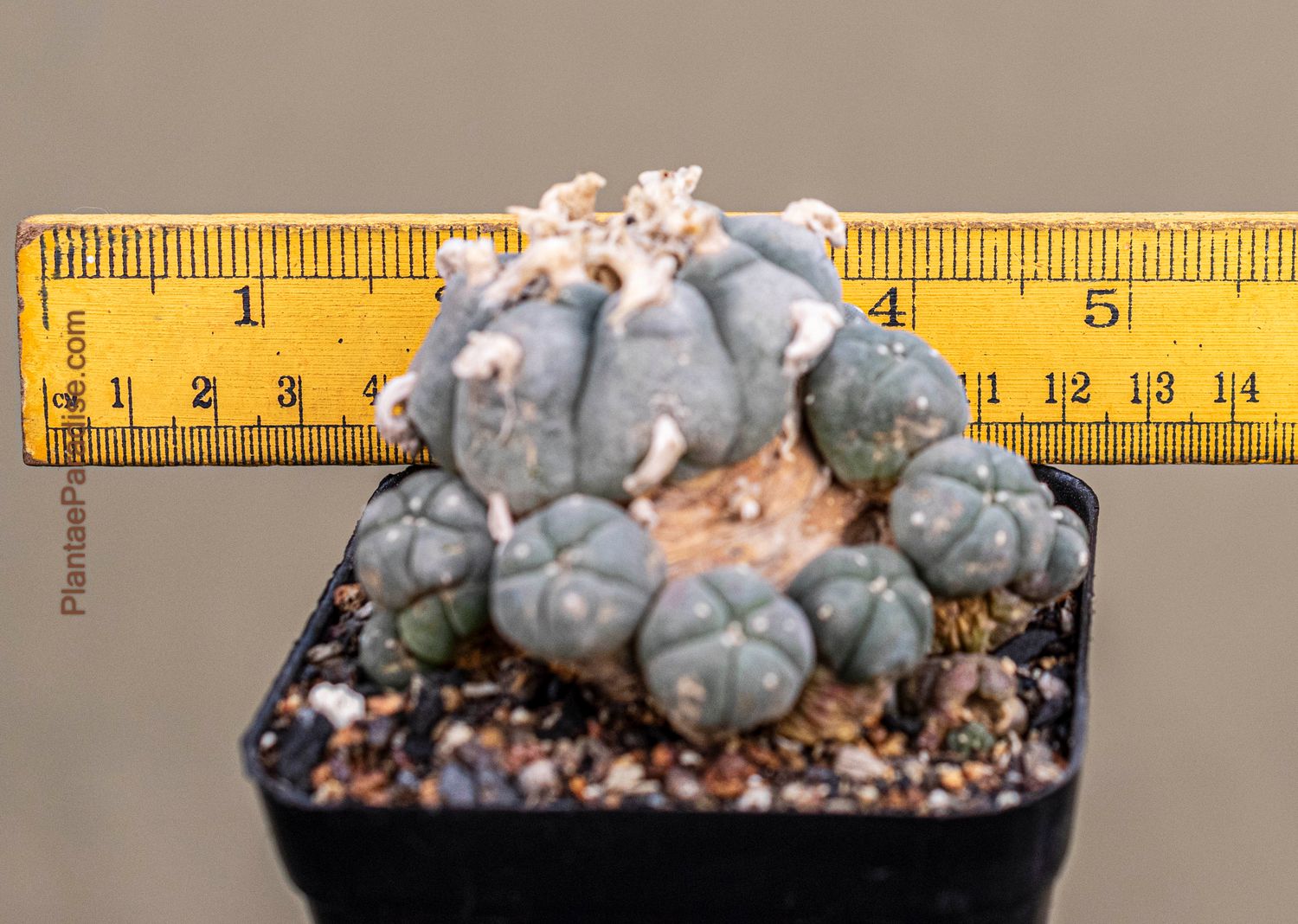
Origin of Name
Lophophora williamsii var. caespitosa is a variety of the species Lophophora williamsii, commonly known as Peyote. The genus name "Lophophora" is derived from the Greek words "lophos," meaning crest or tuft, and "phoros," meaning bearing, referring to the tufted flowers the plant produces. The species name "williamsii" honors C.H. Williams, an American botanist. The varietal name "caespitosa" comes from Latin, meaning "tufted" or "growing in mats," which describes this variety's growth habit of forming clusters or mats of stems.
Technical Description of Plant
Lophophora williamsii var. caespitosa is distinguished by its tendency to form clusters of small, spherical to slightly flattened stems, which can cover the ground in dense mats. Unlike the solitary growth habit of the typical Peyote, this variety produces numerous offshoots from the base, creating a compact cluster. The stems are blue-green to gray-green, with a soft, woolly center where pink to white flowers emerge in spring or early summer. The plant lacks true spines, instead featuring areoles with tufts of hair. The flowers are followed by small, pink fruits.
Origin of Plant
Lophophora williamsii, including its varietal forms, is native to the southwestern United States and northern Mexico and grows in an area that stretches from from the Chihuahuan Desert to the South Texas Plains, on either side of the middle and lower Rio Grande River, southward to the Mexican states of Chihuahua, Coahuila, Durango, Nuevo León, San Luis Potosí, Tamaulipas, Zacatecas.. It thrives in desert and scrubland environments, often growing in limestone -rich soils. The caespitosa variety shares this habitat but is particularly noted for its clustering growth, an adaptation that may provide benefits such as reduced evaporation and protection from herbivores.
Conservation Status
Lophophora williamsii and its varieties, including var. caespitosa, are listed in CITES Appendix II, reflecting international agreement to monitor and control trade to prevent exploitation. The species faces threats from habitat destruction, illegal collection, and overharvesting due to its psychoactive properties. Conservation efforts and legal cultivation are crucial for its survival.
Care Instructions
Lophophora williamsii var. caespitosa prefers a bright, indirect light environment with some protection from the hottest midday sun. It requires well-draining soil, ideally a mix designed for cacti and succulents, with added limestone or pumice for alkalinity. Water moderately during the active growing season, allowing the soil to dry completely between waterings, and reduce watering in the winter to a minimum. This variety is not frost-tolerant and should be protected from temperatures below freezing. Fertilize sparingly with a low-nitrogen cactus fertilizer during the growing season.