

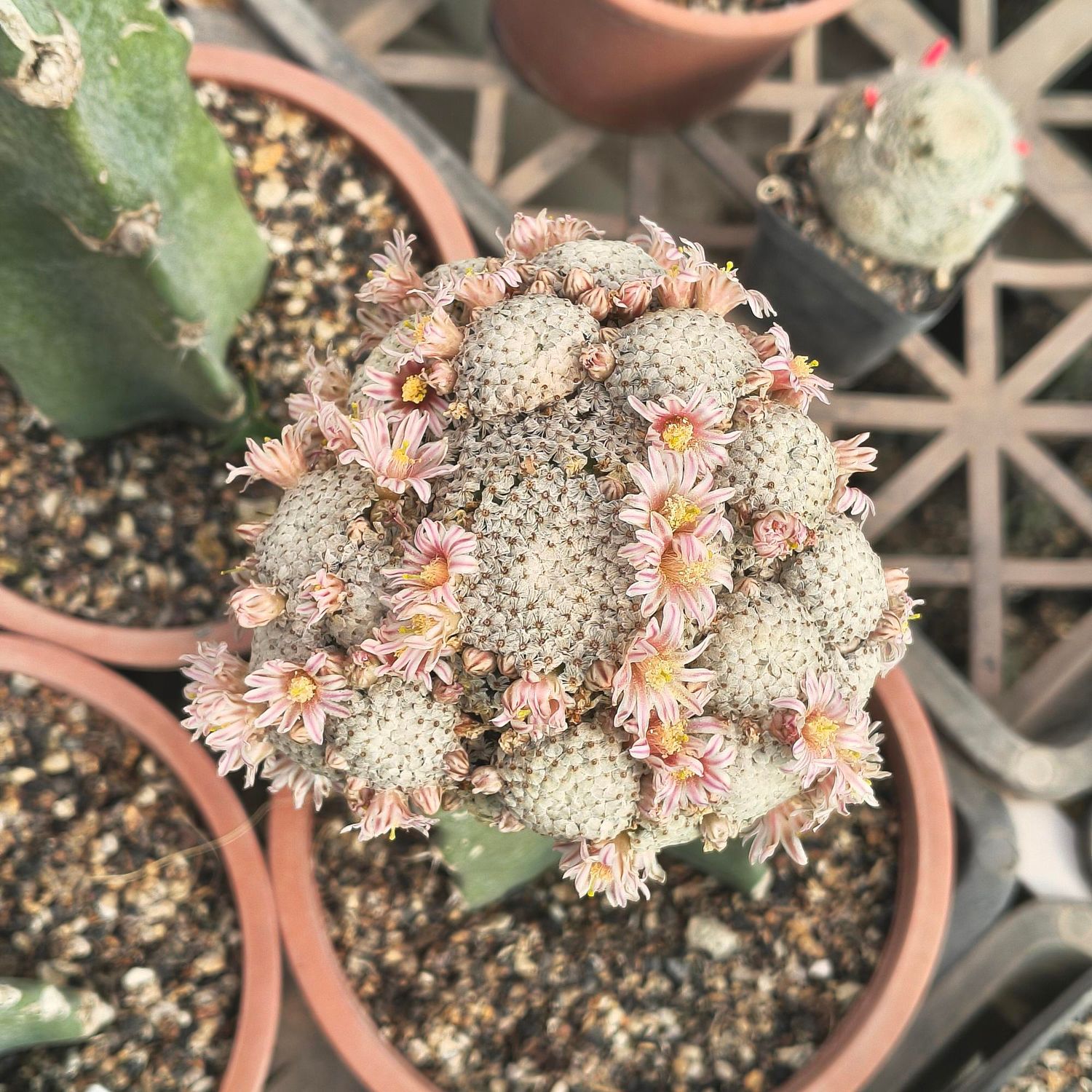
Mammillaria breviplumosa
Product Details
Feathered Treasure: Mammillaria breviplumosa
A coveted miniature masterpiece prized for its dense, cloud-like coat of soft, plumose spines.
- Origin & History of Name: The genus name Mammillaria comes from the Latin mammilla, meaning "nipple" or "teat," referring to the tubercle-based structure of the plant.
The specific epithet breviplumosa is a botanical compound of brevis (short) and plumosa (feathery), accurately describing the short, downy spines that characterize this species. It was formally described relatively recently in the 1990s, making it a modern gem in the succulent world. - Morphology: This is a globose, miniature cactus known for its distinct tubercles—small, nipple-like protrusions—rather than traditional ribs. Each tubercle is topped with an areole bearing numerous white, plumose radial spines that interlock to completely hide the green epidermis. These spines are soft to the touch and give the plant a snowy appearance. It produces delicate, funnel-shaped flowers, often in shades of cream or pale pink, from the axils between the tubercles.
- Habitat & Origin: This is a wild species endemic to a very localized region in Coahuila, Mexico. It grows primarily in limestone crevices. Because of its limited range in habitat, it is considered rare. Our plants are exclusively nursery-bred from seed to support global conservation and prevent the illegal poaching of wild specimens.
- Cultivation Profile:
- Substrate: Requires a highly porous, mineral-heavy mix (80% inorganic material like crushed brick, pumice, or coarse sand). Avoid peat-heavy soils which retain too much moisture for the sensitive taproot.
- Light: Thrives in full sun to very bright filtered light. In the Indian subcontinent, ensure good ventilation; while it loves the heat, stagnant air in high humidity can lead to rot.
- Water/Dormancy: Follow a "soak and dry" method. Water sparingly during the growing season and keep completely dry during the winter dormancy period.
In North India, stop watering from late November until the warmth of March returns.
- Scientific/Historical Anecdote: Mammillaria breviplumosa is often considered a subspecies or close relative of Mammillaria schiedeana. Its discovery was a highlight for field botanists because it represents an extreme evolutionary adaptation; the "feathery" spines act as a thermal blanket, trapping a layer of air to protect the plant from both freezing desert nights and the scorching midday sun.