

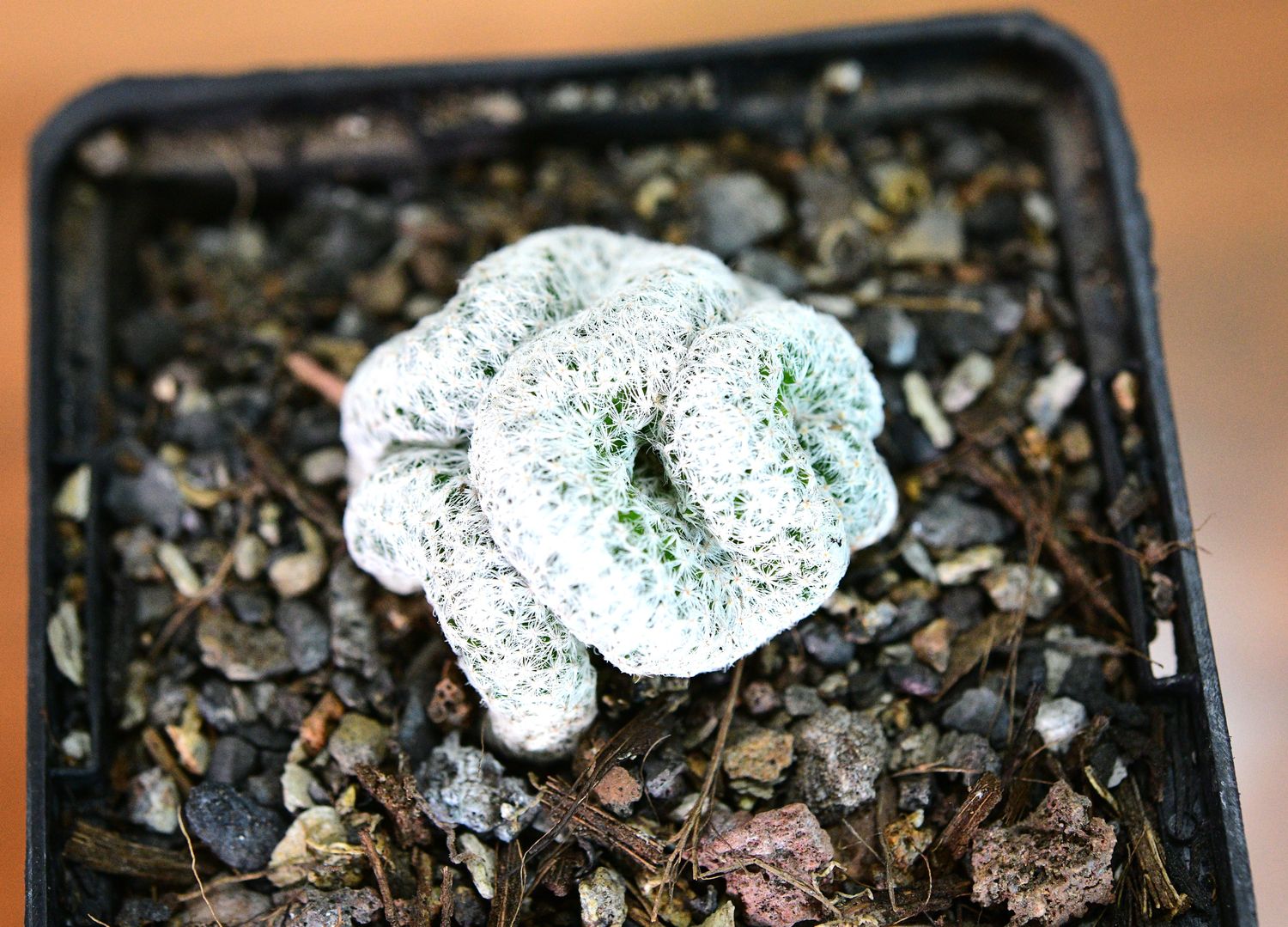
Mammillaria humboldtii cristata
Product Details
Mammillaria humboldtii f. cristata
A cactus so rare in its normal form that finding it at all is a feat — now imagine it twisted into a crest of white, folding, brain-like ridges. This crested humboldtii isn't just a novelty; it's a genetic accident layered on top of one of Mexico's most critically endangered pincushion cacti, making it one of the rarest silhouettes a collector will ever hold.
Origin of Name
The genus name Mammillaria comes from the Latin mammilla, "little nipple," a nod to the small, teat-like tubercles that stud every plant in this vast genus instead of true ribs. The species epithet humboldtii honors Alexander von Humboldt (1769–1859), the Prussian naturalist whose expeditions across the Americas reshaped European understanding of New World botany, geology, and biogeography — even though Humboldt himself never laid eyes on this particular cactus. It was named in his honor by German botanist Christian Ehrenberg in 1840, one of many species dedicated to Humboldt as a mark of the scientific debt the era owed him.
The cristata designation is where this specimen departs from the species proper. From the Latin crista, meaning "crest" or "comb," the term describes a forma — not a distinct species but a mutation that can arise spontaneously in almost any cactus. It occurs when the plant's apical meristem, the single point of growth at the tip of a normal cactus, is damaged or genetically destabilized and begins dividing along a line instead of a point. The result is a fan of tissue that folds and undulates as it grows, producing the wavy, convoluted form collectors prize.
Origin of Plant
Mammillaria humboldtii is endemic to a narrow stretch of central Mexico, found only in the states of Hidalgo and Querétaro, where it grows wedged into limestone crevices and rocky, arid slopes within the Barranca de Metztitlán Biosphere Reserve region. It was first described by Ehrenberg in 1840 from material collected during the great wave of German and European botanical expeditions into Mexico in the early nineteenth century — an era when Mexican Mammillaria diversity was only beginning to be catalogued.
The crested form itself has no independent habitat or expedition history — cristate mutations are not collected from a special population in the wild but arise unpredictably, one plant at a time, either in habitat or, far more often, in cultivation. When a grower encounters or produces a stable crested humboldtii, that individual is propagated vegetatively from cuttings, since the mutation is not reliably passed on through seed. Every crested humboldtii in cultivation today traces back to one of these rare, individual mutant origins.
Description
Where the standard Mammillaria humboldtii forms a tidy, snow-white globe, the crested form abandons symmetry altogether. Its body fans outward and folds back on itself in undulating, brain-like ridges, each ridge still densely studded with the tubercles characteristic of the species. Those tubercles carry the plant's signature feature: a dense, overlapping coat of fine white radial spines — as many as eighty or more per areole — so thick that the green epidermis beneath is almost entirely hidden, giving the whole crest the appearance of a fold of fresh snow.
Flowering is less reliable on crested growth than on globular specimens, but when it occurs, small, vivid magenta to purplish-pink blooms emerge along the ridges in late winter or early spring, a striking contrast against the white spination. Growth is slow and irregular, and the crest widens and deepens its folds over years rather than months, making mature specimens a genuine long-term investment piece.
Conservation Status
The species that underlies this cristate form is in serious trouble in the wild. Mammillaria humboldtii is classified as amenazada (threatened) under Mexico's NOM-059-SEMARNAT federal protection list, and assessments place it at critically endangered status under IUCN criteria, owing to its extremely restricted range, habitat degradation, and pressure from illegal collection. As with most Mammillaria, the genus falls under CITES Appendix II, meaning international trade in wild specimens is tightly regulated.
The crested cultivar sold here carries none of that pressure on wild populations — it exists solely as a nursery-propagated mutation, multiplied from cuttings rather than wild collection. Choosing a cultivated cristata is, in a real sense, the conservation-conscious way to own this species' remarkable form.
Care
Light: Bright, direct sun for at least several hours daily. Strong light keeps spine density tight and prevents etiolation, which distorts the crest further.
Water: Sparingly. Allow the substrate to dry completely between waterings, and water even less in winter. The folds of a crest trap moisture more readily than a smooth globe, so avoid wetting the crevices directly — water the soil, not the plant.
Soil: A mineral-heavy, fast-draining cactus mix with added pumice or grit is essential; standing moisture in the root zone is the fastest way to lose this plant.
Temperature: Protect from frost and prolonged damp cold. This species prefers warm, dry conditions year-round and should be brought under cover well before winter rains or freezes arrive.
Handling tip: The dense spination, while not hooked, is fine and easily lodges in skin — use tongs or thick gloves when repotting, and inspect the folds regularly for trapped debris or early signs of rot, since crested forms hide problems in their creases longer than a globular plant would.
A Story Worth Telling
There's a quiet irony at the heart of every Mammillaria humboldtii: it carries the name of one of history's most prolific field botanists, a man who personally observed and catalogued thousands of species across two continents — yet he never once saw this particular cactus growing in its Hidalgo limestone crevices. It was named in tribute, not in memory, a gesture of scientific reverence rather than firsthand encounter. Layer the crest on top of that, and the story doubles: this specimen isn't just honoring an explorer who never saw it, it's also wearing a form that isn't written into its species description at all — a one-off genetic accident, stabilized and propagated by patient growers, on a species so rare in habitat that most collectors will never see a normal one, let alone a crested one, growing wild.

Cactus Seed Planting Mix
Cactus Seed Planting Mix
Sterile, Fine-Grain Media for Cactus & Succulent Seeds
SKU MNS005
₹74.85



Cactus & Succulent Planting Mix FINE (aka Cactus Soil Mix or Succulent Soil Mix)
Cactus & Succulent Planting Mix FINE (aka Cactus Soil Mix or Succulent Soil Mix)
Fine-Grain Potting Mix for Cactus & Succulent Roots
SKU MNS001
₹39.85
