

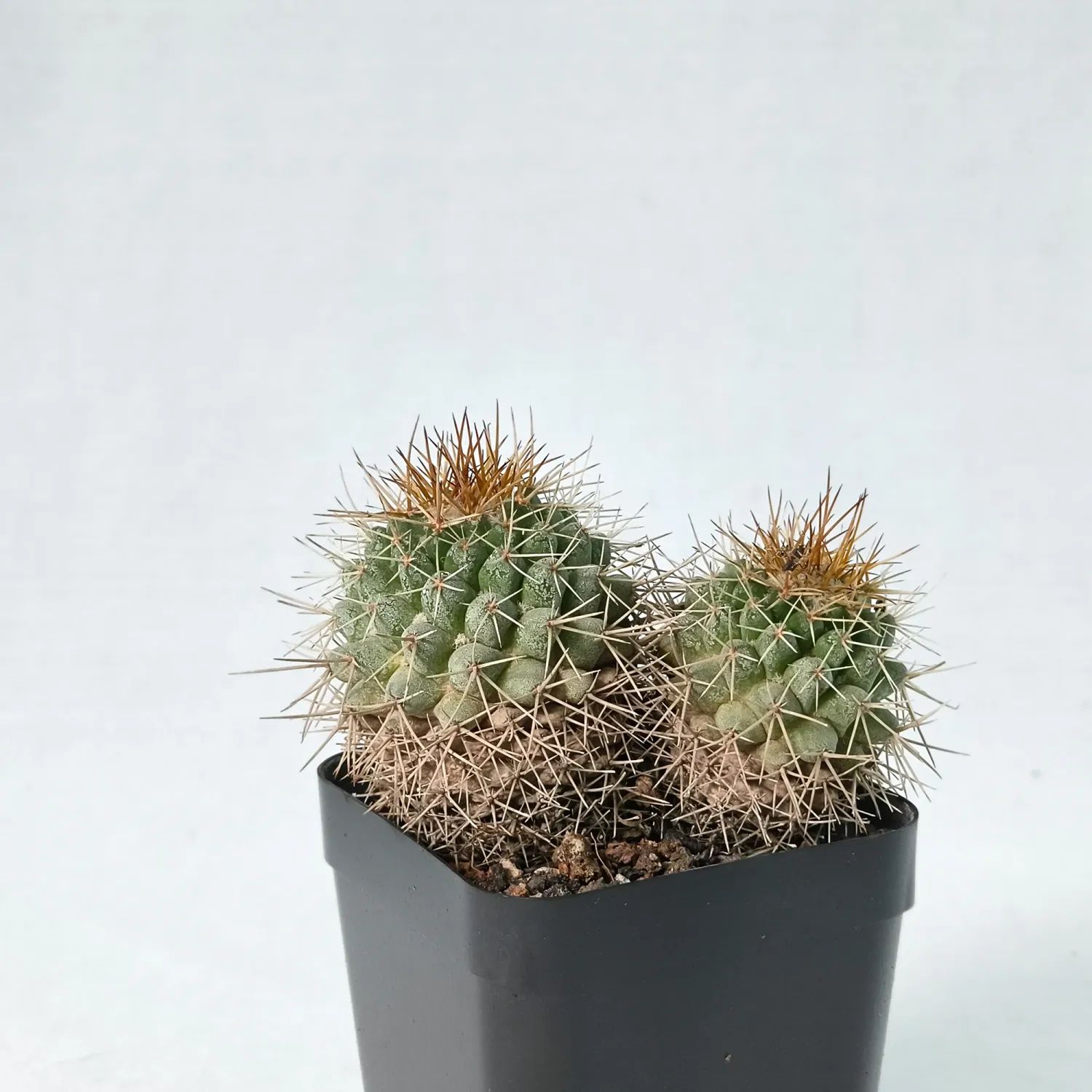
Mammillaria petterssonii Var. saltensis
Product Details
Golden Crown of Mexico: Mammillaria petterssonii var. saltensis
A formidable centerpiece for collectors, prized for its robust golden spination and architectural symmetry.
- Origin & History of Name: The genus name Mammillaria comes from the Latin mammilla (nipple or teat), referencing the characteristic tubercles that cover the plant body.
- Morphology: This cactus features a globose to cylindrical epidermis that can grow quite large. It is covered in prominent, pyramidal tubercles (the "bumps" typical of the genus) rather than continuous ribs. Each tubercle is topped with an areole bearing a dense cluster of stiff, amber-to-golden radial spines and stronger central spines. In maturity, the axils (the spaces between tubercles) develop a dense white wool, creating a striking contrast against the green body.
- Habitat & Origin: This is a wild variety native to the highlands of Mexico, specifically the state of Jalisco near El Salto. It grows in rocky, semi-arid environments at high elevations. Our stock is sourced through controlled nursery propagation, ensuring that these slow-growing specimens are not poached from their native habitat.
- Cultivation Profile:
- Substrate: Requires a mineral-based mix containing at least 60% inorganic material like crushed brick, coarse sand, or pumice. Avoid standard potting compost which retains too much moisture for the thick taproot.
- Light: Thrives in full sun to very bright filtered light.
- Water/Dormancy: Follow a "soak and dry" method during the growing season. During the Indian Monsoon, keep the plant under cover to avoid atmospheric moisture buildup in the woolly axils. Maintain a strict dry dormancy from November to February to trigger spring flowering.
- Scientific/Historical Anecdote: Mammillaria is one of the largest and most diverse genera in the Cactaceae family, first established by Adrian Haworth in 1812.



Cactus & Succulent Planting Mix COARSE (aka Cactus Soil Mix or Succulent Soil Mix)
Cactus & Succulent Planting Mix COARSE (aka Cactus Soil Mix or Succulent Soil Mix)
Washed, Free-Draining Mineral Mix for Cactus & Succulents
SKU MNS003
₹44.85
New


Monsoon Guardian Kit (5 in 1)
Monsoon Guardian Kit (5 in 1)
Complete 5-in-1 biological protection kit for cacti & succulents
SKU MNS024
₹850.00