

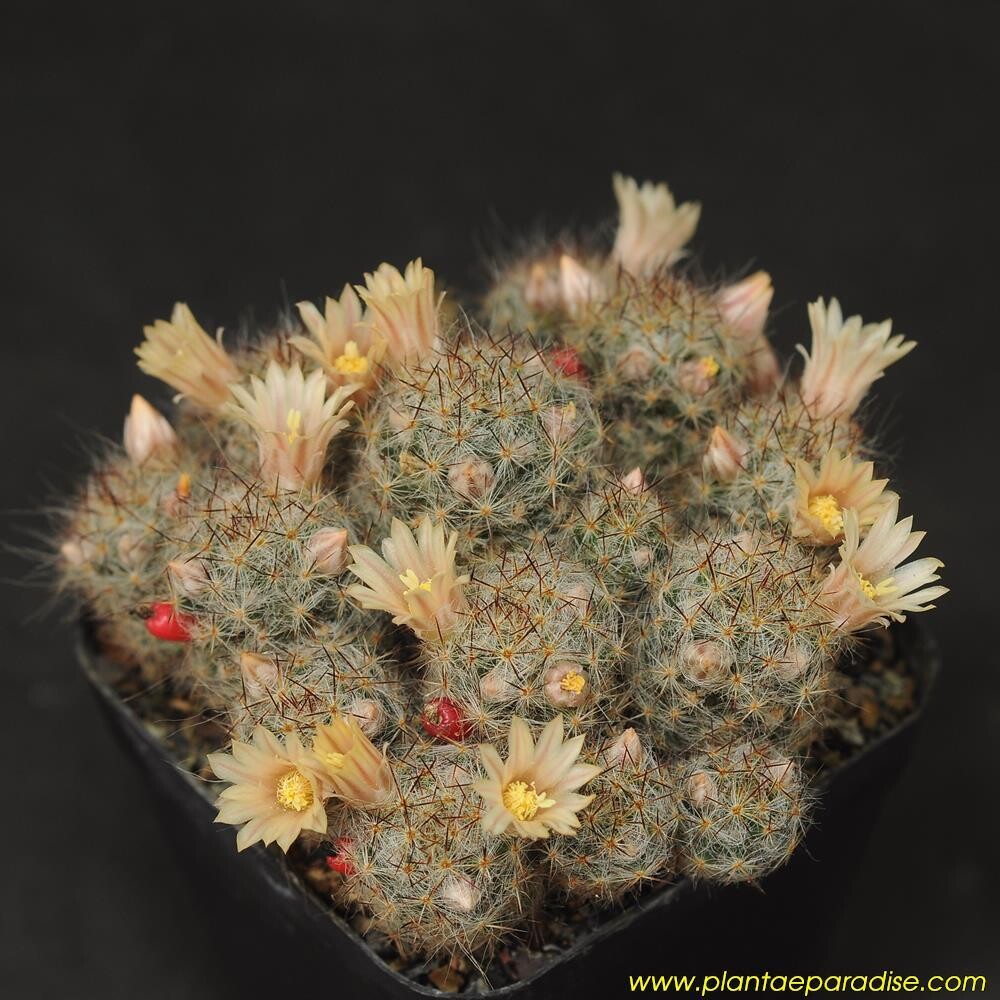
Mammillaria prolifera Albispinus
Product Details
Snowy Clustering Classic: Mammillaria prolifera 'Albispinus'
A prolific, white-spined beauty that transforms into a dense, frosted mound of architectural elegance.
- Origin & History of Name: The genus name Mammillaria comes from the Latin mammilla, meaning "nipple" or "teat," referring to the tubercle structures characteristic of the genus.
The species name prolifera denotes its tendency to produce offsets (pups) freely. The cultivar name 'Albispinus' is a Latin compound of albus (white) and spinus (spine), identifying this specific variety's strikingly bright, snow-white needle coloration. - Morphology: This cactus is characterized by its globose to cylindrical stems that cluster heavily.
Its epidermis is obscured by a dense mesh of fine, hair-like white radial spines. Unlike many cacti, it lacks costae (ribs), instead featuring spirally arranged tubercles. It produces small, cream-colored flowers followed by elongated, edible red berries that persist on the plant, adding secondary visual interest.
- Habitat & Origin: The base species is native to the Caribbean, Mexico, and Texas.
However, 'Albispinus' is a selected cultivar prized in horticulture for its pure white spination. These plants are nursery-propagated through clonal division or seed, ensuring a sustainable supply that protects wild populations from poaching. - Cultivation Profile:
- Substrate: Use a highly porous, mineral-based mix (60% coarse sand/perlite and 40% loamy soil). Ensure excellent drainage to withstand the high-volume rainfall typical of the Indian monsoon.
- Light: Prefers bright, filtered sunlight. In the Indian subcontinent, morning sun is ideal; provide 30% shade cloth protection during the harsh afternoon heat of May and June.
- Water/Dormancy: Water thoroughly only when the medium is bone-dry. During the winter months in North India or the peak monsoon in coastal regions, suspend watering to honor its dormancy and prevent root rot.
- Scientific/Historical Anecdote: Mammillaria prolifera was one of the earliest cacti introduced to European botany, documented as far back as the late 17th century. It is scientifically unique for its "pulpous" fruit; unlike many cacti whose fruit dries up, these "Texas Nipples" produce berries that stay succulent and bright for months, acting as a biological beacon for birds in their native scrubland.


Cactus Seed Planting Mix
Cactus Seed Planting Mix
Sterile, Fine-Grain Media for Cactus & Succulent Seeds
SKU MNS005
₹74.85
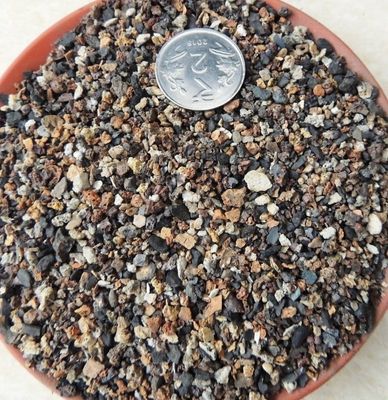

Cactus & Succulent Planting Mix FINE (aka Cactus Soil Mix or Succulent Soil Mix)
Cactus & Succulent Planting Mix FINE (aka Cactus Soil Mix or Succulent Soil Mix)
Fine-Grain Potting Mix for Cactus & Succulent Roots
SKU MNS001
₹39.85


Cactus & Succulent Planting Mix COARSE (aka Cactus Soil Mix or Succulent Soil Mix)
Cactus & Succulent Planting Mix COARSE (aka Cactus Soil Mix or Succulent Soil Mix)
Washed, Free-Draining Mineral Mix for Cactus & Succulents
SKU MNS003
₹44.85