

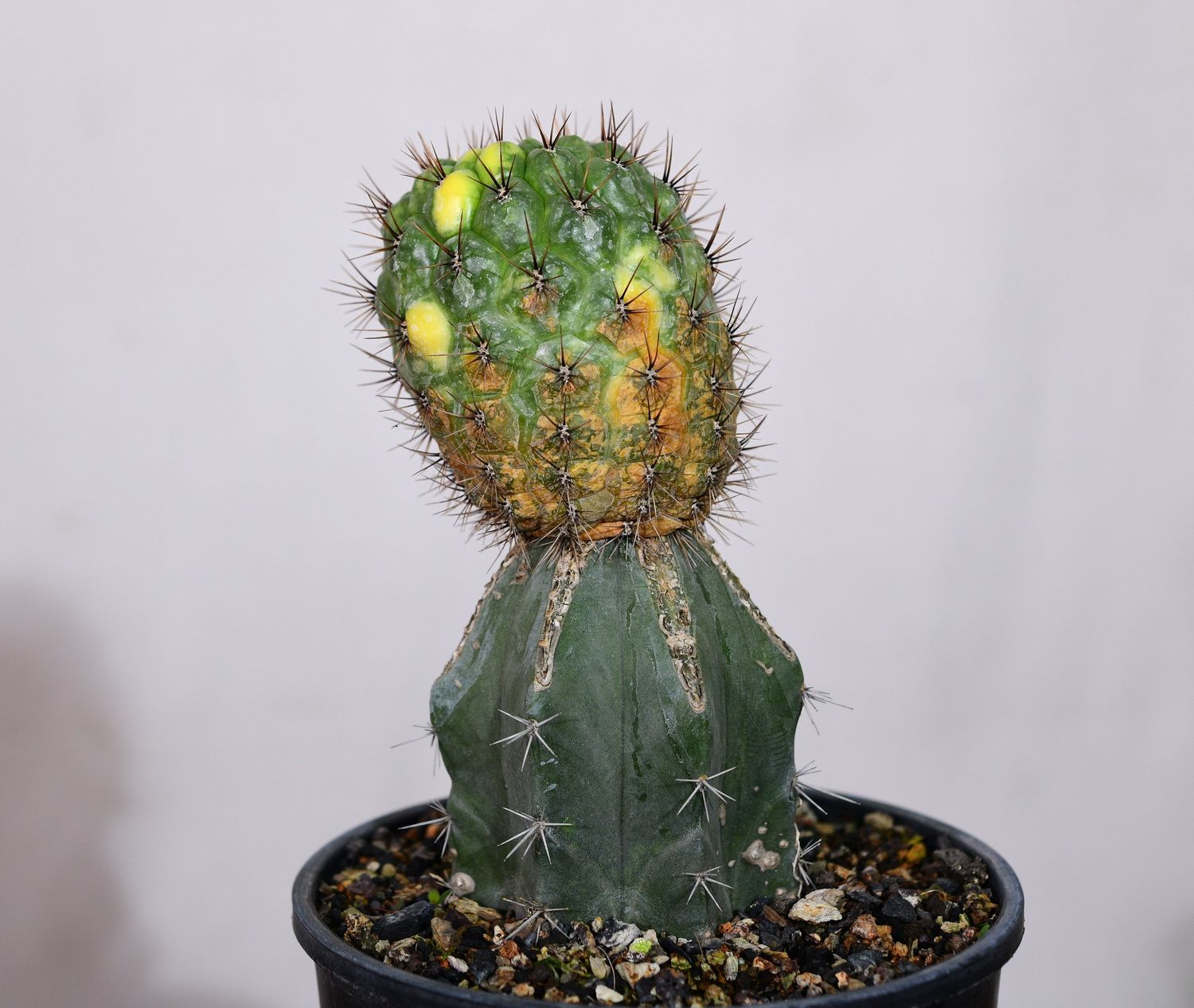
Matucana aurantiaca Variegated
Product Details
Golden Sunburst: Matucana aurantiaca Variegated
An exquisite collector's rarity featuring vibrant chlorophyll-free splashes against a classic Andean silhouette.
- Origin & History of Name: The genus name Matucana is derived from the town of Matucana, Peru, located in the Rimac valley where the first specimens were identified.
The species name aurantiaca comes from the Latin aurantiacus, meaning orange-colored, specifically referencing the brilliant hue of its trumpet-shaped flowers. - Morphology: This specimen exhibits striking variegation, where the epidermis displays a mix of forest green and creamy yellow due to a lack of chlorophyll in certain sectors.
It features low, rounded costae (ribs) divided into distinct tubercles. The plant is moderately spined with curved, brownish-yellow needles emerging from woolly areoles, providing a textured contrast to the smooth, variegated skin. - Habitat & Origin: The base species is a wild cactus native to the high-altitude regions of Cajamarca, Peru.
However, this variegated form is a stable cultivar meticulously selected in nursery settings for its genetic mutation. These plants are ethically propagated via offsets or grafting to ensure environmental sustainability and avoid the depletion of high-altitude wild populations. - Cultivation Profile:
- Substrate: Requires an open, highly mineral-based mix (coarse sand, lava rock, or crushed brick mixed with minimal leaf mold). This is crucial in the Indian subcontinent to ensure rapid drainage during high-humidity periods.
- Light: Thrives in filtered bright light. In the Indian summer, avoid direct noon sun which can easily scorch the delicate variegated (yellow) patches of the epidermis.
- Water/Dormancy: Water sparingly from March to October, allowing the pot to dry fully. During the Indian monsoon, keep the plant in a rain-protected, airy spot. Maintain a dry dormancy in winter to encourage spring flowering.
- Scientific/Historical Anecdote: The genus Matucana was established by Nathaniel Britton and Joseph Rose in 1922.
A unique biological trait of this genus is that many species have evolved zygomorphic (bilaterally symmetrical) flowers rather than the radial symmetry common in most cacti; this adaptation specifically allows for pollination by high-altitude hummingbirds.
New

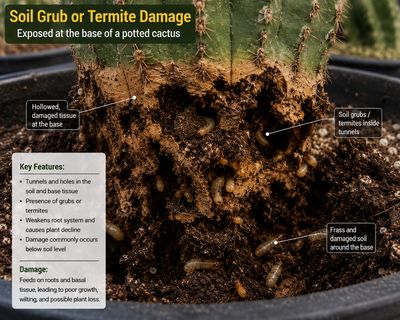
Monsoon Guardian Kit (5 in 1)
Monsoon Guardian Kit (5 in 1)
Complete 5-in-1 biological protection kit for cacti & succulents
SKU MNS024
₹850.00
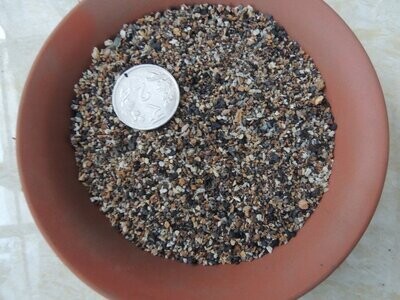
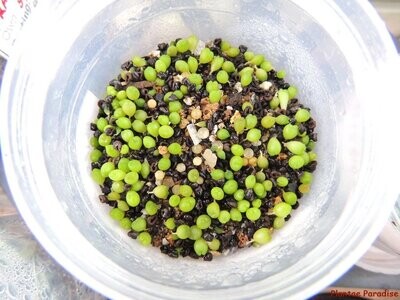
Cactus Seed Planting Mix
Cactus Seed Planting Mix
Sterile, Fine-Grain Media for Cactus & Succulent Seeds
SKU MNS005
₹74.85
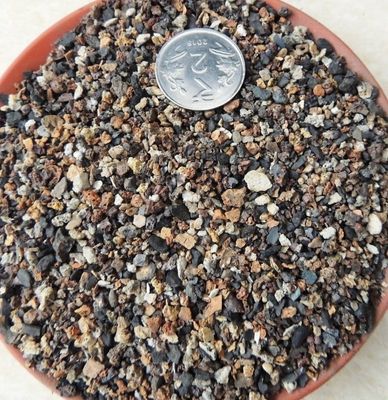

Cactus & Succulent Planting Mix FINE (aka Cactus Soil Mix or Succulent Soil Mix)
Cactus & Succulent Planting Mix FINE (aka Cactus Soil Mix or Succulent Soil Mix)
Fine-Grain Potting Mix for Cactus & Succulent Roots
SKU MNS001
₹39.85
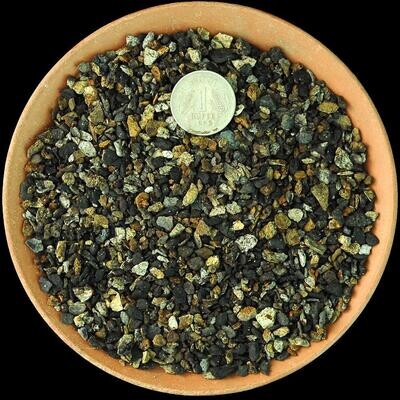
Cactus & Succulent Planting Mix COARSE (aka Cactus Soil Mix or Succulent Soil Mix)
Cactus & Succulent Planting Mix COARSE (aka Cactus Soil Mix or Succulent Soil Mix)
Washed, Free-Draining Mineral Mix for Cactus & Succulents
SKU MNS003
₹44.85