

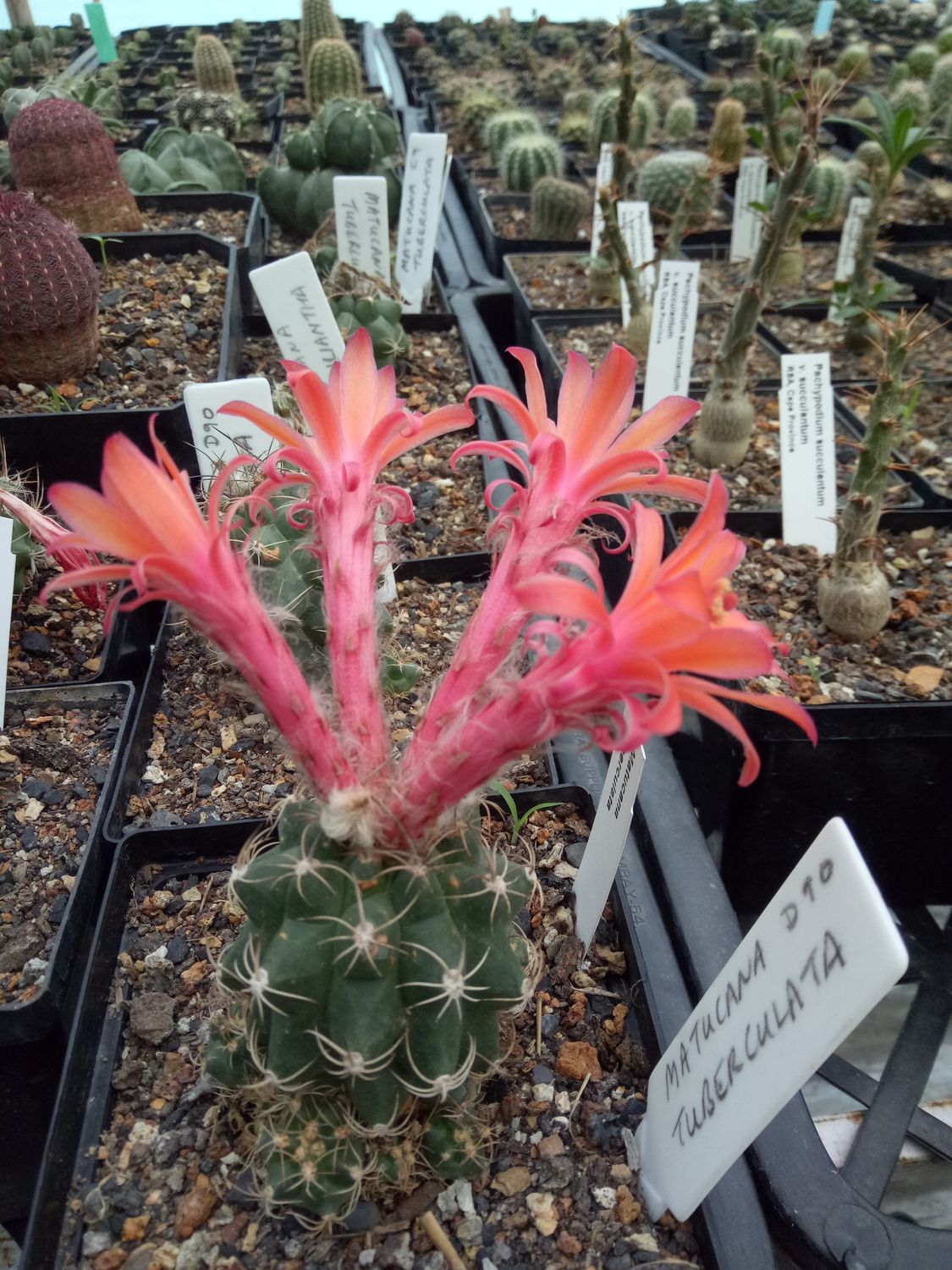
Matucana tuberculata
Product Details
The Andean Jewel: Matucana tuberculata
A geometric masterpiece of the high Andes, this rare miniature cactus is a sought-after prize for the discerning succulent collector.
- Origin & History of Name: The genus Matucana is named after the Peruvian town of Matucana, located near the habitat of the first discovered species.
The specific epithet tuberculata is derived from the Latin tuberculum, meaning "small swelling" or "pimple," referring to the prominent, rounded nodules (tubercles) that define the plant's surface rather than traditional continuous ribs. - Morphology: This species is a globular to short-cylindrical cactus featuring a vibrant green epidermis.
Unlike many cacti with straight vertical ridges, its costae (ribs) are divided into distinct, spiraling tubercles. Each tubercle is topped with an areole that produces straight, needle-like spines. It is prized for its bright orange to scarlet zygomorphic (bilaterally symmetrical) flowers that emerge from the crown. - Habitat & Origin: Matucana tuberculata is a wild species native to the valley of the Marañón River in northern Peru.
It grows on steep, rocky slopes at high elevations. To ensure environmental sustainability, ensure your specimen is nursery-propagated rather than wild-collected, as habitat loss is a significant threat to Andean flora. - Cultivation Profile:
- Substrate: Use a strictly mineral-based mix (70% grit such as coarse sand, perlite, or crushed brick and 30% organic matter). In the humid Indian climate, high porosity is essential to prevent root rot.
- Light: Requires bright, indirect sunlight.
In the Indian subcontinent, protect from the harsh afternoon sun (12:00 PM – 4:00 PM) to avoid scorching the epidermis, but ensure high light levels to maintain a compact shape. - Water/Dormancy: Water deeply only when the medium is completely bone-dry. During the monsoon and winter months, significantly reduce watering as the plant enters a period of semi-dormancy; excess moisture in high humidity is its primary enemy.
- Scientific/Historical Anecdote: The genus Matucana was once folded into the genus Borzicactus, but modern DNA sequencing and the unique structure of its "diurnal" (day-blooming) flowers confirmed its distinct lineage. Interestingly, despite growing in high altitudes where temperatures drop significantly, these plants have adapted to handle intense ultraviolet radiation, which contributes to their dense, protective spine development.


Cactus & Succulent Planting Mix COARSE (aka Cactus Soil Mix or Succulent Soil Mix)
Cactus & Succulent Planting Mix COARSE (aka Cactus Soil Mix or Succulent Soil Mix)
Washed, Free-Draining Mineral Mix for Cactus & Succulents
SKU MNS003
₹44.85

New


Monsoon Guardian Kit (5 in 1)
Monsoon Guardian Kit (5 in 1)
Complete 5-in-1 biological protection kit for cacti & succulents
SKU MNS024
₹850.00