

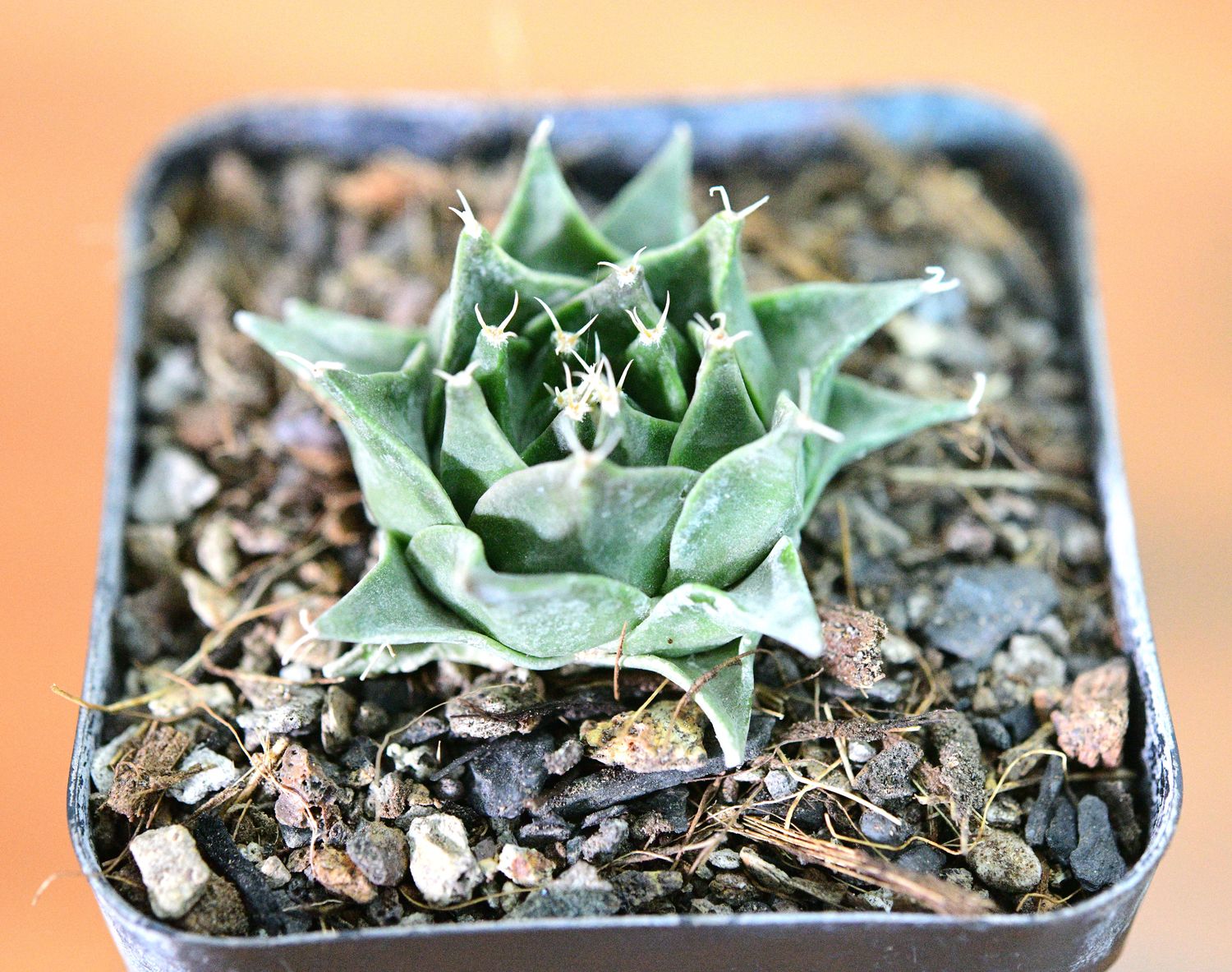
Obergonia denegrii
Product Details
Geometric Rarity: Obregonia denegrii
Regarded as a living fossil, this monotypic cactus mimics the form of an artichoke, making it a pinnacle acquisition for the serious minimalist collector.
- Origin & History of Name: The genus name Obregonia honors Álvaro Obregón, the 39th President of Mexico, while the specific epithet denegrii pays tribute to Ramón P. de Negri, a prominent Mexican politician. Described in 1925 by botanist Alberto Vojtěch Frič, it is a monotypic genus, meaning it contains only this single species, further emphasizing its unique evolutionary lineage.
- Morphology: Obregonia denegrii is characterized by its distinct tubercles, which are triangular, leaf-like protrusions that overlap to form a spiral rosette.
Unlike standard ribbed cacti, it lacks traditional costae. The epidermis is a pale grey-green, and the tips of the tubercles bear small, deciduous spines on the areoles. Its slow-growing, sunken globular form is designed for crypsis, allowing it to blend into rocky limestone environments. - Habitat & Origin: This is a wild species endemic to a very restricted area in the Valley of Jaumave, Tamaulipas, Mexico.
It is currently listed as Vulnerable on the IUCN Red List due to habitat loss and illegal over-collection. Commercial specimens must be exclusively nursery-grown from seed to ensure the sustainability of wild populations and compliance with CITES regulations. - Cultivation Profile:
- Substrate: Requires a strictly mineral-based, alkaline mix. Use a base of limestone grit, coarse sand, and clay, with less than 10% organic matter to prevent taproot rot.
- Light: Thrives in bright, filtered light. In the Indian subcontinent, avoid direct mid-day sun, which can scorch the epidermis; a 50% shade net is ideal for maintaining the characteristic grey-green hue.
- Water/Dormancy: Extremely drought-tolerant. Provide deep watering only when the substrate is completely bone-dry during the summer. In the Indian winter, the plant enters total dormancy; suspend watering entirely to prevent fungal pathogens in the thick taproot.
- Scientific/Historical Anecdote: Obregonia denegrii is often cited as an evolutionary "link" between primitive leafy cacti and the more highly derived ribbed species. Local indigenous populations historically recognized it for its medicinal properties, and it contains trace amounts of alkaloids similar to those found in the Lophophora (Peyote) genus, though in significantly lower concentrations.

Cactus & Succulent Planting Mix COARSE (aka Cactus Soil Mix or Succulent Soil Mix)
Cactus & Succulent Planting Mix COARSE (aka Cactus Soil Mix or Succulent Soil Mix)
Washed, Free-Draining Mineral Mix for Cactus & Succulents
SKU MNS003
₹44.85

New

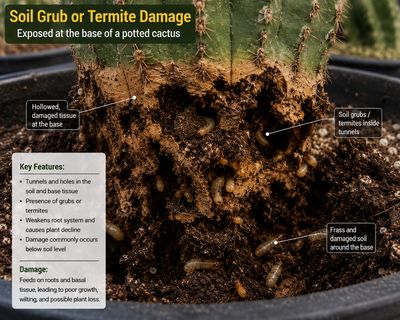
Monsoon Guardian Kit (5 in 1)
Monsoon Guardian Kit (5 in 1)
Complete 5-in-1 biological protection kit for cacti & succulents
SKU MNS024
₹850.00


Cactus Seed Planting Mix
Cactus Seed Planting Mix
Sterile, Fine-Grain Media for Cactus & Succulent Seeds
SKU MNS005
₹74.85