

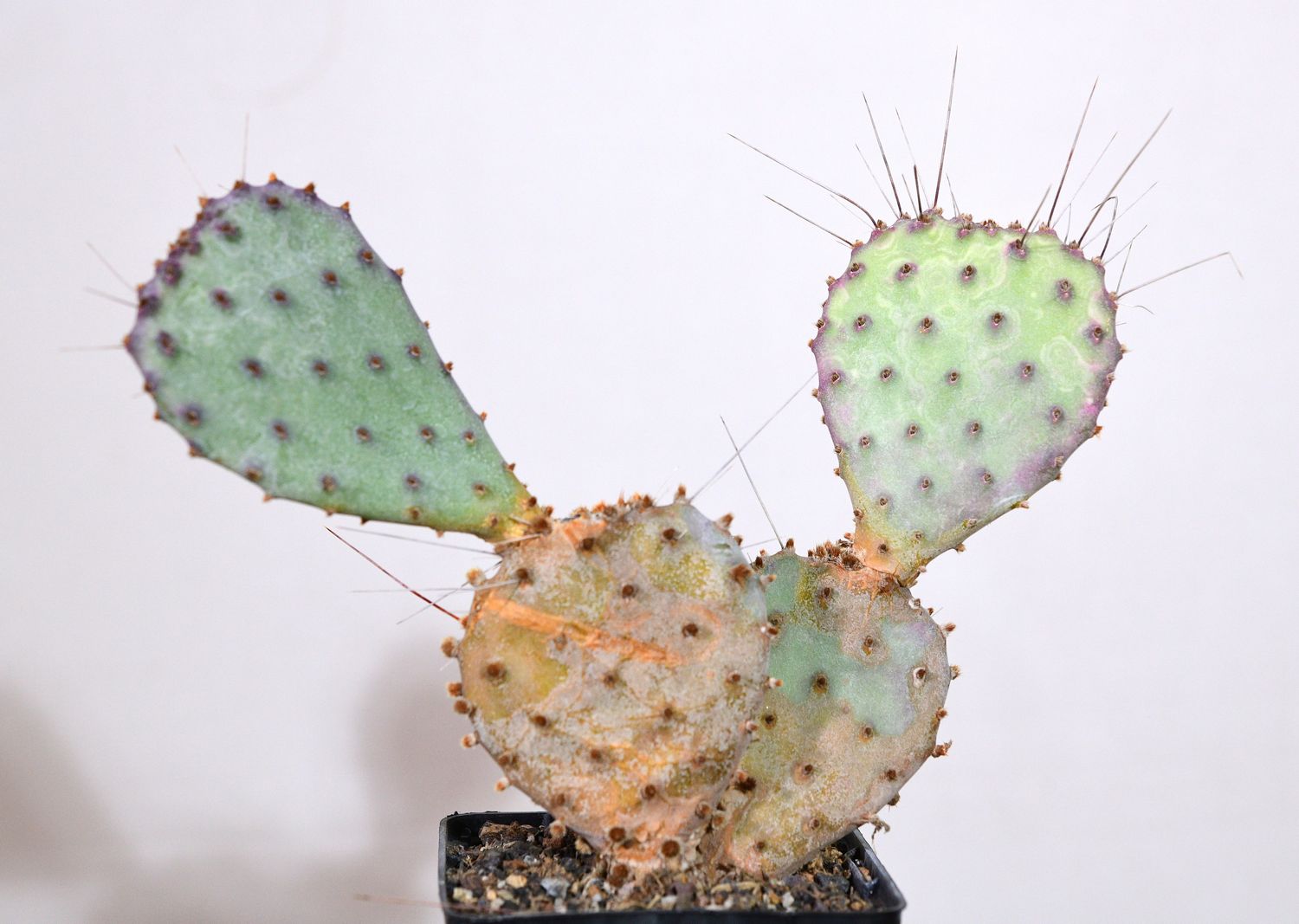
Opuntia basilaris 'Baby Rita' (Prickly Pear)
Product Details
Desert Jewel: Opuntia basilaris 'Baby Rita'
A vibrant, compact rarity prized for its year-round purple hues and brilliant carmine blooms.
- Origin & History of Name: The genus name Opuntia refers to the ancient Greek city of Opus, where succulent plants were said to grow. The specific epithet basilaris translates to "at the base," referring to the way the pads grow from a central point.
The cultivar name 'Baby Rita' was selected to distinguish this dwarf variety from the larger 'Santa Rita' prickly pear, emphasizing its petite, garden-friendly scale. - Morphology: This cultivar is a "spineless" cactus, though it possesses tiny, barbed bristles called glochids on its epidermis. It is visually striking due to its flat, fleshy cladodes (pads) that transition from blue-grey to deep violet-purple when stressed by cold or sun. In spring, it produces large, sessile flowers with a high density of petals in a deep magenta-pink.
- Habitat & Origin: Opuntia basilaris is a wild species native to the Mojave and Sonoran Deserts of the Southwestern United States.
However, 'Baby Rita' is a specific cultivar selected for its dwarf stature and enhanced purple pigmentation. This plant is a sustainable choice for xeriscaping, as it requires minimal resources once established. - Cultivation Profile:
- Substrate: Use a strictly mineral-based mix (60% coarse sand, pumice, or gravel and 40% organic matter). Avoid standard garden soil which retains too much humidity in the Indian monsoon.
- Light: Requires Full Sun. In India, ensure it receives at least 6–8 hours of direct sunlight to maintain its deep purple coloration; otherwise, it may revert to green.
- Water/Dormancy: Water deeply but infrequently. During the monsoon and winter, withhold water almost entirely. The pads may wrinkle or "shrivel" slightly during dormancy; this is a natural survival mechanism and not a sign of distress.
- Scientific/Historical Anecdote: The parent species, Opuntia basilaris, was first described by George Engelmann and John Bigelow in 1856.
Unlike many cacti that use spines for shade, this species relies on its high concentration of betalain pigments (the same compounds found in beets) to protect its tissues from intense UV radiation, which creates its iconic purple glow.
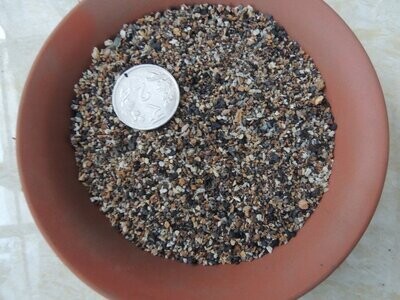
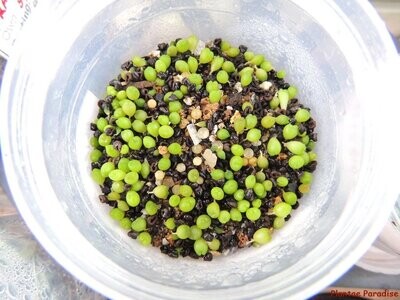
Cactus Seed Planting Mix
Cactus Seed Planting Mix
Sterile, Fine-Grain Media for Cactus & Succulent Seeds
SKU MNS005
₹74.85


New
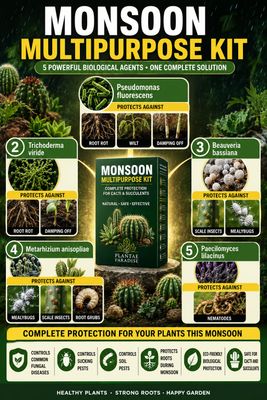
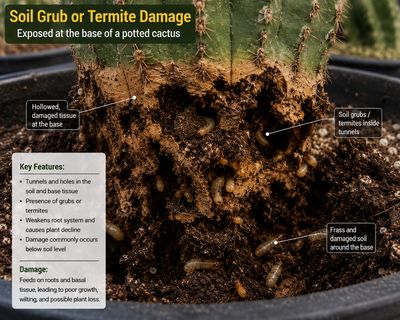
Monsoon Guardian Kit (5 in 1)
Monsoon Guardian Kit (5 in 1)
Complete 5-in-1 biological protection kit for cacti & succulents
SKU MNS024
₹850.00