Opuntia microdasys Crest
Prepare to be utterly mesmerized by a living sculpture unlike any other! The Opuntia microdasys Crest, often known as the "Crested Bunny Ear Cactus," is a horticultural marvel, transforming the beloved "bunny ear" form into a breathtaking, undulating fan of vibrant green. This fascinating succulent is a testament to nature's capacity for surprise, offering an architectural wonder that will captivate all who behold its unique, brain-like convolutions and fuzzy charm.
1. Origin of Name
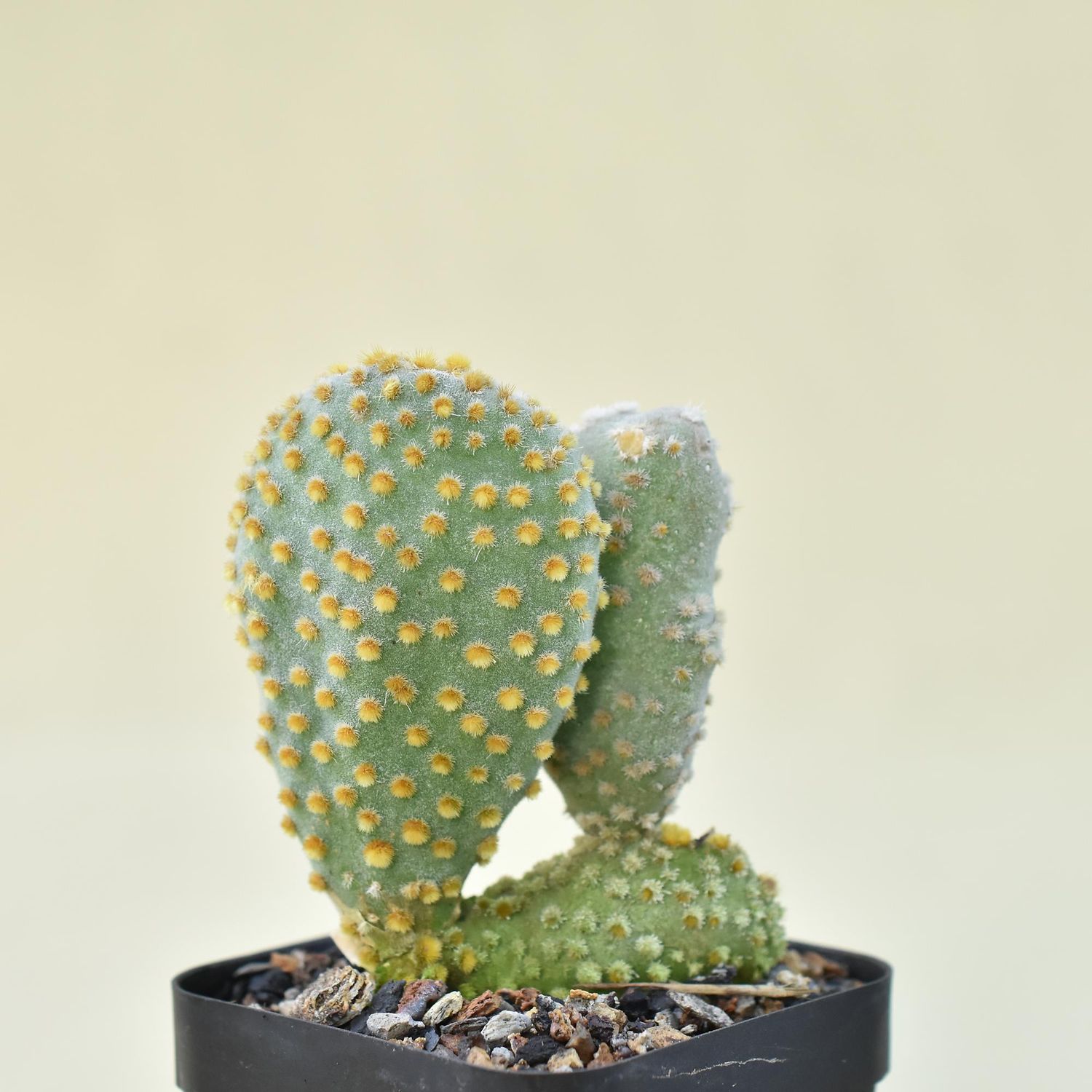
The genus name, Opuntia, has a history believed to trace back to "Opus," an ancient Greek city where a spiny plant, possibly a type of fig, was said to grow. Carl Linnaeus later adopted this name for the group of cacti characterized by their flattened, paddle-like stem segments. The specific epithet, microdasys, is derived from Greek: "mikros" meaning "small," and "dasys" meaning "hairy" or "dense." This aptly describes the plant's most notable defensive feature – the numerous, tiny, yet dense clusters of bristle-like hairs called glochids, which cover its pads like polka dots. The term "Crest" (or "Cristata" in botanical Latin) refers to a fascinating and highly prized genetic mutation known as fasciation. This phenomenon causes the plant's apical meristem (the growing tip) to broaden and flatten, resulting in an abnormal, fan-like, wavy, or convoluted growth pattern instead of the typical rounded or cylindrical stem. It's a horticultural term denoting a highly ornamental, mutated form of the species.
2. Origin of Plant
The parent species, Opuntia microdasys, is native to the arid and semi-arid regions of Central and Northern Mexico, particularly found in states like Coahuila and Zacatecas. It thrives in desert scrub, rocky hillsides, and open plains, adapted to intense sunlight and dry conditions. However, the crested form of Opuntia microdasys is a spontaneous genetic mutation that can occur in the wild, but is predominantly found and propagated in cultivation. It is not a separate species with its own geographic origin, but rather a unique growth habit arising from the species. These fascinating crested forms are then typically perpetuated through vegetative propagation (cuttings) to maintain their distinct shape.
3. Description
The Opuntia microdasys Crest is a truly unique and sculptural cactus, distinct from its typical "bunny ear" counterpart. Instead of forming individual oval pads, its stem segments broaden and flatten into a complex, undulating, fan-like or brain-like structure, creating a continuous, convoluted ridge of growth. The resulting form is highly individualistic for each plant, ranging from broad, wavy fans to intricate, brain-like masses. The color of the crested pads is typically a bright, vibrant green, which can develop attractive reddish, purplish, or bronze hues along the crest edges when exposed to strong sunlight or environmental stress. While lacking large spines, the plant is adorned with numerous areoles, each bearing clusters of tiny, barbed, yellowish-brown to reddish-brown glochids. These delicate-looking bristles are highly irritating if touched, giving the plant its distinctive "fuzzy" appearance without the danger of large thorns. Over time, a well-grown specimen can form a substantial, highly intricate mound, reaching 30-60 cm (1-2 feet) or more in width and height. Flowering is less common in crested forms but, when it occurs, small, yellow flowers may emerge from the crest.
4. Conservation Status
The parent species, Opuntia microdasys, is widespread and common throughout its native Mexican range and is not currently considered threatened or endangered by major conservation organizations. As the 'Crest' form is a horticultural mutant, it does not possess a separate conservation status in the wild. All 'Crest' plants in cultivation are propagated from existing stock. By cultivating and appreciating such unique forms, plant enthusiasts indirectly contribute to conservation by reducing any potential demand for wild-collected specimens of the species, thus protecting natural populations and their habitats.
5. Care
Caring for the Opuntia microdasys Crest is similar to its standard form, requiring attention to typical cactus needs but with extra caution due to its glochids.
- Watering: Allow the soil to dry out completely between waterings. Water thoroughly during the growing season (spring and summer), but significantly reduce frequency in autumn and keep almost entirely dry during winter dormancy. Overwatering is the most common cause of rot.
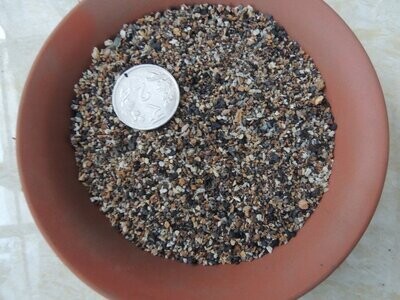
- Soil: Requires an exceptionally well-draining cactus and succulent mix. A blend high in inorganic materials such as pumice, perlite, and coarse sand (70-80% inorganic) is crucial to ensure rapid drainage.
- Light: Provide full sun to bright indirect light. It thrives in several hours of direct sunlight daily, which promotes compact growth and vibrant coloration. In extremely hot climates, some afternoon shade can prevent scorching.
- Temperature: Prefers warm temperatures during its active growth. It is not frost-tolerant and must be protected from temperatures below 0°C (32°F), ideally kept above 5°C (41°F).
- Tips: Handle with extreme care! The glochids are easily dislodged and can be very irritating to the skin and eyes. Always use gloves or tongs. Good air circulation is beneficial. Fertilize sparingly with a low-nitrogen cactus fertilizer during the active growing season. Its unique shape makes it an excellent choice for a specimen pot.
6. Engaging Anecdote
The phenomenon of fasciation, which gives the Opuntia microdasys Crest its mesmerizing form, is one of nature's most intriguing "mistakes." It's a bizarre genetic mutation where a single growing point elongates and flattens, sometimes creating a ribbon-like or even brain-like appearance. For centuries, gardeners and botanists have been fascinated by these "crested" plants, as they defy the typical symmetry and predictable growth patterns of their species. While some theorize that environmental factors like frost, insect damage, or hormonal imbalances might trigger fasciation, its exact causes remain somewhat mysterious. This unpredictable deviation from the norm makes each crested plant utterly unique – no two are ever exactly alike. Owning an Opuntia microdasys Crest is like holding a botanical paradox: a natural anomaly celebrated for its artistic irregularity. It serves as a captivating reminder that even in the most well-understood species, nature can still surprise us with stunning, one-of-a-kind masterpieces, turning a genetic "glitch" into an object of profound beauty and horticultural desire.