

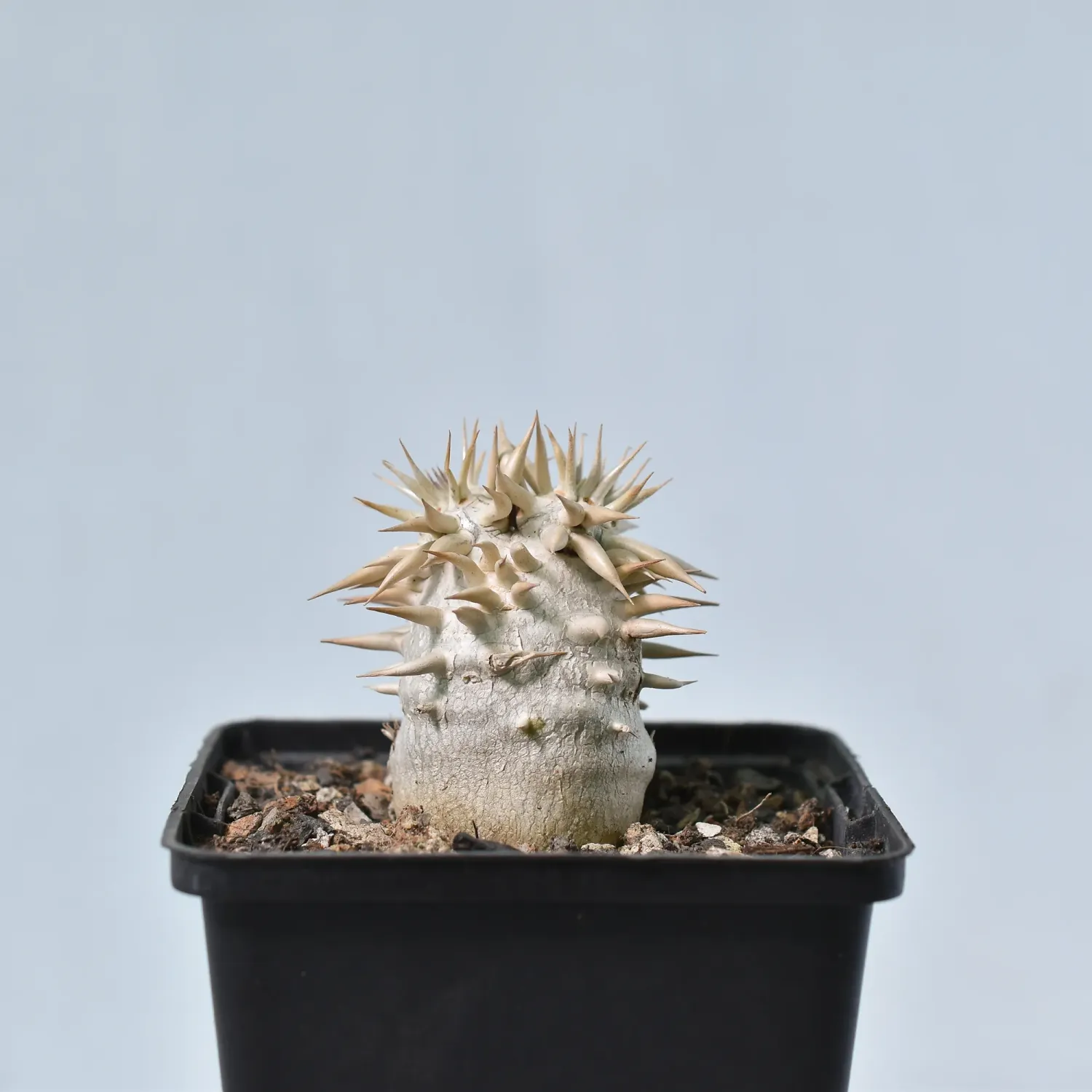
Pachypodium enigmaticum
Product Details
The Golden Enigma: Pachypodium enigmaticum
A centerpiece for the serious collector, this rare Madagascan succulent defies expectations with its brilliant blooms and sculptural form.
- Origin & History of Name: The name is derived from the Greek pachys (thick) and podion (foot), referring to the swollen base.
The specific epithet enigmaticum was chosen by botanists Pavelka, Prokeš, and Richter in 2004. It reflects the "enigmatic" nature of the species, which was long confused with Pachypodium baronii until its distinct yellow flowers and unique seed morphology confirmed it as a separate species. - Morphology: This species is a pachycaul succulent, characterized by a globose or bottle-shaped caudex (swollen stem) that serves as water storage.
Its epidermis is silver-grey and armed with paired spines. Unlike its red-flowering relatives, it produces vibrant yellow, salverform flowers. The foliage consists of glossy green, lanceolate leaves that emerge from the apex of the stem during the growing season. - Habitat & Origin: This is a wild species endemic to the Sofia region in northern Madagascar. It grows in narrow ecological niches on sun-exposed gneiss rock faces. Our specimens are nursery-grown from cultivated seeds to ensure the protection of wild populations and adhere to CITES sustainability standards.
- Cultivation Profile:
- Substrate: A strictly mineral-based mix is essential for the Indian climate. Use a blend of 70% inorganic material (pumice, perlite, or crushed brick) and 30% organic matter (well-aged compost or coco-peat) to prevent root rot during monsoons.
- Light: Requires full, direct sunlight (6+ hours).
In extreme heat zones like Rajasthan or Central India, provide 50% shade cloth during peak afternoon hours in May and June to avoid epidermal scorching. - Water/Dormancy: Water deeply when the caudex feels slightly soft during the summer. In the Indian winter (November–February), the plant enters dormancy and drops its leaves; water must be withheld almost entirely during this period to simulate its natural dry season.
- Scientific/Historical Anecdote: For decades, Pachypodium enigmaticum was a "ghost" in botanical circles. While locals knew of its existence, it remained officially undescribed because it occupied a morphological middle ground between other species. Its formal recognition in 2004 settled a long-standing debate among taxonomists who couldn't agree if it was a hybrid or a true species; DNA sequencing eventually proved its unique evolutionary lineage.