

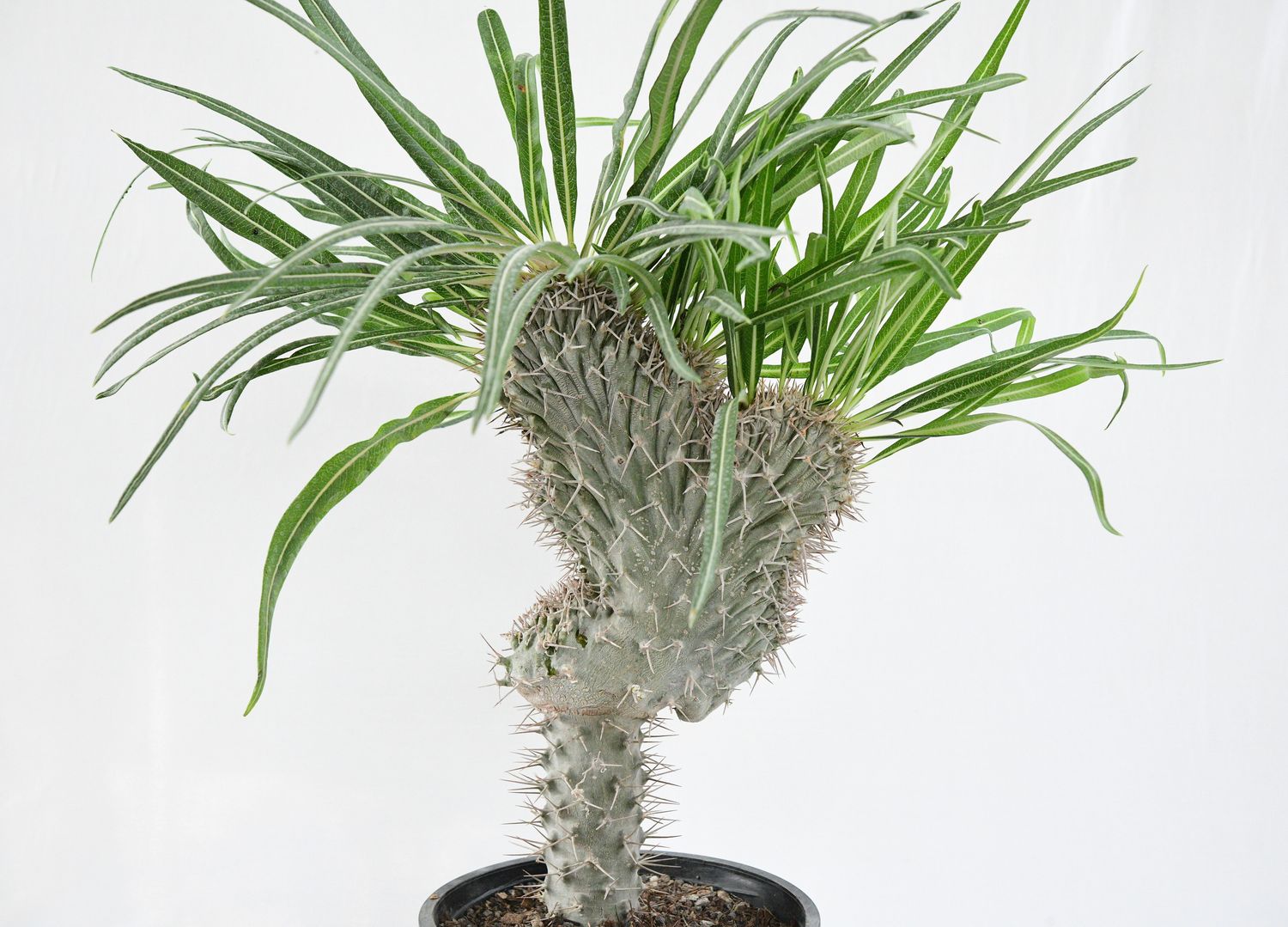
Pachypodium geayii crest
Product Details
Silver Sentinel: Pachypodium geayii crest
A rare, architectural masterpiece featuring a shimmering metallic epidermis and extraordinary crested growth.
- Origin & History of Name: The genus name Pachypodium is derived from the Greek pachys (thick) and podion (foot), referencing the swollen caudex.
The species name geayii honors Martin François Geay, a French botanist and collector who discovered the plant in Madagascar around the turn of the 20th century. The term "crest" refers to the fasciation mutation, where the growing point elongates into a fan-like ridge rather than a circular tip. - Morphology: This specimen exhibits "cristate" growth, where the apical meristem produces a winding, brain-like fold instead of a vertical trunk. Its epidermis is covered in fine, silver-grey pubescence that reflects intense sunlight. It features needle-like spines emerging from distinct areoles along the ridge, and while the standard form has long linear leaves, the crested form produces condensed, crowded foliage along the undulating "crest."
- Habitat & Origin: The base species is a wild succulent tree endemic to the arid, southwestern regions of Madagascar.
This specific crested form is a rare horticultural cultivar propagated via grafting or specialized cuttings. To ensure sustainability, these plants are nursery-grown rather than poached from their sensitive island habitat. - Cultivation Profile:
- Substrate: A strictly mineral-based mix is essential. Use a blend of 70% grit (pumice, perlite, or crushed brick) and 30% organic matter to suit Indian humidity levels.
- Light: Requires full, direct sun. In Indian summers, ensure high ventilation if kept under glass to prevent scorching the crested ridge.
- Water/Dormancy: Water deeply during the hot growing season once the substrate is bone-dry. During the winter dormancy (especially in North India), withhold water entirely to prevent "caudex rot," as the plant may shed its leaves.
- Scientific/Historical Anecdote: Despite its appearance, Pachypodium geayii is more closely related to the common Oleander and Frangipani than to true cacti. It produces a thick, caustic latex sap—a common trait in the Apocynaceae family—which serves as a highly evolved chemical defense mechanism against herbivores in the dry Malagasy bush.


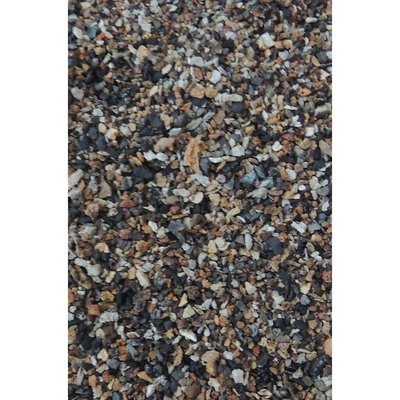
Cactus & Succulent Planting Mix FINE (aka Cactus Soil Mix or Succulent Soil Mix)
Cactus & Succulent Planting Mix FINE (aka Cactus Soil Mix or Succulent Soil Mix)
Fine-Grain Potting Mix for Cactus & Succulent Roots
SKU MNS001
₹39.85
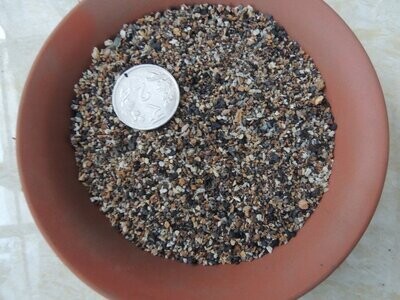
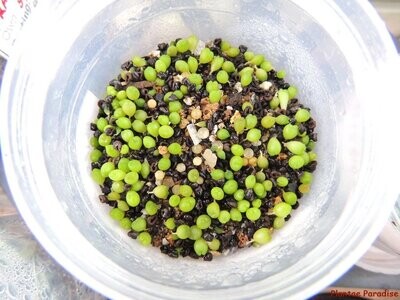
Cactus Seed Planting Mix
Cactus Seed Planting Mix
Sterile, Fine-Grain Media for Cactus & Succulent Seeds
SKU MNS005
₹74.85
