

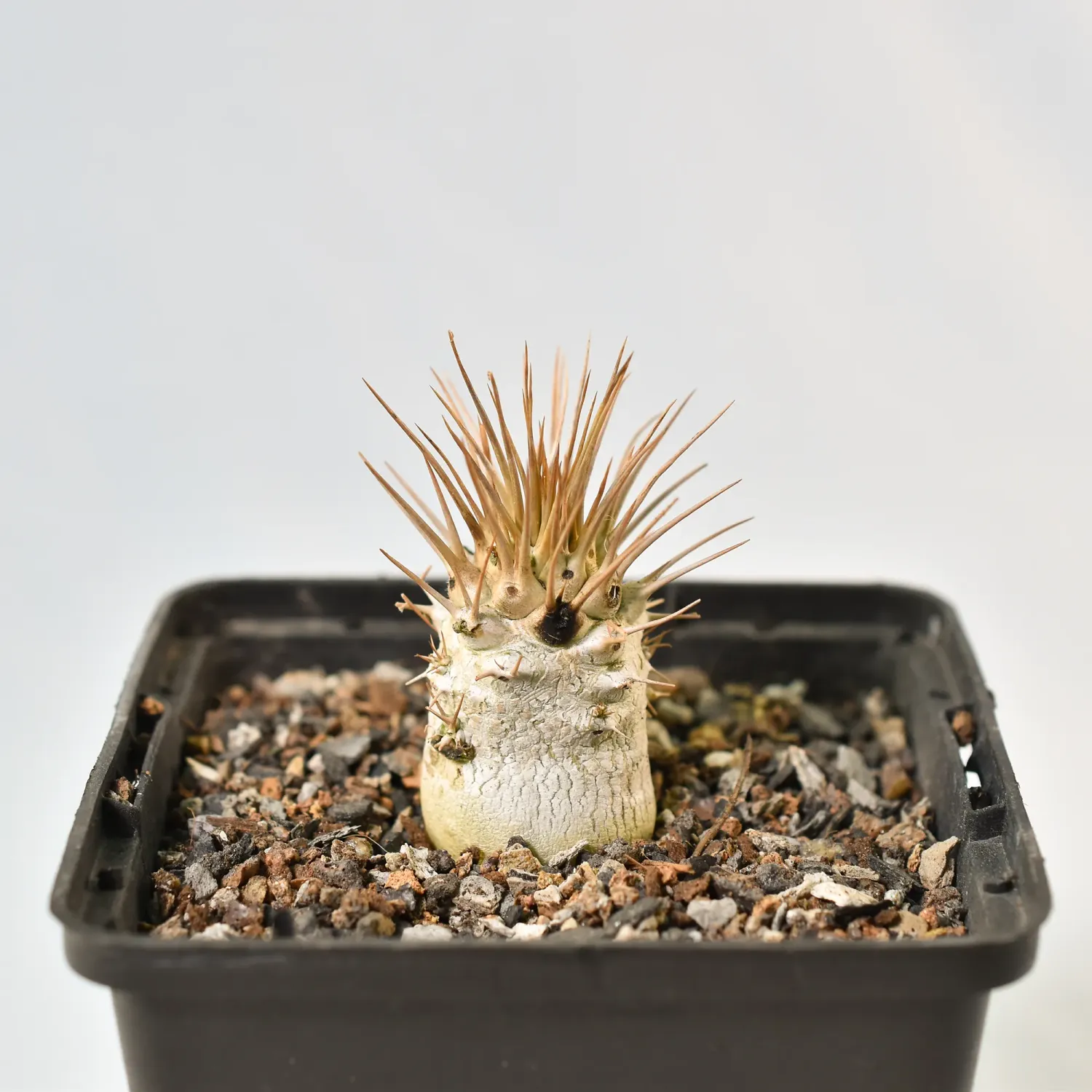
Pachypodium namaquanum
Product Details
The Half-Human Wonder: Pachypodium namaquanum
A prehistoric silhouette for the elite collector, this slow-growing succulent is among the most coveted architectural marvels of the xeric world.
- Origin & History of Name: The genus name Pachypodium derives from the Greek pachys (thick) and podion (foot), referring to the swollen base.
The species name namaquanum honors Namaqualand, the arid region straddling South Africa and Namibia. It is famously known as the "Halfmens" (Afrikaans for "semi-human") due to a Nama legend suggesting the plants are ancestral spirits frozen in a northward-gazing pose. - Morphology: This pachycaul succulent features a thick, unbranched caudex covered in a dense epidermis of protective spines. The apex is crowned with a rosette of undulated, velvety green leaves.
Its most striking characteristic is its phototropism, where the growing tip curves permanently toward the north to maximize winter sun exposure. - Habitat & Origin: This is a wild species native to the Orange River valley in the Northern Cape and Namibia.
It grows in extremely rocky, arid desert environments. Our specimens are exclusively nursery-grown from seed to ensure the sustainability of wild populations and compliance with CITES conservation protocols. - Cultivation Profile:
- Substrate: Use a strictly mineral-based mix (70% grit/pumice, 30% coarse sand) to prevent root rot. Avoid standard potting soil.
- Light: Requires full, direct sun. In the Indian subcontinent, ensure it receives the brightest possible location, though young plants may need slight shading during the peak of May/June heat.
- Water/Dormancy: This is a winter-grower.
Water sparingly from October to March. In India, it must be kept bone-dry during the monsoon (July–September) to mimic its natural dormant period; high humidity without ventilation is its primary risk.
- Scientific/Historical Anecdote: The "Halfmens" was first documented for Western science by the British lieutenant and explorer William Paterson in 1779. It is one of the slowest-growing plants in the trade, often adding only 0.5 to 1.5 centimeters of height per year, meaning a one-meter specimen may be over a century old.